Introduction
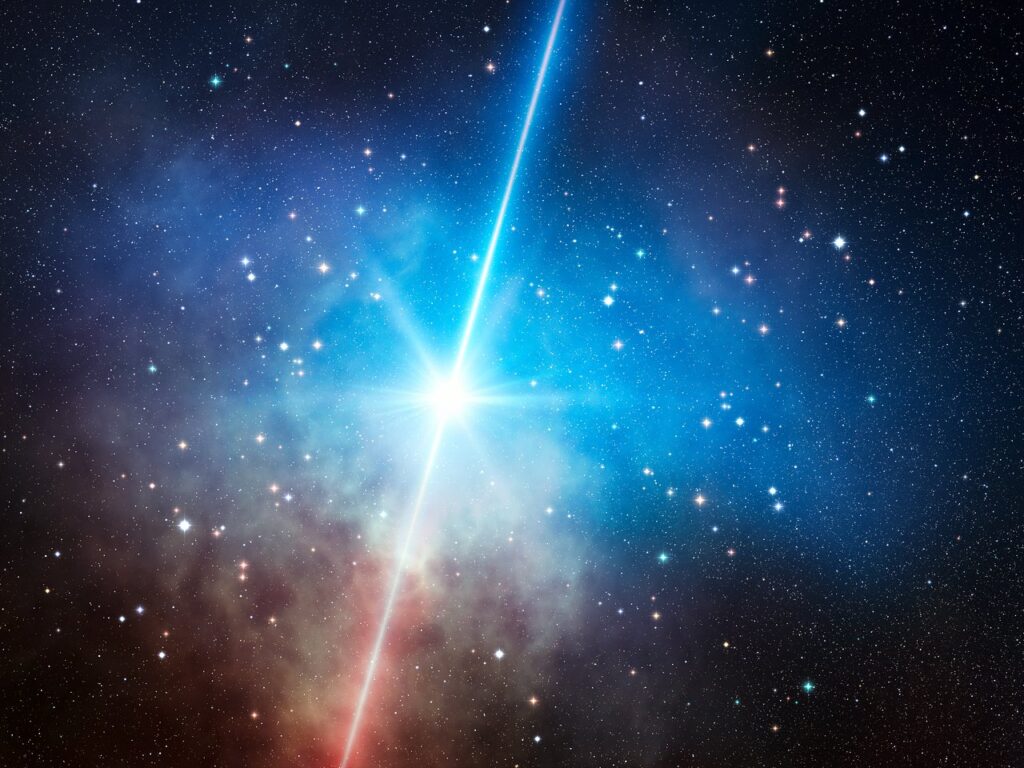
People love explosions. Whether it be releasing fireworks in the sky or watching action movies packed with bomb blasts, there is something about ignitions of mass destruction that fascinate and captivate the human mind. People might enjoy standing at dramatic firework shows or staring intently as huge detonations fill up our screens. Even just reading brief descriptions of a Gamma Ray Blast, the universe’s brightest explosions, inspires feelings of awe and astonishment like no other.
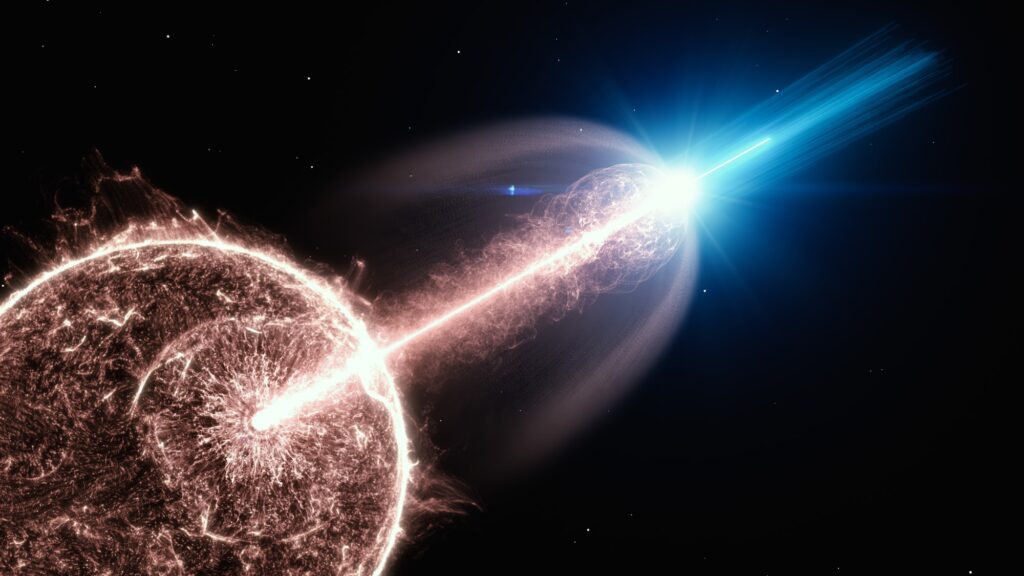
A visual representation created by an artist showcasing a relativistic jet filled with extremely energetic gamma-ray photons erupting from a dying star. (Image source: DESY, Science Communication Lab)
In the great expanse of the cosmos, where giant stars burn and die, where celestial occurrences routinely push the boundaries of our understanding, few events match the sheer intensity and enigmatic mystique of gamma-ray bursts (GRBs). They are often referred to as “The most powerful explosions in the universe,” a titanic title that suitably indicates their immense severity, as these gargantuan bursts of energy outshine entire galaxies with their tremendous luminosity.
Envision yourself witnessing such a marvel from close quarters, ignoring the fact that you would be fried within seconds. For a few moments, it would appear as if everything around and beyond you had been consumed wholly by a blazing eruption of light, unleashing such swathes of energy that it can momentarily surpass the rest of the universe in gamma-ray emissions. Just trying to fathom such an experience would leave you baffled. Otherworldly incidents like these remind us time and time again that not even human imagination is sufficient to understand the scale at which the universe operates.
How It Works
As the name suggests, GRBs are outward expulsions of gamma rays, the most energetic form of light. The time period for which they illuminate vast stretches of space varies extensively; hence, they are normally categorized into two types: short-duration blasts and long-duration blasts. The former may typically last for two seconds, while the latter can persist onwards for several minutes.
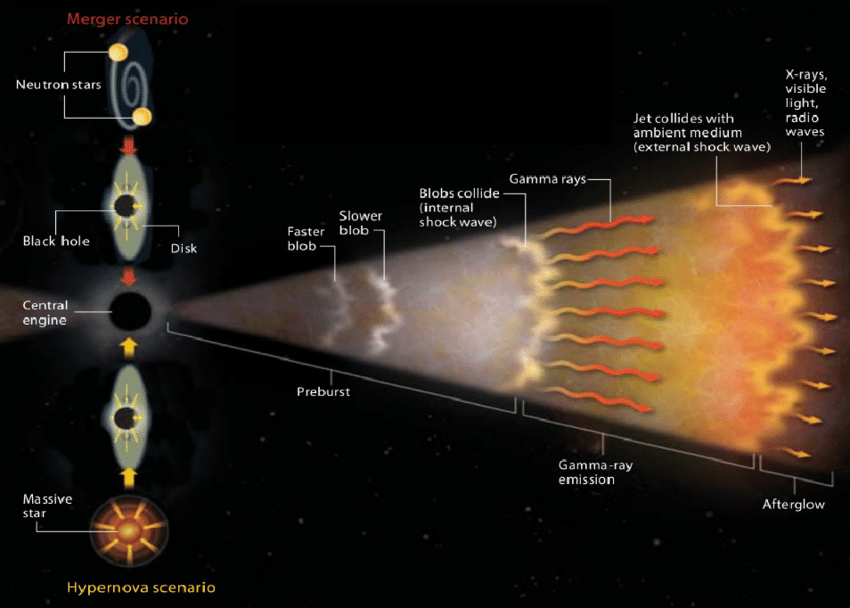
The origins of these astral spectacles are steeped deep in extraordinary stellar phenomena, concerning the life cycles and inner workings of celestial bodies. Long-duration blasts are believed by many astrophysicists to be the result of the collapse of colossal stars, causing the formation of black holes and neutron stars, while short-duration blasts are theorized to be a consequence of neutron star-black hole collisions and neutron star mergers.
A visual representation created by an artist showcasing a relativistic jet filled with extremely energetic gamma-ray photons erupting from a dying star. (Image source: DESY, Science Communication Lab)
However, these bursts are not just visually striking; they also have broad implications and far-reaching ramifications. Due to the utterly enormous amount of X-rays, visible light, and gamma rays they discharge, GRBs are considered extremely dangerous if they make contact with a planet. Their high-energy radiation emissions can completely strip away and demolish a planet’s atmosphere, sterilizing it entirely.
Even Earth’s atmosphere, which provides protection against this kind of radiation, is at serious risk if it finds itself in the direct path of a GRB. While the amount of damage caused would depend on the proximity of the burst to Earth, one that is beamed precisely at our home planet would significantly ruin or destroy portions of the atmosphere, especially the ozone layer. The burst would also be a massive source of photons that would induce chemical reactions giving rise to photochemical smog, further diminishing our protective shield from harmful cosmic rays.
This is all separate from the lethal volumes of radiation that would eradicate most species on the surface of the globe, resulting in mass extinction. It's not all doom and gloom, though; the statistical probability of a GRB ever eviscerating Earth through a straight impact is pretty low, as the blue marble exists in a region of the Milky Way where supermassive stars are a rare sight, and binary compact object systems are not nearby. Hence, even if a GRB were to occur in our galaxy, the chances of it being aimed our way are slim.
Largest explosions: Depiction of the scenario involving internal and external shocks in gamma-ray bursts. (Image courtesy of NASA)
Despite the catastrophic devastation they can cause, gamma-ray bursts also act as cosmic probes that help us venture farther into the universe. They can be detected across unimaginably large distances, providing a unique opportunity for physicists to study the history of the cosmos through their path of travel. Additionally, since gamma rays are extremely energetic and travel at the speed of light (as all electromagnetic waves do), they reach us virtually unaltered and unimpaired, conveying essential information surrounding the far-flung sections of space.
Recent research has hinted at their presence, with X-ray activity in some dwarf galaxies suggesting the existence of black holes with masses ranging from 36,000 to 316,000 times that of our sun. These findings have provided a glimpse into the previously uncharted territory of intermediate black holes, shedding light on their potential role in the cosmic tapestry. As we continue to explore and unravel the secrets of our universe, these black holes serve as captivating puzzles, challenging our understanding of the cosmos and fueling the human spirit of curiosity.
They serve as major distance markers, as by studying and examining their redshift (the shift in the wavelength of light due to the expansion of the universe), scientists can ascertain the gap between their host galaxies and our own. Furthermore, since long-duration GRBs are a product of the life cycles of big stars, and since these types of stars are relatively short-lived when viewed through an overarching cosmic lens, long-duration bursts offer valuable insights into the circumstances and conditions of the early universe, where large stars were more commonplace.
Conclusion
Researchers everywhere are utilizing cutting-edge observatories and telescopes to gather data on these violent explosions. Fundamentally, while the concept and overwhelming power of GRBs may incite dread, wonder, and fear, they are also a pivotal tool for uncovering more data about the universe that aids us in comprehending it better. The true nature of gamma-ray bursts continues to be a subject of extensive scientific inquiry, emerging as a field of research full of mystery and intrigue.
As our knowledge of these remarkable events continues to flourish, so too does our appreciation for the intricate and mind-boggling beauty of the wider universe. Human efforts to understand magnificent phenomena such as GRBs corroborate the notion that, in the face of the unknown and mystifying, our thirst for knowledge is boundless, and the cosmos is an infinite wellspring of wonder, discovery, and enlightenment. To summarize this thought in a simple phrase, we can quote an expression from the first man on the moon.
"Mystery creates wonder, and wonder is the basis of man's desire to understand." -Neil Armstrong