Introduction
Imagine, if you will, a portal through spacetime: a passage that connects distant corners of the cosmos, bending the very fabric of reality itself. Think, for an instance, of a tunnel that begins at a singular point, wherever in the great vacuum of space, and ends in a different location, or a different time, or maybe even both—a tunnel that may cover the distance of a billion light-years, or a few meters, leading to divergent timelines or different universes altogether. Sounds like something out of the fertile mind of an aspiring science fiction writer, doesn't it? It may even seem completely mind-bending, something that, if proven in some form, would greatly alter the very trajectory of human thought. Not only when it comes to space travel and the like but also what we think we know about the cosmos already. Well, the portals described above are already an intriguing part of theoretical physics, and they are known as Wormholes. Although they are just proposed concepts currently (Scientists are not even sure if they exist or how to make them), research is ever ongoing, and discovery may not be impossibly far.
Wormholes, bridging cosmic chasms, have not only captivated human imagination for decades but have also offered a tantalizing glimpse into the universe's deepest mysteries. These hypothetical entities have provided us a glimpse into the realm of science fiction turning into a scientific possibility. In this article, we will delve into the marvelous world of wormholes from their theoretical frameworks to their potential implications.
An Insight
The concept of wormholes was introduced in the realm of general relativity. This groundbreaking theory of gravitation, put forth by Albert Einstein in the 20th century, describes the force of gravity as the curvature of spacetime due to massive objects. Basically, a massive object like a planet or a star causes the fabric of spacetime to bend, due to which the objects start to move in their vicinity. It proposed a possibility of 'shortcuts,' essentially creating a bridge between two distant points across spacetime. In the mid-1930s, Nathan Rosen and Einstein introduced the concept of tunnel-like structures, which were later known as Einstein-Rosen bridges. These structures were seen as a mathematical curiosity at that time, but they laid the foundation for further exploration.
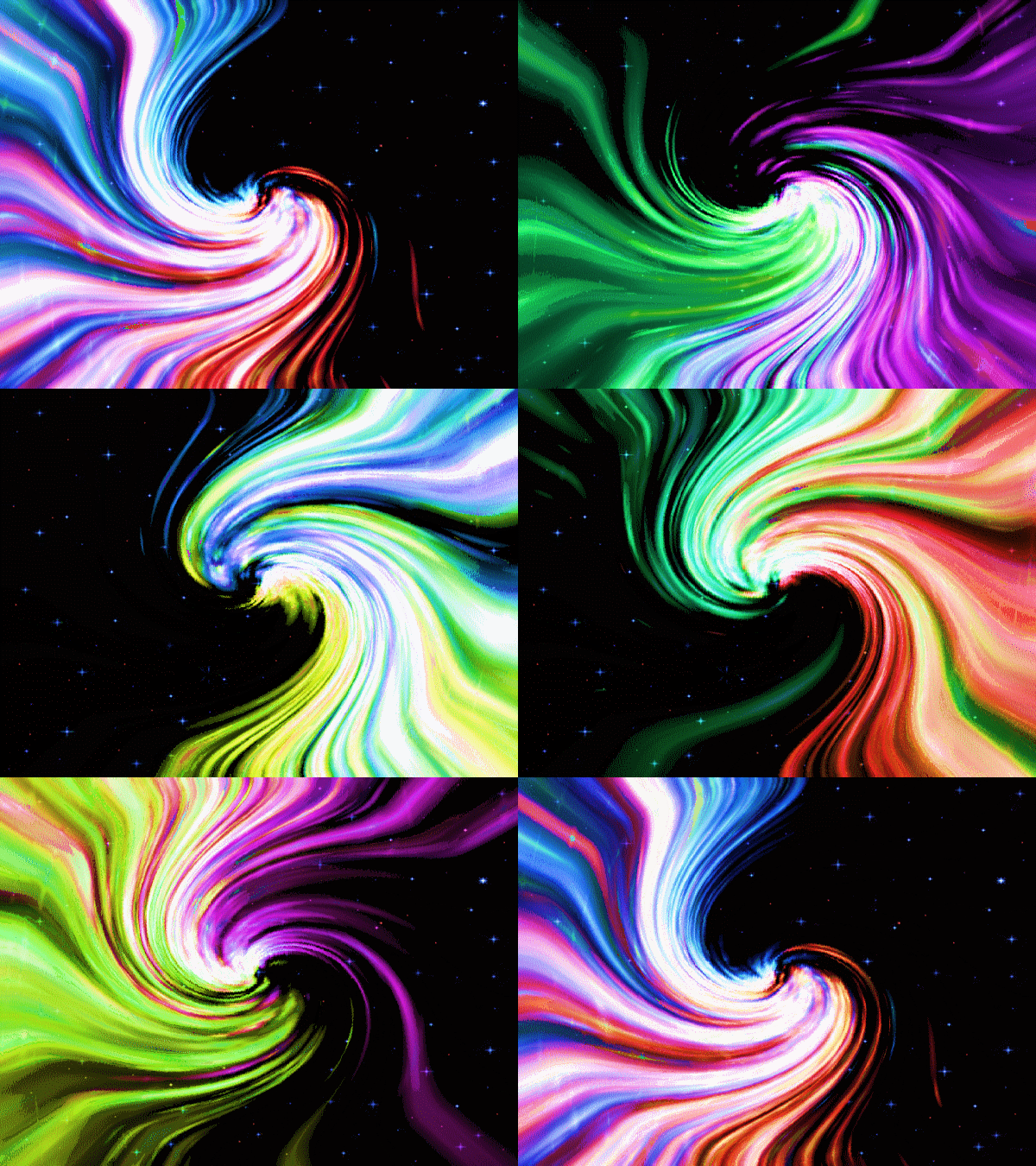
An Illustration called "Through The Wormhole" By Smoothe (Source : DeviantArt)
To visualize a wormhole, imagine bending a piece of paper so that two distant points touch, creating a shortcut between them. This concept is analogous to an Einstein-Rosen bridge. However, creating a traversable wormhole, where humans or spacecraft can safely pass through, presents immense challenges.
Theoretical Framework
Exotic matter, a concept that may sound analogous to science fiction, is crucial to wormhole theories. It possesses negative energy density and negative pressure, which counteracts the gravitational forces attempting to collapse the wormhole. The presence of such exotic matter is essential to maintain the structural integrity of the wormhole. However, the existence of such exotic matter remains purely theoretical, and no experimental evidence supports its existence.
The mathematical models have shown that wormholes could exist as solutions to Einstein's field equations, which describe the geometry of spacetime. However, it's significant to understand that these models often rely on idealized conditions and hypothetical forms of exotic matter with negative energy density to stabilize the wormhole. This exotic matter would be necessary to keep the throat of the wormhole open, preventing it from collapsing upon itself.
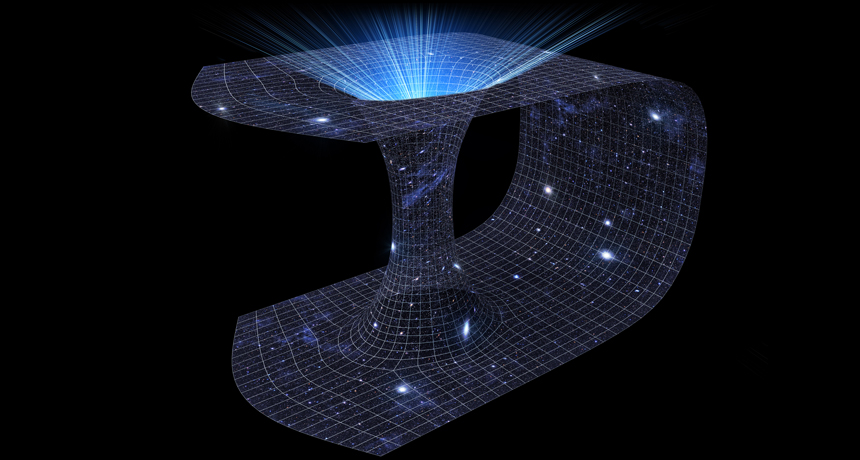
Wormholes, theorized by Einstein's general theory of relativity, could potentially link distant black holes, shedding light on quantum entanglement and the unification of physics (Source : ShutterStock)
Wormholes in Popular Culture
Wormholes have been a staple of science fiction for decades, serving as charismatic plots in books, movies, and television shows. They are portrayed as gateways to other galaxies, alternate dimensions, or even time travel. One of the most iconic depictions of a wormhole is in the television series "Star Trek," where the crew of the starship USS Voyager used a stable wormhole to navigate vast distances in space. In "Interstellar," a sci-fi film directed by Christopher Nolan, a wormhole near Saturn offers a portal to distant galaxies, enabling humanity's survival. These portrayals, while imaginative, are rooted in the intriguing possibilities wormholes offer.
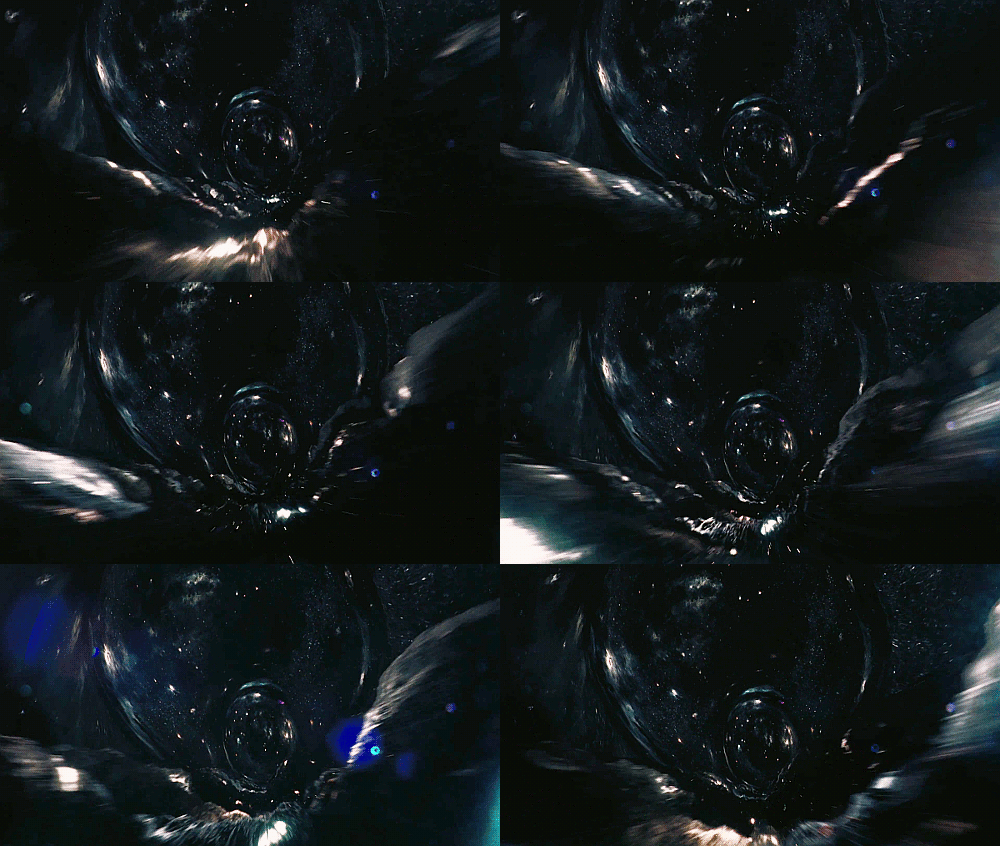
A wormhole, as depicted in the greatest science fiction film ever made, Interstellar (Source : Christopher Nolan)
Implications
While the practical use of wormholes for space travel remains elusive, the study of these theoretical constructs has significantly contributed to our understanding of the fundamental laws governing the universe. Some potential applications of them may include FTL (Faster Than Light-Travel), time travel, and unparalleled cosmic connectivity. They might serve as windows into uncharted territories, allowing us to observe the birth of stars, exotic celestial phenomena, or even other universes. Research into wormholes has led to new insights into the nature of space-time, gravitational forces, and the possibilities of exotic matter. However, the idea of time travel through wormholes raises a plethora of intriguing questions. Would it be possible to change the past or influence the future? Could paradoxes arise, such as the famous "grandfather paradox," in which a time traveler inadvertently prevents their own existence? These questions remain unresolved, and they challenge our understanding of the laws of physics as we currently know them.
Future Prospects and Discoveries
As the frontiers of physics continue to expand, the study of wormholes remains an area of enormous interest and speculation. The quest to comprehend the intricate dynamics of space-time and the potential existence of exotic matter fuels ongoing research and theoretical explorations. With advancements in theoretical physics, computational modeling, and astronomical observations, we may yet unravel the secrets of these enigmatic cosmic gateways, shedding light on the profound mysteries of the universe and our place within it. Conclusively, much of all this may appear to be wild speculation, a series of far-fetched assumptions, or even just imaginative notions that may have little basis in reality, being mere products of the vast creative power held by our minds. But even so, it is said that inquisitive faculty is one of the greatest strengths held by humanity.
Many of the most exceptional discoveries in our species' history have sprung forth from a simple thought, beginning with only two short words that have moved numerous individuals to achieve the unthinkable and help unravel enigmas that have plagued our collective conscience for millennia. Those words are "What if...," and the following is a quote that best signifies their importance to human development:
"Science does not know its debt to imagination." - Ralph Waldo Emerson