Before the likes of Galileo Galilei and Nicholas Copernicus, there existed one of the most influential yet controversial astronomers of all time: Claudius Ptolemy. Born around 100 CE and living in the Egyptian city of Alexandria under the rule of the Roman Empire, he made several discoveries using ideas mostly from the Greek Astronomer, Hipparchus, that were later used to compile one of the most important books in science, The Almagest. Originally written in Koine Greek and divided into 13 separate books, it delves into detail regarding the planetary paths and the motions of the stars, laying the groundwork for centuries of astronomical inquiry. Ptolemy emerged as a towering intellect of his time, pioneering advancements in astronomy, geography, and mathematics that continue to intrigue and inspire to this day.
Early Life
We don't know much about his early life except for the fact that he was born around 100 CE. There is also no information regarding his background except for the information one can extract through his name, which is a mixture of the Greek Egyptian "Ptolemy" and the Roman "Claudius". From this we can perhaps deduce that his family was perhaps Greek and had settled in Egypt. Other than astronomy, he had a deep interest in geography where he used his knowledge to make a detailed world map with longitudes and latitudes. According to historians, the first of his observations occurred on March 12, 127. And his last recorded one was February 2, 141.
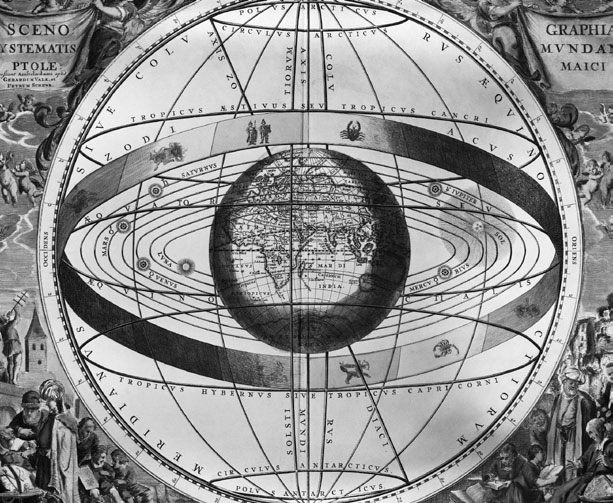
Map of the Universe according to Ptolemy, from a 17th century Dutch atlas by Gerard Valck (Photo Credit: CORDIS)
His Work
In a time long ago, before telescopes and fancy instruments, Ptolemy studied the stars using only his eyes and math skills. He believed that Earth was at the center of everything in the sky, a common idea back then, but one that was later challenged by Galileo Galilei. This challenge not only changed history but also altered the prevailing notion of the heavens entrenched in the minds of people at that time.
Ptolemy didn't just look at the stars; he also did lots of math to understand how they moved. He built on the work of others, like Hipparchus of Rhodes, who came up with a system of epicycles and eccentric (small circles whose centers move around the circumferences of larger ones) circles to explain why Earth was the center of the solar system. He used over 80 of these circles to explain how the Sun, Moon, and planets moved across the sky. This idea was refined by Ptolemy through fine calculations and was renamed the Ptolemaic System that became the center of all theories regarding the objects in the night sky and was used by astronomers to calculate and predict the position of planets quite accurately.
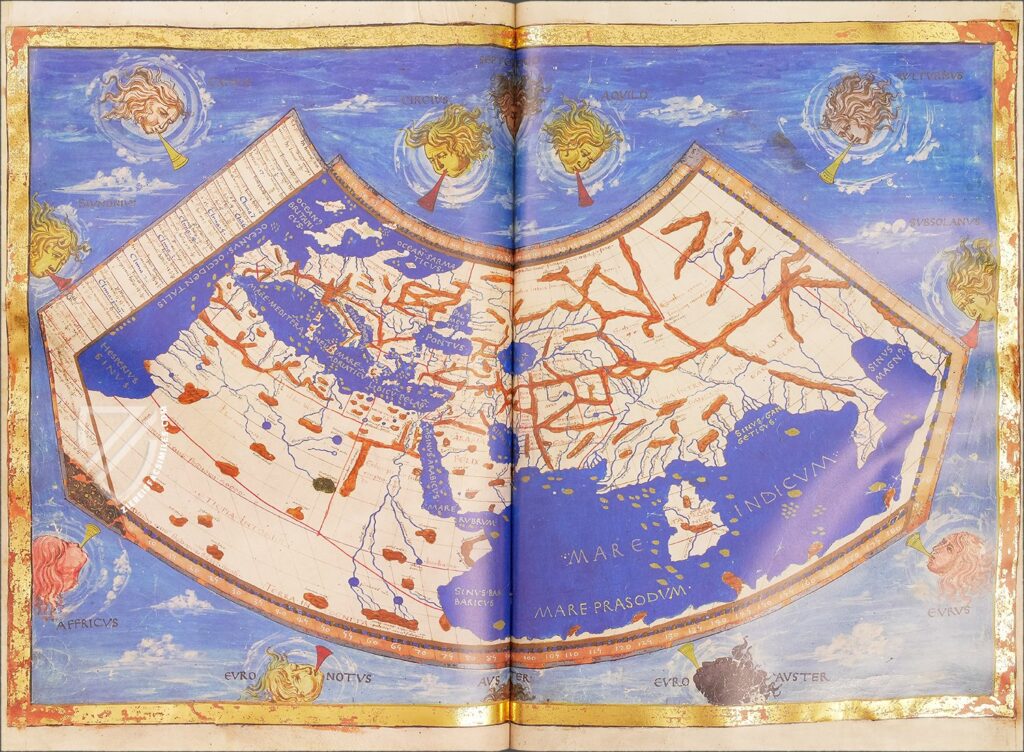
His magnum opus, "Almagest," is a comprehensive compilation of astronomical knowledge in the ancient world. (Photo Credit: Facsimiles)
Deciphering Planetary Motion
In ancient times, while the stars' movements seemed predictable, figuring out how planets moved in the night sky was trickier. The Greeks called planets "wandering stars" because they didn't follow the same smooth paths as stars. Sometimes, they even looked like they were going backward! This puzzled astronomers because they thought everything in the sky moved in perfect circles. To explain these weird movements, ancient scholars like Apollonius of Perga and Hipparchus came up with ideas like circles within circles. Ptolemy, another famous astronomer, combined these ideas into a clever model that included a special point called the equant.
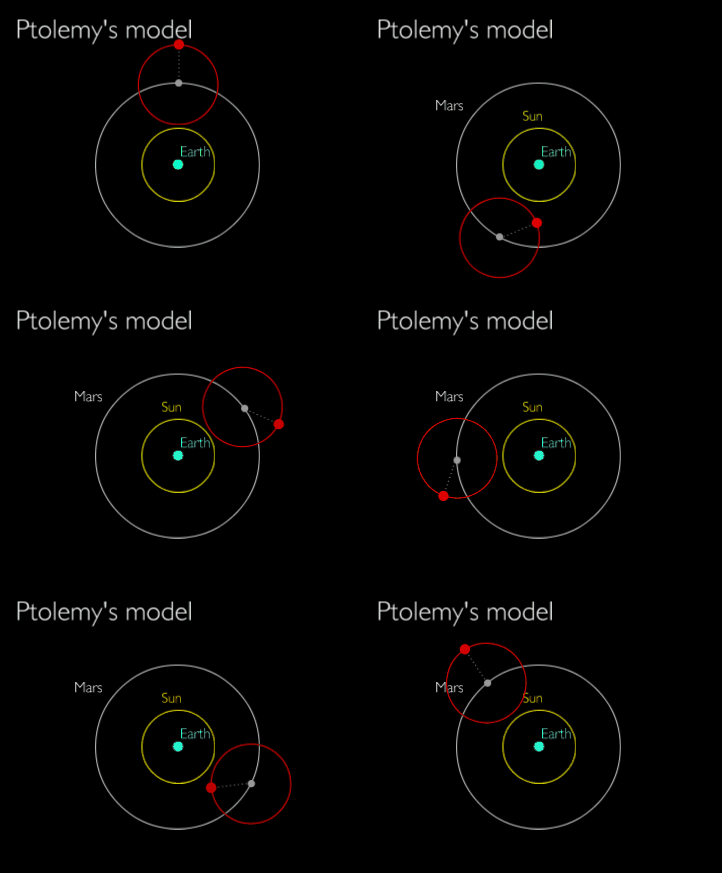
Central to Ptolemy's cosmological model is his theory of epicycles, which sought to account for the irregular movements of the planets as observed from Earth. According to Ptolemy, each planet moved in a small circle, called an epicycle, which in turn moved along a larger circle around the Earth. While later astronomers would refine and ultimately supersede this model, Ptolemy's epicycles represented a significant advancement in our understanding of planetary motion. This model helped explain things for a long time until Johannes Kepler came along with even better ideas in the 17th century.
Ptolemy's model posited Earth as the center, with planets orbiting it in epicycles. The animation illustrates Mars on its epicycle orbiting the Sun. (Credit: Kepler's Discovery)
The study of the planets' movements led ancient astronomers to develop some fascinating theories. They noticed that planets seemed to brighten and dim over time, suggesting they were getting closer and farther from Earth. However, they believed all heavenly motion followed strict circular paths, which made explaining these changes tricky. To solve this puzzle, scholars like Apollonius of Perga and Hipparchus proposed concepts like the eccentric, deferent, and epicycle. Ptolemy, building on their work, introduced the equant, a point around which planets moved at uniform speeds. This model, though complex, proved remarkably effective for centuries, offering valuable insights into celestial mechanics. It wasn't until Johannes Kepler revolutionized our understanding of planetary motion in the 17th century that Ptolemy's model was eventually surpassed.
Robert Newton and His “The Crime Of Claudius Ptolemy”
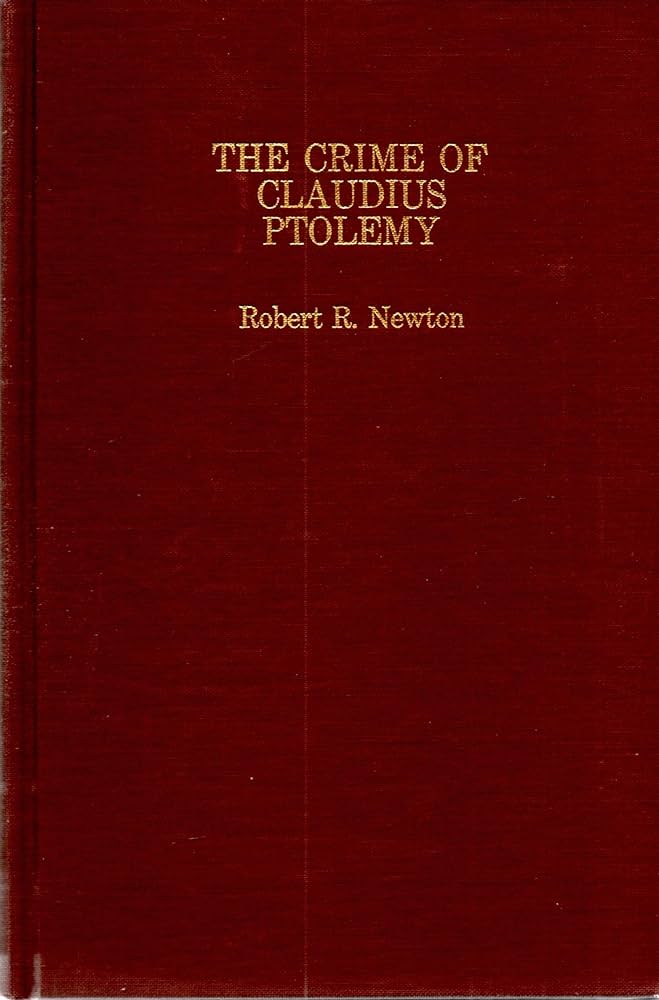
In conclusion, the future of Claudius Ptolemy finds himself amidst a contentious debate regarding the authenticity of his contributions. While revered by many as a pioneering figure in the field, others, notably Robert Newton in his provocative book "The Crime of Claudius Ptolemy," challenge his legacy by positing that Ptolemy may have engaged in fraudulent practices. Newton's assertion hinges on discrepancies between Ptolemy's purported observations and modern astronomical data, particularly focusing on the precision of Ptolemy's measurements, such as those related to equinoxes.
Newton proposes controversial theories suggesting Ptolemy might have falsified data and plagiarized the works of earlier astronomers. (Image Source: Goodreads)
Scholars like Jean Delambre question whether Ptolemy conducted direct observations or relied primarily on theoretical calculations and examples to substantiate his theories. Modern analyses of Ptolemy's reported data reveal discrepancies between his recorded positions for celestial bodies and their actual locations, prompting diverse interpretations among scholars. While some cast doubt on Ptolemy's integrity, suggesting deliberate manipulation of data to fit his mathematical models, others propose a more nuanced view, positing that Ptolemy may have selectively utilized genuine observations to bolster his theories. Despite these scholarly debates, Ptolemy's enduring influence underscores the intricacies of historical scientific inquiry and the complexities inherent in evaluating ancient astronomical texts.
Ptolemy's legacy, though marred by controversy, remains indelibly imprinted on the annals of astronomy. His comprehensive treatise, "The Almagest," continues to serve as a foundational text in the study of celestial mechanics, shaping generations of astronomers' understanding of the cosmos. At the heart of the Almagest lies Ptolemy's geocentric model of the universe, which posits that the Earth sits motionless at the center of the cosmos, with celestial bodies orbiting around it. While this model may seem antiquated by modern standards, it was revolutionary in its time, providing a framework for understanding the movements of the heavens.
Ptolemy’s life is a suitable encapsulation of the nature of legacy and the immortality of ideals themselves in stark contrast to the humans that hold them. Although details on his early years and personal history are scarce and meager, his ideas, propositions and accomplishments carry great overall historical significance, to the point that even though the man himself remains a mystery, his name is renowned in the annals of scientific progress. While some of his observations and ideas may have been proven later to not be wholly accurate, supplanted by models proposed by those that succeeded him, they were still integral developments that were influential in establishing the trajectory of modern cosmological discovery.
Conclusion
When we take a step back and view the record of scientific advancement as a whole through the ages, a common theme emerges. Each scientific breakthrough, like a carefully placed building block, serves as the foundation for the next, building upon centuries of accumulated knowledge and understanding. From the pioneering insights of early thinkers to the cutting-edge research of today, each discovery serves to expand the boundaries of human understanding. This interconnected web of discovery is what makes science truly beautiful—it is a collaborative endeavor, with each generation standing on the shoulders of those who came before, reaching ever higher towards the stars. A quote by Isaac Newton, one of the greatest physicists to ever live, summarizes this approach adequately.
“If I have seen further, it is by standing upon the shoulders of giants.”