
The Increasing Danger Of Space Debris
This article explains the growing threat of space debris, its risks to satellites and astronauts, and the innovative solutions shaping safer space exploration.
Phenomenon
Astronomy
NASA
Phenomenon
The Increasing Danger Of Space Debris
15 Min Read
Space has traditionally been viewed as an endless expanse of celestial phenomena, but growing human activity has revealed its limitations and vulnerabilities. Alongside scientific discoveries and technological progress, concerns about sustainability and safety are now central to discussions about the future of space. Increasing congestion in orbital regions has raised the risk of collisions and debris accumulation, which in turn threatens the long-term accessibility of these environments.
Unlike natural cosmic phenomena such as black holes that remain distant and theoretical in their impact on human life, space debris presents a direct and immediate challenge. Every fragment of nonfunctional material orbiting Earth represents a potential hazard to satellites, spacecraft, and the infrastructure that modern society depends on. Recognising and addressing this issue is critical to ensuring the continued use of space for exploration, communication, and scientific advancement.
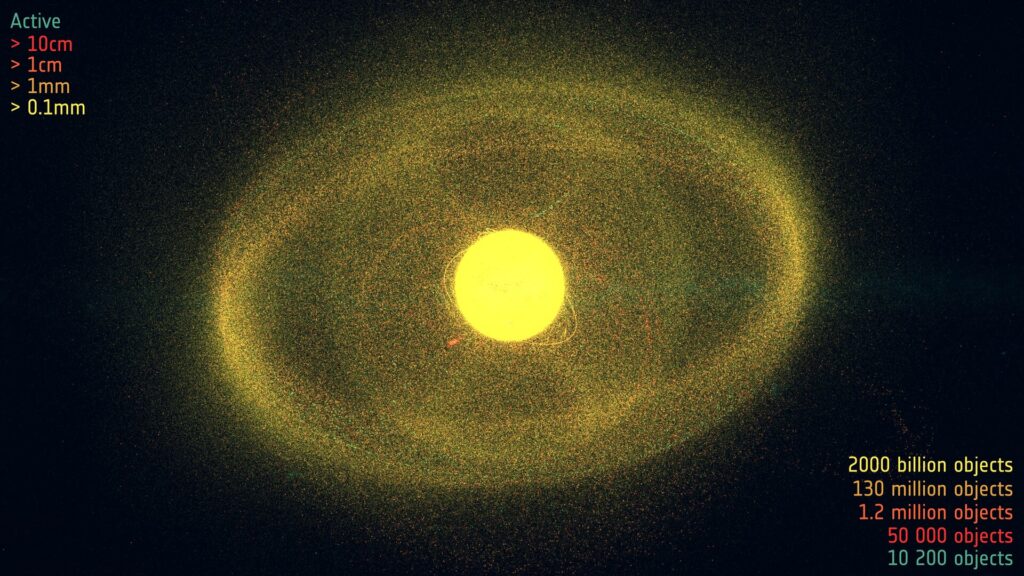
A visual model showing the distribution of space debris orbiting Earth, highlighting the vast cloud of fragments, satellites, and rocket remnants surrounding our planet. (Photo Credit: ESA)
The Risk Of Progress
Science, physics, and astronomy have long empowered society to explore the cosmos, connect across continents, and predict weather patterns. However, these remarkable achievements now face a significant and largely unseen risk that could put them in jeopardy.A growing cloud of space debris presents a serious threat to ongoing space missions and to the infrastructure that supports life on Earth. With the increasing number of satellite launches and rocket activity, addressing this challenge has become more urgent than ever.
Space debris generally consists of obsolete satellites, spent rocket stages, and fragments produced by collisions, erosion, and disintegration. Even the smallest pieces, such as paint flakes and metal shavings, add to the clutter. Though tiny, these objects move at incredible speeds, often surpassing 28,000 kilometres per hour, nearly 23 times the speed of sound at sea level.
The root of the problem goes back to the earliest days of space exploration. The launch of Sputnik 1 in 1957 marked the beginning of the space age, but it also marked the start of a long-term issue. Every mission since then has added to the accumulation of orbital debris, including obsolete satellites, discarded rocket stages, and countless fragments created by collisions, explosions, and erosion. These objects did not disappear once their missions ended but remained in orbit, gradually forming an expanding cloud of human-made junk around Earth.
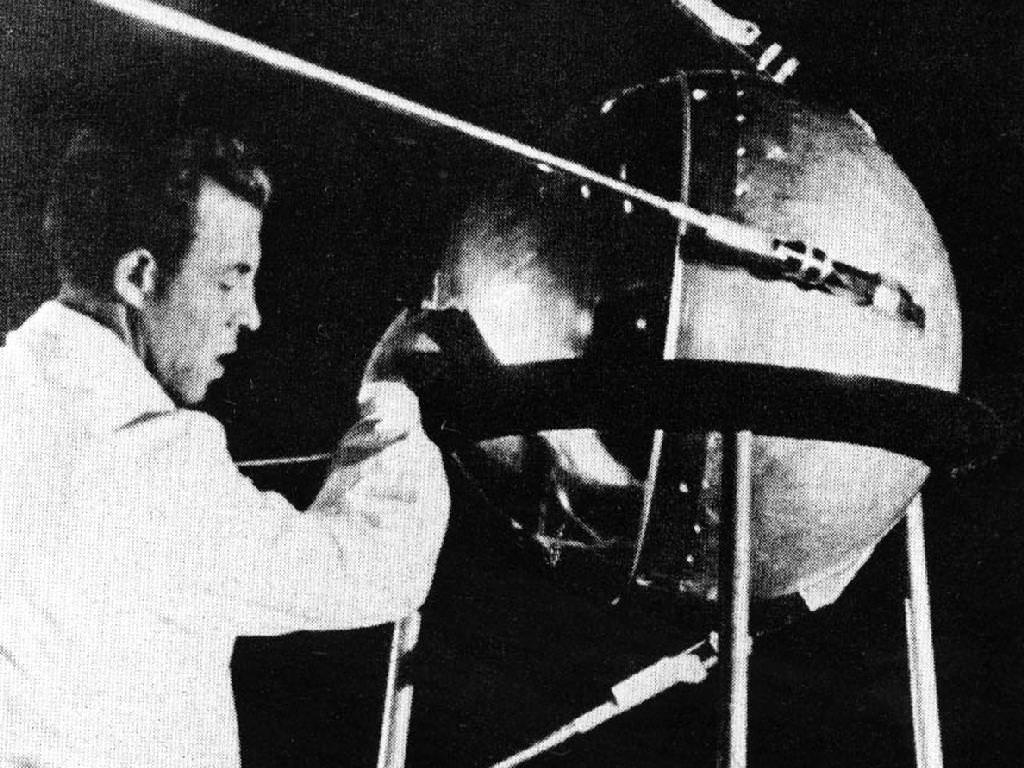
A technician working on Sputnik 1, the world’s first artificial satellite, before its historic launch in 1957 that marked the beginning of the space age. (Photo Credit: NASA)
Although some debris eventually reenters the atmosphere and burns up, a large portion, especially that in higher orbits, can remain for decades or even centuries. At those altitudes, where atmospheric drag is almost nonexistent, nothing slows them down or pulls them back. As a result, each new launch increases the problem, and if left unchecked, space debris will continue to pose growing risks to active satellites, future missions, and the sustainability of space exploration itself.
The Kessler Syndrome
The buildup of space debris has accelerated sharply, fueled by the rise of satellite deployments and the long-lived remains of rocket stages in orbit. Low Earth Orbit (LEO), defined as the region where orbital periods are 128 minutes or less with a minimum of 11.25 revolutions per day and eccentricity below 0.25, is particularly vulnerable because of its dense concentration of satellites. Every additional object placed into LEO raises the probability of collisions, and each collision creates fragments that further increase risk.
This self-sustaining cycle of fragmentation is described as the Kessler Syndrome, first outlined in 1978 by NASA scientist Donald J. Kessler and Burton Cour-Palais. It refers to a scenario where debris density becomes so high that collisions trigger a chain reaction, rendering certain orbital zones hazardous for decades or longer. Unlike cinematic depictions of sudden destruction, such as in Gravity, experts emphasise that the process would unfold gradually over decades or centuries.
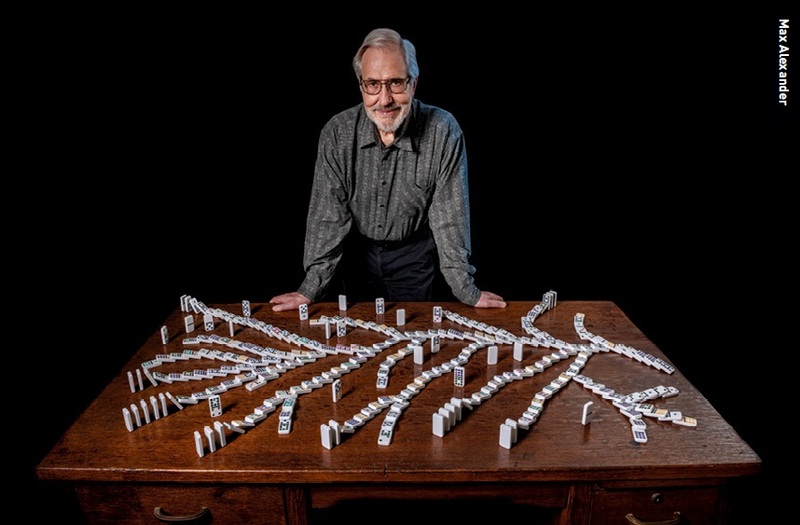
This is an image of Donald J. Kessler standing behind a table with dominoes arranged to represent the chain reaction effect of space debris collisions. (Photo Credit: Max Alexander)
Evidence of this progression already exists. In 2009, the collision between an Iridium communications satellite and a Russian Cosmos satellite produced about 2,000 large fragments, many of which still pose threats. Earlier events include the 1996 breakup of the French CERISE satellite and the 1991 collision involving the Russian Cosmos 1934 satellite. More recently, antisatellite missile tests by India in 2019 and Russia in 2021 generated over 1,500 tracked debris pieces, forcing astronauts on the International Space Station to take precautionary shelter. Even smaller, less publicized events—such as a hypervelocity impact breaking fragments off a Vega rocket payload adapter—demonstrate that collisions continue to occur.
The Kessler Syndrome does not depend on a single catastrophic incident but rather on the cumulative effect of these collisions. Modelling indicates that while lower altitudes around 400–500 km benefit from atmospheric drag that clears debris within years, higher regions above 800 km retain debris for centuries, and at altitudes around 1,000 km, fragments can persist for millennia. These higher bands, populated by satellites such as Hubble, Iridium, and OneWeb, are especially at risk of cascading growth.
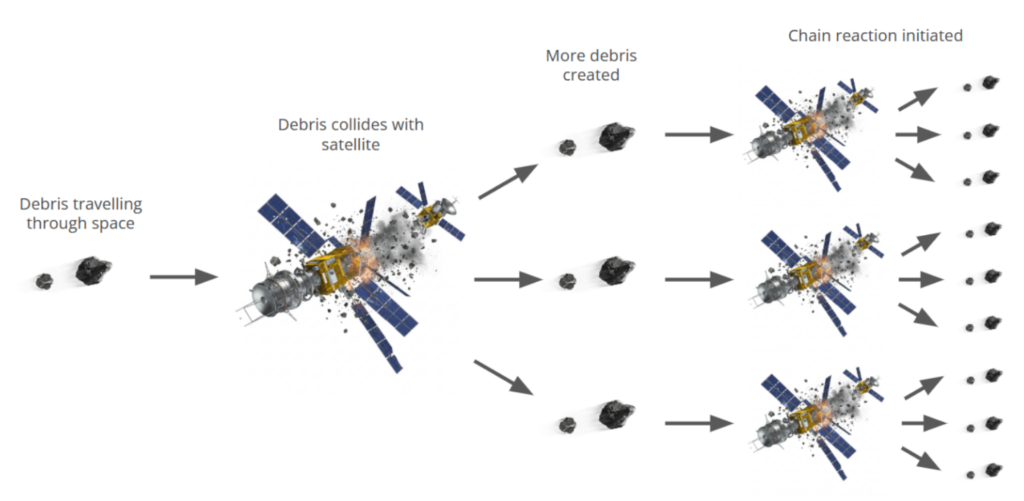
Diagram illustrating the Kessler Syndrome, a piece of space debris collides with a satellite, creating more debris, which triggers a chain reaction of collisions and further fragmentation in orbit. (Photo Credit: Amplyfi)
Experts remain divided on whether the Kessler Syndrome has formally begun. Some, including NASA’s Mark Matney, consider past major collisions as the opening phase of the cascade, while others view the risk as an approaching threshold not yet crossed. Regardless, current assessments show collision probabilities continuing to rise, with estimates of about a one-in-ten chance of another major collision each year. The long timescales involved obscure whether the cascade is already underway, but the trend of increasing debris density and repeated collision events align with Kessler’s original prediction.
The Iridium-Cosmos Collision
Companies like SpaceX, Amazon, and OneWeb are launching vast networks of small satellites designed to deliver internet access to every corner of the planet. These ambitious initiatives hold the promise of bridging the digital divide and connecting underserved regions. However, there's a catch: as these specialised constellations fly into orbit, they also contribute to a rapidly growing congestion in space.
The risk of crashes increases significantly with the number of objects present, and the consequences can be severe. A notable incident occurred on February 10, 2009, when the active U.S. communications satellite Iridium 33 collided with the Russian satellite Cosmos 2251. This event marked the first accidental hypervelocity collision between two intact satellites. The impact created over 1,800 traceable fragments, each of which posed a threat to other spacecraft. Additionally, many smaller fragments, less than 10 centimetres in size, were generated. Although these were harder to detect, they were still equally dangerous.
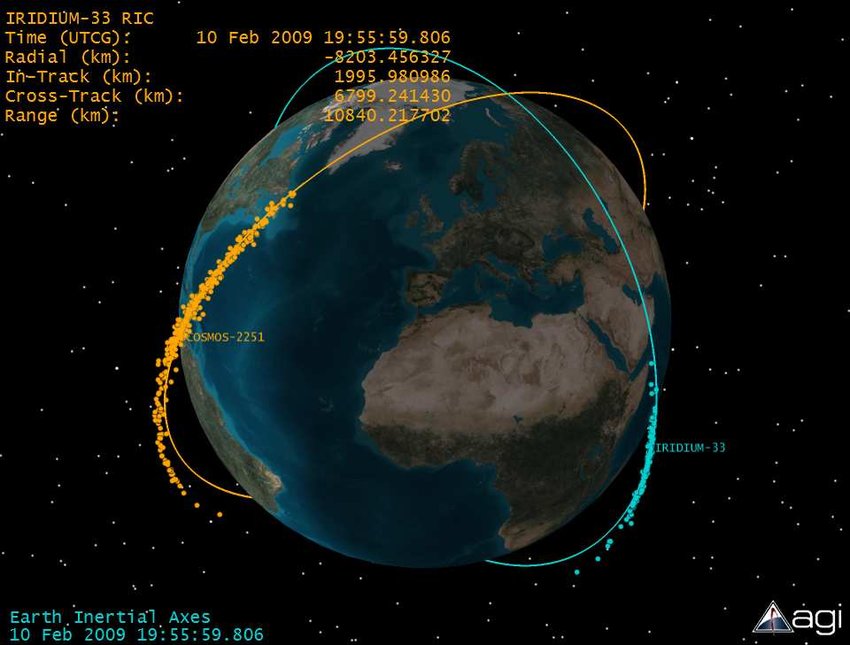
A view of Iridium 33 and Cosmos 2251 Debris 180 Minutes Post-Collision (Photo Credit: AGI)
The Iridium-Cosmos collision acted as a wake-up call for the global space community. It shattered the misconception that the universe was too vast for such accidents to happen, and stressed the urgent need for coordinated efforts to manage orbital traffic effectively. The debris from this collision continues to orbit Earth, spreading across various altitudes and increasing the likelihood of further incidents. The International Space Station (ISS), which orbits within the congested LEO region, has had to perform multiple crash avoidance schemes to steer clear of debris. These gimmicks are not only costly but also disrupt scientific operations and pose risks to the astronauts aboard.
What The Numbers Say
To emphasise the critical message that space is conveying to us, it helps to look at some compelling statistics that truly drive the point home. As of 2021, the U.S. Space Surveillance Network was monitoring an astounding 27,000 pieces of orbital debris larger than 10 centimetres. By 2024, the situation had only escalated. According to the European Space Agency (ESA), the amount of orbital waste is surging at an alarming rate, with space surveillance networks now tracking nearly 35,000 objects. Of these, about 9,100 are active satellites, while the remaining 26,000 are classified as hazardous debris. These objects, although seemingly small, can be extremely dangerous since even tiny fragments have the potential to puncture spacecraft shielding and cause serious damage.
The implications of space debris extend far beyond astronauts and space agencies, as modern life is closely tied to satellite-based services. Communications, GPS navigation, weather forecasting, television broadcasting, and even financial transactions all rely on satellites orbiting Earth. A single collision disabling an essential satellite could disrupt these services, leading to economic losses and posing risks to public safety. GPS systems, for example, are vital for aviation, maritime navigation, and emergency response, while weather satellites provide critical data for predicting storms and natural disasters. The loss or degradation of such capabilities due to debris collisions would have far-reaching consequences on Earth.
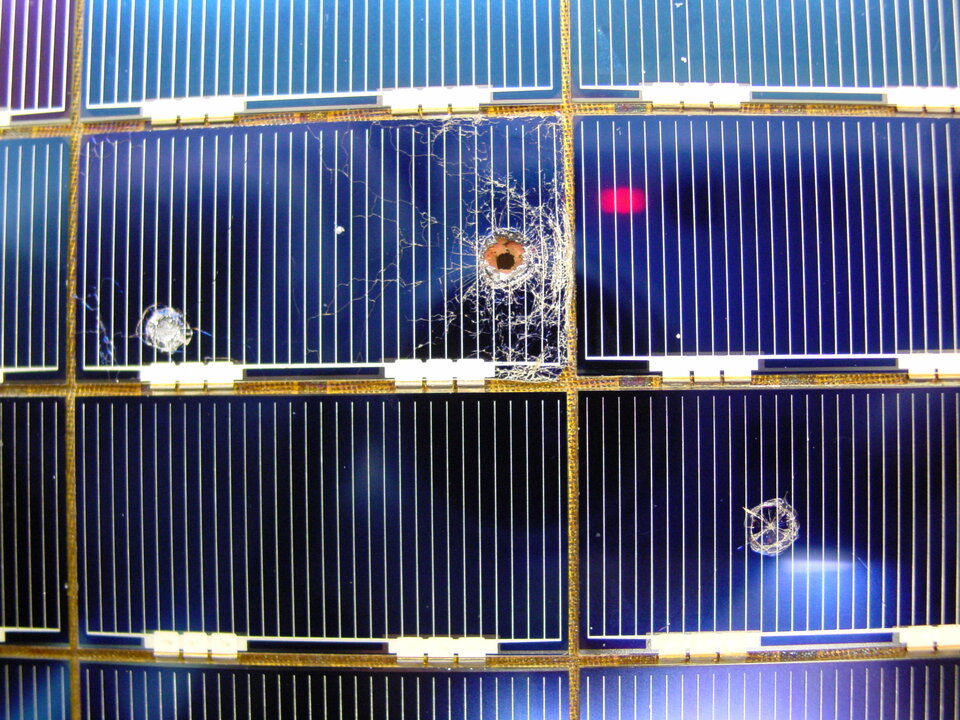
Solar panels, retrieved from the Hubble Space Telescope, damaged due to space debris while in orbit in 2002. (Photo Credit: ESA)
Recognising the seriousness of this growing challenge, scientists and space agencies around the world are actively working on innovative solutions to mitigate the threat of space debris. By developing technologies for monitoring, managing, and eventually removing debris, they aim to ensure the long-term sustainability of space exploration and safeguard the infrastructure on which our daily lives depend.
Innovative Strategies & Guidelines
One promising approach to addressing the issue of space debris is Active Debris Removal (ADR), which focuses on capturing and deorbiting large fragments. The ClearSpace-1 mission, scheduled for launch in 2026 by the European Space Agency (ESA), will demonstrate this technology by retrieving a defunct satellite and guiding it to a controlled re-entry. Other proposed methods for debris removal include robotic arms, nets, harpoons, and even lasers to capture or redirect objects. While complex and costly, these missions represent a vital step toward cleaning up Earth’s orbit.
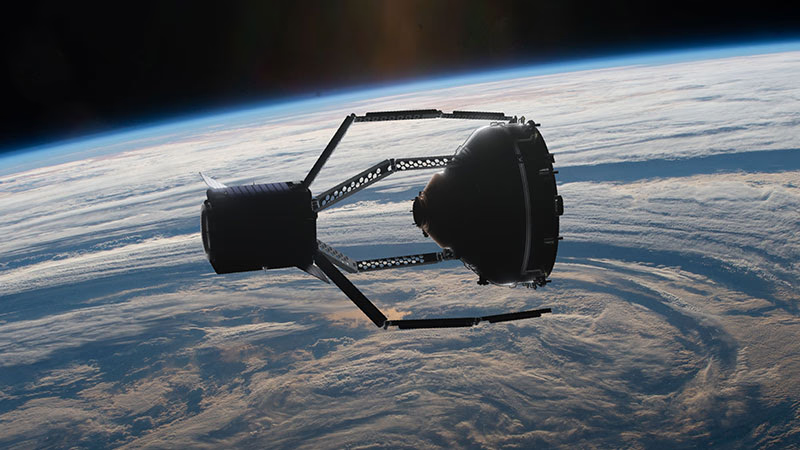
A conceptual rendering of the ClearSpace-1 mission in orbit, showing the spacecraft in the process of capturing a piece of debris (the Vespa adapter). (Photo Credit: ClearSpace)
Another strategy is to design satellites with built-in mechanisms for end-of-life disposal. For example, some satellites may carry propulsion systems that allow them to deorbit themselves once their missions conclude, while others could be designed to self-destruct safely. Developers are also experimenting with materials that disintegrate more completely during re-entry, reducing the likelihood of debris reaching Earth’s surface. These innovations significantly reduce the risk of adding new fragments to an already crowded orbital environment.
Beyond technology, operators are embracing a greater sense of responsibility in managing space activities. Many now adhere to international guidelines that discourage intentional fragmentation, encourage safe operational practices, and promote data sharing to minimize the risk of collisions. This shift signals an important cultural change in how space is approached, reflecting growing recognition of the need for sustainability in orbit.
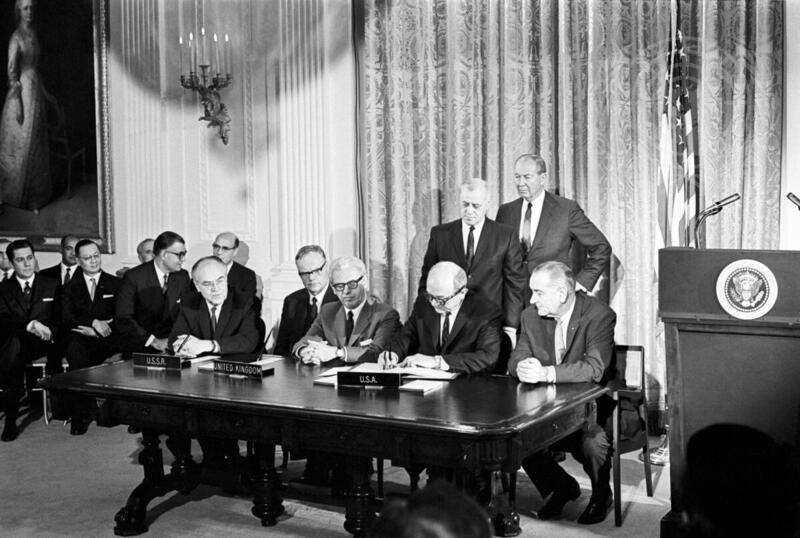
The Outer Space Treaty being signed on 27 Jan, 1968 by the governments of Russia (then part of USSR), UK and the US. (Photo Credit: UN Photo)
Technology alone cannot solve the problem; strong international cooperation is equally crucial. The United Nations Office for Outer Space Affairs (UNOOSA) promotes guidelines for the long-term sustainability of space, including debris mitigation and coordination among satellite operators. Foundational treaties, such as the Outer Space Treaty of 1967, emphasize the peaceful use of space and state responsibility for national space activities, but they lack enforceable mechanisms for traffic management. More recent initiatives, like the Space Traffic Management (STM) framework supported by ESA and the U.S., aim to improve collision avoidance, data sharing, and operational transparency. However, the absence of binding global regulations, combined with the rapid increase in commercial launches, highlights the urgent need for stronger, unified international action.