
Jupiter: The Largest Planet In The Solar System
This article explores Jupiter, the Solar System’s largest gas giant, covering its atmosphere, Great Red Spot, magnetic field, moons, and role in planetary evolution.
Planets
Astronomy
NASA
Planets
Jupiter: The Largest Planet In The Solar System
18 Min Read
Introduction
Since ancient times, the sky has shaped how people understood their world. Our ancestors looked up and used the stars and planets as guides in their daily lives. Among all those lights, Jupiter stood out the most. Its huge size and bright glow made it impossible to ignore, and people from every corner of the world noticed it. We can see its presence across multiple civilisations e.g The planet is mentioned as Marduk in ancient Babylonian texts, Zeus in early Greek manuscripts, and Jupiter in Roman antiquity.
Named after the Roman god of the sky and thunder, Jupiter is the largest piece, after the Sun, that completes the puzzle of our solar system. Its powerful gravity shapes the orbits of countless objects and holds dozens of moons, almost like a tiny solar system of its own. When you look at Jupiter, you see swirling bands of red, white, and gold constantly shifting, along with a massive storm that has been raging for centuries. All of this paints Jupiter as a living, moving giant that has fascinated humanity for as long as we’ve been watching the sky.
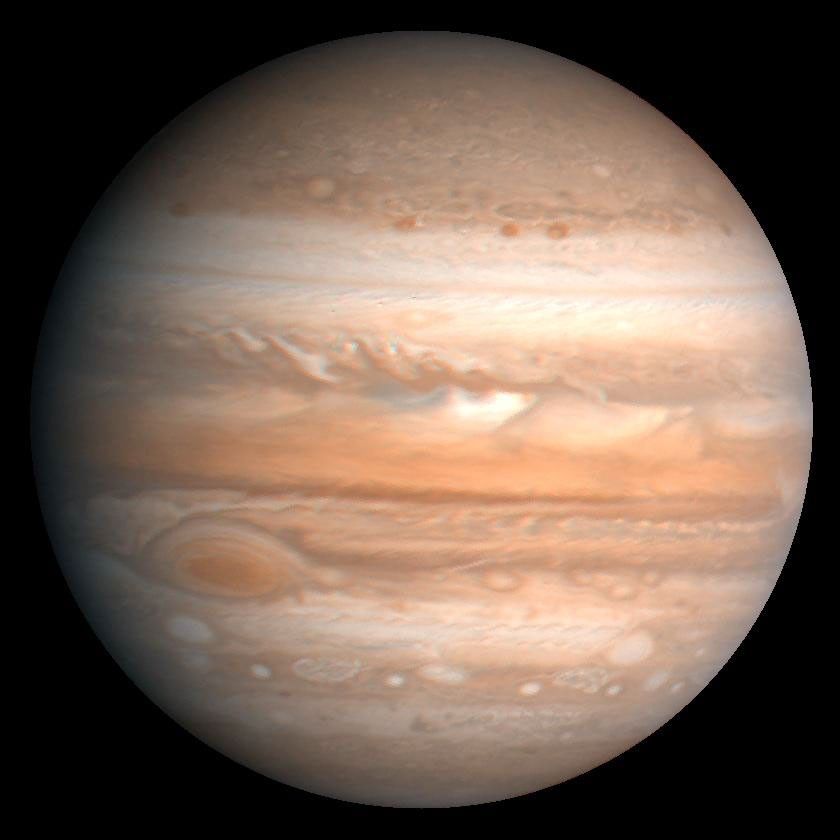
Processed color image of Jupiter produced in 1990 by the U.S. Geological Survey from a Voyager image taken in 1979. (Photo Credit: NASA/JPL/USGS)
Detection
Like all the planets and objects in the solar system (except, of course, our Earth), Jupiter had to be discovered at some point. Because of its massive size and brightness, it was almost certainly noticed very early in human history. Ancient civilizations, including the Babylonians, Greeks, Chinese, and Indians, recorded Jupiter in their sky charts long before telescopes existed.
But globally, we credit the true scientific detection of Jupiter and its moons to none other than Galileo Galilei. The Italian astronomer was scanning the night sky with his rudimentary, self-made telescope when he pointed it toward the gas giant. To his surprise, he was able to make out distinct features on Jupiter’s surface along with four small “stars” beside it. These turned out to be Jupiter’s four largest moons: Io, Europa, Ganymede, and Callisto, now known as the Galilean moons.

This sketch depicting Galileo Galilei demonstrating his telescope to the Doge and senators of Venice in 1609. (Photo Credit: Wikimedia Commons)
This discovery excited him because it directly challenged the long-held geocentric model, which claimed that everything in the cosmos revolved around Earth. Observing moons orbiting Jupiter provided strong evidence for the heliocentric model, where the Sun, not Earth, is at the center of the solar system. At the time, this idea was considered dangerous, controversial, and even blasphemous, but Galileo’s findings helped change the course of astronomy forever.
After the efforts of Galileo, Jupiter continued to reveal more of its secrets to curious astronomers. In the 1660s, Giovanni Cassini used a more advanced telescope to study the giant planet in even greater detail. He noticed dark spots and colorful bands streaking across its surface and, by tracking how quickly they moved, he was able to estimate Jupiter’s remarkably fast rotation period. Cassini is also believed to be the first to observe the Great Red Spot, a colossal storm swirling in Jupiter’s atmosphere. Imagine a single storm, bigger than Earth itself, that has been raging nonstop for more than 450 years. It remains one of the most fascinating and mysterious features in our entire solar system.
Physical Characteristics
Jupiter is a gas giant, meaning it has no solid surface and is composed primarily of hydrogen and helium. It’s the largest and oldest planet in our solar system, enough to contain 1,000 Earths. Formed from the dust and gas left over from the formation of the Sun 4.6 billion years ago, it has the shortest day in the solar system, taking about 9.9 hours to rotate.
The planet has a radius of approximately 69,911 kilometers (43,440.7 miles), making it about 11 times wider than Earth. To put this into perspective, if Earth were scaled down to the size of a grape, Jupiter would be comparable to a basketball. It is located at a distance of 778 million kilometers (484 million miles) from the Sun, which equals to about 5.2 astronomical units (AU) away with one AU representing the distance from the Sun to Earth. At this distance, it takes sunlight about 43 minutes to reach Jupiter from the Sun.
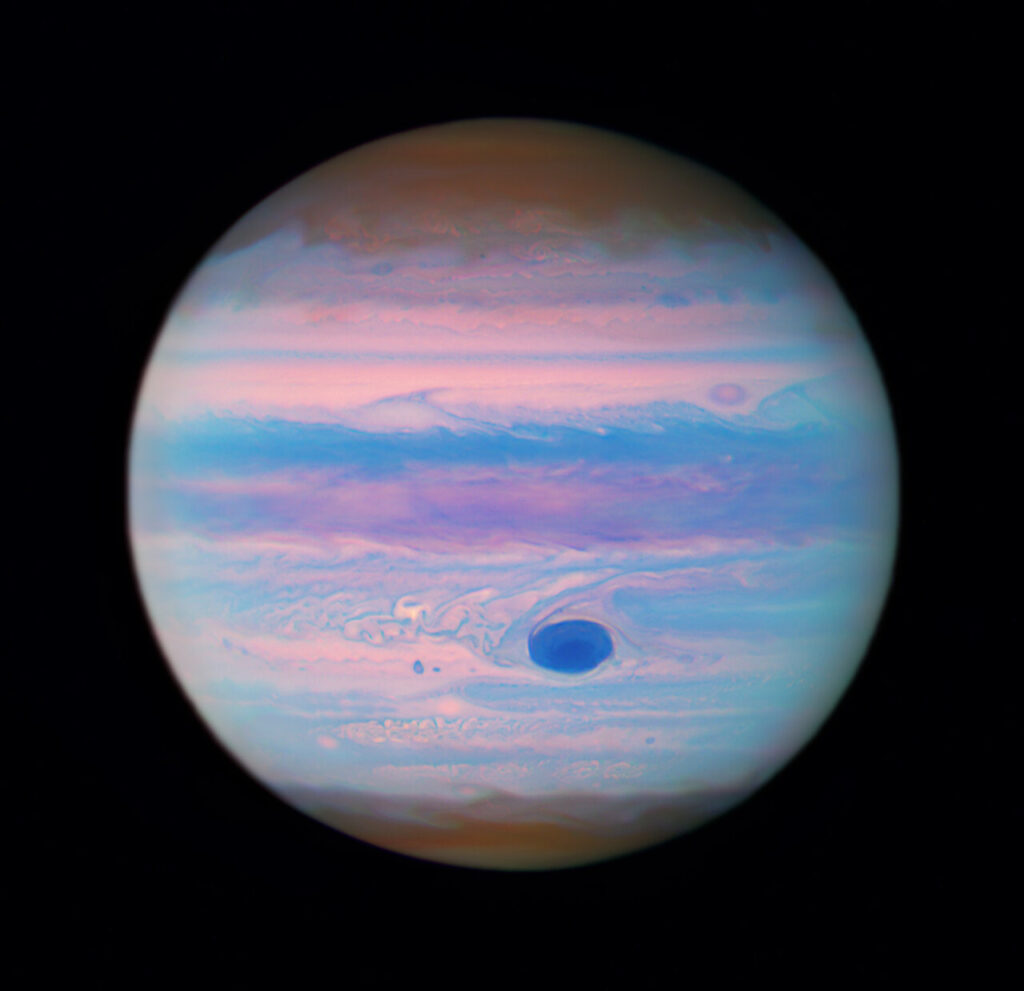
This image taken through the Hubble Space Telescope shows the planet Jupiter in a color composite of ultraviolet wavelengths, showcasing its many unique features. (Photo Credit: NASA, ESA)
Despite being far from the Sun, Jupiter’s gravitational influence dominates much of the solar system. Its massive presence helps shape the paths of asteroids and comets, acting as a cosmic shield that reduces the number of dangerous impacts on the inner planets. With a mass of 1.9 × 10^27 kilograms, about 318 times that of Earth, Jupiter is extremely heavy, but surprisingly not very dense. Its low density of 1.33 grams per cubic centimeter reflects its gaseous makeup and distinguishes it from rocky planets like Earth.
Atmospheric Structures
Every planet has its own special atmosphere where Jupiter is no exception as its atmosphere is the largest in the Solar System, composed primarily of molecular hydrogen and helium, with smaller amounts of methane, ammonia, hydrogen sulfide, and water. If we talk in terms of numbers, hydrogen accounts for 90% of the atmosphere whereas helium accounts for almost 10% of it.
Now then if you imagine a rock being thrown onto Jupiter, the pressure and temperature goes up as it goes towards its center. This increase causes the gases to separate into layers. These layers include: the troposphere, stratosphere, thermosphere, and exosphere, each with distinct temperature gradients. The troposphere rests on the so-called “surface” of Jupiter and extends to about 30 miles (50 kilometers) above it. This layer has complex cloud systems formed from ammonia ice, ammonium hydrosulfide, and water, which, in turn, create the planet’s striking zones and belts, alternating light and dark bands that run parallel to the equator.
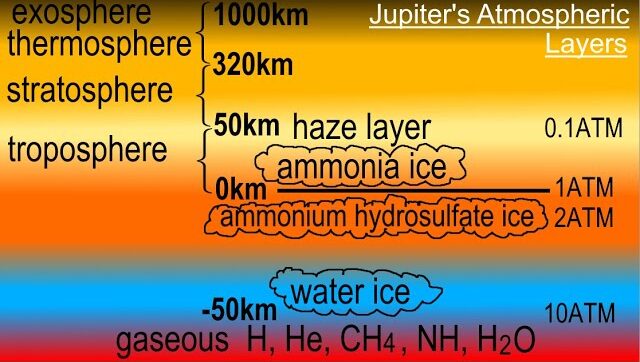
A colorful cross-section of Jupiter’s atmosphere showing layers, altitudes, cloud types, pressure (0.1–10 ATM), and composition (H, He, CH₄, NH₃, H₂O), titled “Jupiter’s Atmospheric Layers. (Photo Credit: Michel van Biezen)
Above Jupiter’s troposphere lies the stratosphere, stretching up to about 200 miles (320 km) and filled with thin hazes of hydrocarbons. Temperatures in this region start at an icy minus 260°F and gradually warm to around minus 150°F (minus 100°C) as altitude increases, heated by both sunlight and Jupiter’s internal energy, ending where the pressure drops to one-thousandth of Earth’s surface pressure.
Above it sits the thermosphere, where temperatures soar to nearly 1,340°F (725°C) at altitudes exceeding 600 miles (1,000 km). This layer hosts Jupiter’s glowing auroras near the poles and produces a faint airglow that prevents the night sky from becoming completely dark, gaining heat from the Sun and energetic particles flowing in from the magnetosphere. Beyond the thermosphere is the exosphere, the planet’s outermost atmospheric layer, where gas particles are so sparse that they can drift off into space, gradually merging with the emptiness of the interplanetary environment.
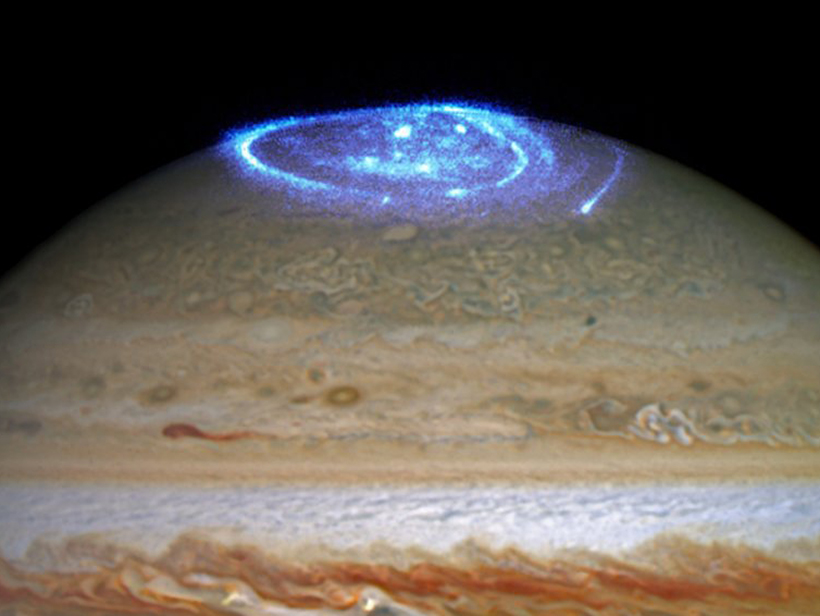
A color-enhanced image of Jupiter showing its banded cloud layers in shades of tan, brown, and white, with the planet’s curved limb visible against the blackness of space. (Photo Credit: NASA, ESA)
Beneath the visible clouds lies a deeper atmosphere where pressures and temperatures rise dramatically. Scientists believe that water clouds exist below the ammonia layer, and further down, hydrogen transitions into a metallic state under immense pressure. This is thought to be responsible for Jupiter’s strong magnetic field. The atmosphere also hosts lightning storms, auroras, vortices, and other phenomena that rival those on Earth in scale and intensity.
The Great Red Spot
The most unique feature of Jupiter, which is one of the first things you see via a telescope, is the Great Red Spot, a vast anticyclonic storm located 22° south of the equator. It has been a spectacle for a while with there being two men who are often credited with one of the first ones to see it. First is Giovanni Cassini who is said to have reported a “permanent spot” in 1665 that repeatedly appeared in the same location with consistent size and shape.
Second comes Robert Hooke, who independently observed and documented a large spot on Jupiter around 1664–1665, producing one of the earliest detailed drawings of the planet. Together, their observations suggest that the Great Red Spot, or at least a long-lived storm system in the same region, has persisted for over 350 years, making it the longest-lasting known storm in the Solar System.
Today, the Great Red Spot is the largest storm in the solar system, with its diameter being 10,159 miles (16,350 kilometers) wide, which is 1.3 times Earth’s diameter. However, the storm has been shrinking for the past century as it was once about 40,000 km in length and will continue to do so, leading to it possibly being circular by 2040.
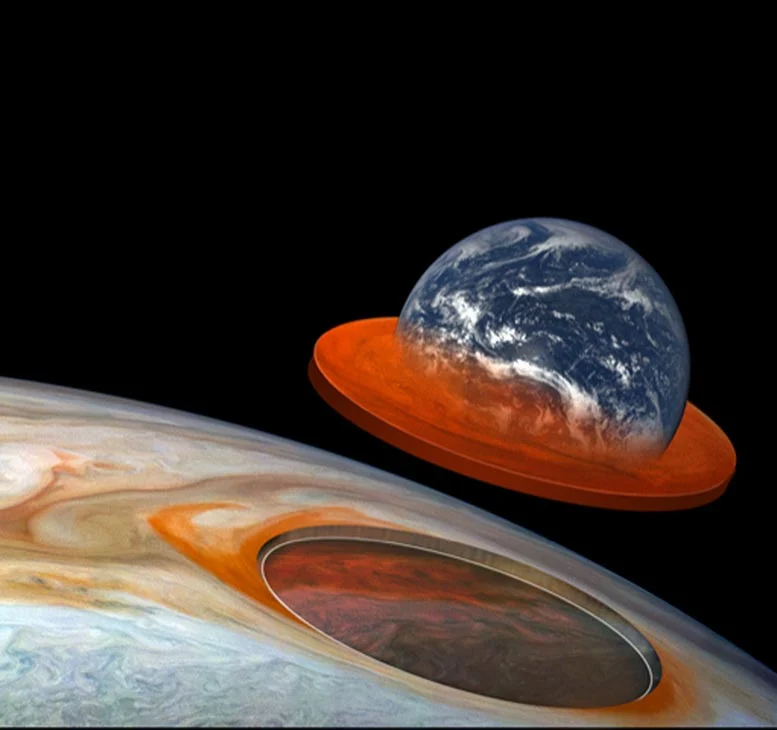
This illustration combines a JunoCam image of Jupiter with Earth for scale, highlighting the immense size and depth of Jupiter’s Great Red Spot. (Photo Credit: NASA)
Jupiter's Role in the Solar System and Its Magnetic Field
Being the largest planet in the Solar System, Jupiter possesses the strongest gravitational influence and the most powerful magnetic field of any planet. These characteristics have allowed it to play a major role in the formation and evolution of the Solar System, deflecting, capturing, and ejecting debris while altering the paths of comets and asteroids. While it is often credited with shielding Earth from a barrage of celestial projectiles, its immense gravity can also redirect comets toward the inner planets, demonstrating its dual nature as both a protector and a potential harbinger of chaos.
Jupiter’s strong magnetic field is generated by the movement of metallic hydrogen within its interior and extends millions of kilometers into space, forming a magnetosphere larger than the Sun itself. This vast magnetic bubble traps charged particles, creating intense radiation belts that pose challenges for spacecraft and future human exploration. Interactions between Jupiter’s magnetic field and charged particles from the solar wind produce spectacular auroras, offering valuable insights into the planet’s magnetic environment. Additionally, the volcanic activity of its moon Io injects plasma into the magnetosphere, further influencing these stunning light displays and highlighting the complex interplay between Jupiter and its moons.
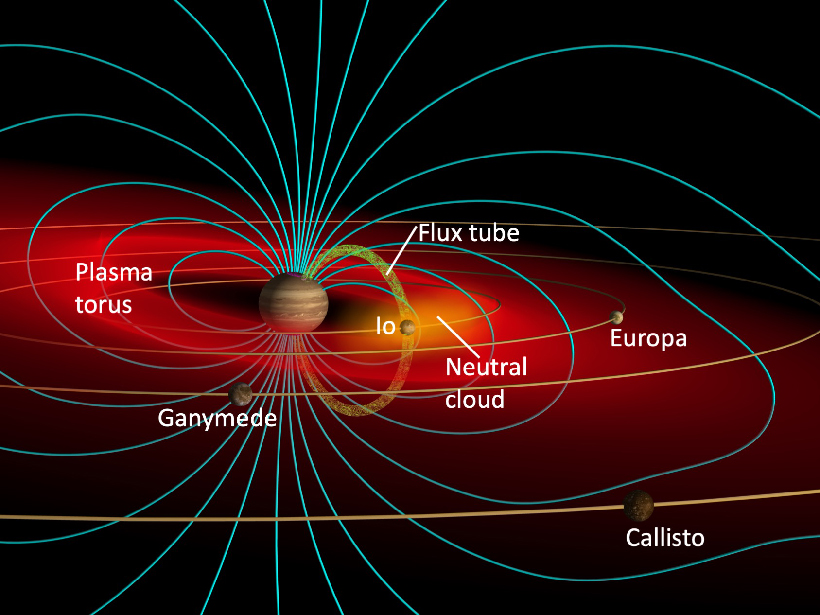
This illustration shows how Jupiter’s moons Io and Europa interact with the planet’s powerful magnetosphere, with ionized particles from Io forming a plasma torus around Jupiter. (Photo Credit: Journal of Geophysical Research)
Jupiter's Endless Moons
The planet is orbited by at least 97 known moons, which vary from tiny irregular bodies to large worlds that rival planets. This total doesn’t include several meter-sized moonlets, nor does it account for hundreds of potential kilometer-sized outer irregular moons that have only been briefly observed by telescopes.
Together, the moons form a satellite system commonly known as the Jovian system. The four largest moons, referred to as the “Galilean moons”, were discovered by both Galileo Galilei and Simon Marius in 1610 and are essential to the study of planetary science. The Galilean moons are significantly larger and more massive than the other moons of Jupiter; the remaining 93 known moons and the rings together make up only 0.003% of the total mass of objects orbiting the planet. These are named: Io, Europa, Ganymede, and Callisto.
In more recent times, dozens of smaller Jovian moons have been detected. Many of these have been named after lovers or daughters of Jupiter, the Roman god, or his Greek equivalent, Zeus.
The Galilean Moons
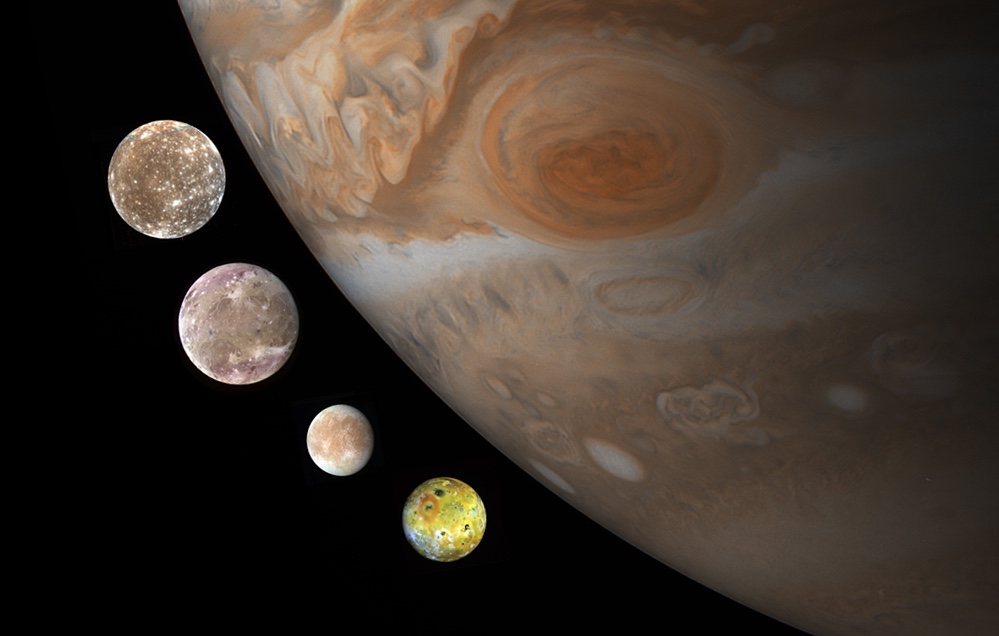
The image displays Jupiter’s four largest moons, Io, Europa, Ganymede, and Callisto, from bottom to top. Jupiter is shown to scale on the right. (Photo Credit: NASA, Kevin M. Gill)
Io is the most volcanically active body in the Solar System with hundreds of volcanic eruptions constantly reshaping its surface. This extreme volcanic activity is driven by tidal heating, caused by intense gravitational interactions with Jupiter and its neighboring moons, particularly Ganymede and Europa. These forces stretch and compress Io’s interior, generating enormous heat that melts rock and fuels frequent eruptions. As a result, Io’s surface is covered with vast lava plains, towering volcanic plumes, and sulfur-rich deposits that give it a distinctive yellow-orange appearance.
In contrast, Europa is one of the most compelling moons in the search for extraterrestrial life due to the presence of a global subsurface ocean beneath its icy crust. This ocean is kept in a liquid state by tidal heating generated from Europa’s gravitational interaction with Jupiter. Europa’s surface is relatively smooth and crisscrossed with a network of cracks, ridges, and bands, indicating ongoing geological processes and possible exchange between the surface and the ocean below. The combination of liquid water, chemical nutrients, and energy sources makes Europa a prime candidate for habitability, and it is a major focus of future space missions aimed at understanding the potential for life beyond Earth.
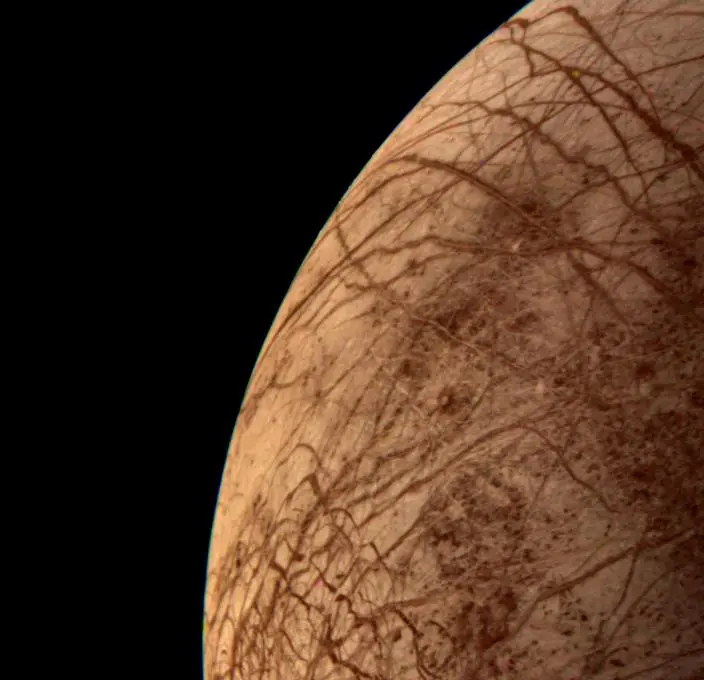
Color image of the Jovian moon Europa acquired by the Voyager 2 spacecraft during its close approach on July 9, 1979. The complex array of striations indicates that the crust has been fractured and filled with materials from the interior. (Photo Credit: NASA/JPL-Caltech)
Ganymede is the largest moon in the Solar System, even larger than Mercury. It’s considered unusual because it possesses its own magnetic field, likely generated by a liquid iron core. This magnetic field creates a small magnetosphere embedded within Jupiter’s much stronger one. Ganymede’s surface features a combination of older, heavily cratered regions and younger, grooved terrains, indicating a complex geological history. Additionally, evidence points to the existence of a subsurface ocean beneath its icy crust, possibly layered between layers of ice, which adds to its importance in studies of moon formation, internal structures, and magnetic field generation beyond planets.
Callisto, the outermost of the Galilean moons, is instead heavily cratered and geologically inactive compared to its siblings. Unlike its siblings, Callisto experiences minimal tidal heating due to its distance from Jupiter, making it less geologically active. Thus, its ancient surface preserves a record of impacts that date back billions of years. It may also have a subsurface ocean, but its distance from Jupiter’s tidal forces makes that less likely. Its stability and location away from the planet’s radiation belts make it a potential candidate for future human exploration.
Smaller Moons
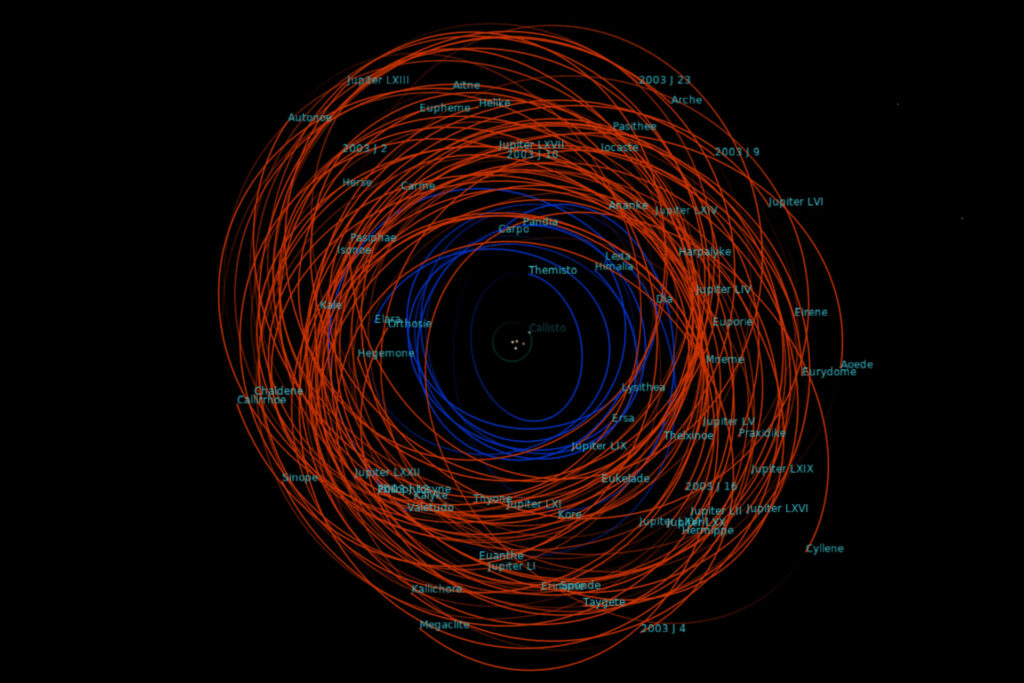
This chart shows the orbits of Jupiter’s 71 outer irregular satellites (as of Jan 2021) colored by direction: prograde in blue, retrograde in red, and the lost S/2003 J 10 in dark red. Callisto’s orbit (dark green) is shown for scale. (Photo Credit: Wikimedia Commons)
Jupiter also hosts a large number of smaller moons, many of which are irregularly shaped and believed to be captured asteroids from the early Solar System. Studying these moons provides valuable insights into Jupiter’s immense gravitational influence, the planet’s formation, and the dynamical history of the Solar System. Some of these moons, such as Amalthea, Metis, and Adrastea, actively contribute dust and debris to Jupiter’s faint ring system, helping us understand the interactions between moons and planetary rings. Others, like Thebe and Himalia, reveal the diversity of orbital patterns and compositions among Jupiter’s satellites.
Due to their small size, distant orbits, and faintness, many of these moons are difficult to observe, but advances in telescope technology and space missions continue to uncover new information, complementing our knowledge gained from the more prominent Galilean moons.
Missions to Jupiter
If mythology has taught us anything, it’s that Jupiter lives up to its name, constantly surprising us with its complexity. The exploration of this gas giant has been a central goal of space science, with multiple missions offering invaluable insights.
Pioneer 10 and 11, launched in 1972 and 1973 respectively, were the first spacecraft to venture into the outer Solar System. Pioneer 10 became the first to fly past Jupiter, go through the asteroid belt, and use all-nuclear electrical power. During its closest approach on December 4, 1973, it passed 81,000 miles from Jupiter, capturing detailed images of the planet and its moons, including Ganymede, Europa, and Callisto, and measuring Jupiter’s magnetic field and atmosphere. Originally designed for a 21-month mission, Pioneer 10 far exceeded expectations, sending its last signal from 7.6 billion miles away in January 2003 and continuing to provide valuable insights into the Solar System and interstellar space.
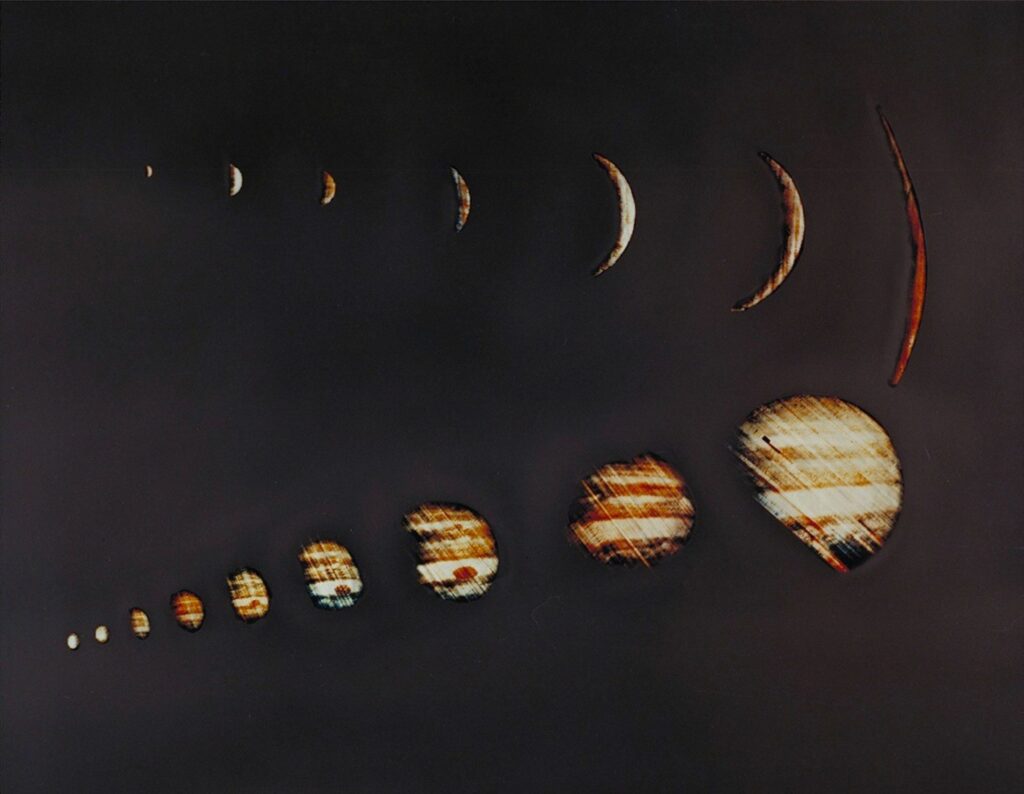
This sequence of images shows Jupiter captured by NASA’s Pioneer 10 spacecraft on December 4, 1973, as it approached and then passed behind the planet. (Photo Credit: NASA)
Pioneer 11, launched by NASA on April 6, 1973, flew past Jupiter on December 3, 1974, coming three times closer than its sister spacecraft Pioneer 10. It travelled at over 106,000 miles per hour and captured detailed images of the planet, including the Great Red Spot, and about 200 pictures of its moons. The spacecraft studied Jupiter’s magnetic field, bow shock, and atmosphere, revealing how the magnetosphere interacts with the solar wind. Using Jupiter’s gravity, Pioneer 11 was then slingshot toward Saturn, continuing its historic journey through the outer Solar System while contact ended in 1995.
Later, Voyager 1 and 2 conducted detailed flybys of Jupiter in 1979, capturing high-resolution images of the planet’s intricate cloud bands, massive storms, and the Great Red Spot with unprecedented clarity. These missions revealed active volcanism on Io, making it the most geologically active body in the Solar System, and provided insights into the icy surfaces and subsurface oceans of Europa, Ganymede, and Callisto.
The spacecraft also discovered Jupiter’s thin ring system and examined its composition, while providing the first close-up measurements of the planet’s powerful magnetic field, intense radiation belts, and charged particle environment. Voyager’s observations of auroras near Jupiter’s poles and the interactions between the planet’s magnetosphere and its moons greatly expanded our understanding of Jupiter’s complex system, laying the groundwork for future missions like Galileo, Juno, and the upcoming Europa Clipper.
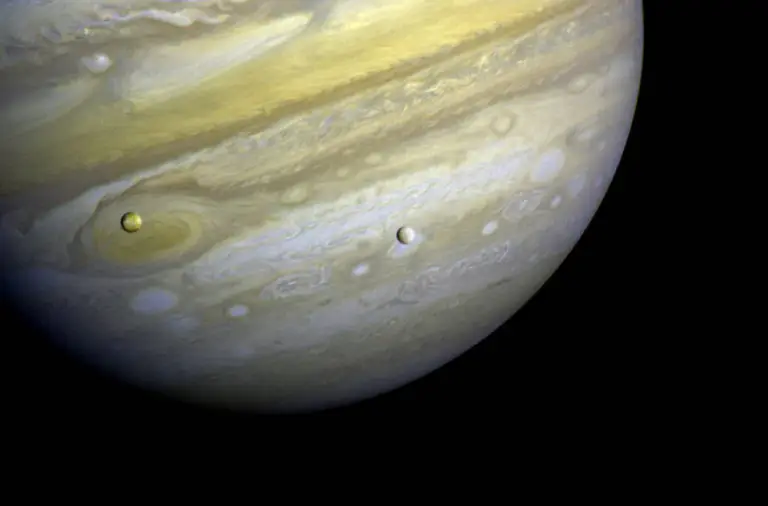
An image of Jupiter captured by Voyager 1, showcasing the swirling clouds of the Great Red Spot, with Io on the left and Europa transiting in front of the planet. (Photo Credit: NASA)
Later, Galileo, launched in 1989, further expanded this knowledge by becoming the first spacecraft to orbit Jupiter, delivering in-depth data on its atmosphere, magnetic field, and the Galilean moons. It confirmed the existence of a subsurface ocean beneath Europa’s ice, documented detailed volcanic eruptions on Io, and revealed that Ganymede possesses its own intrinsic magnetic field.
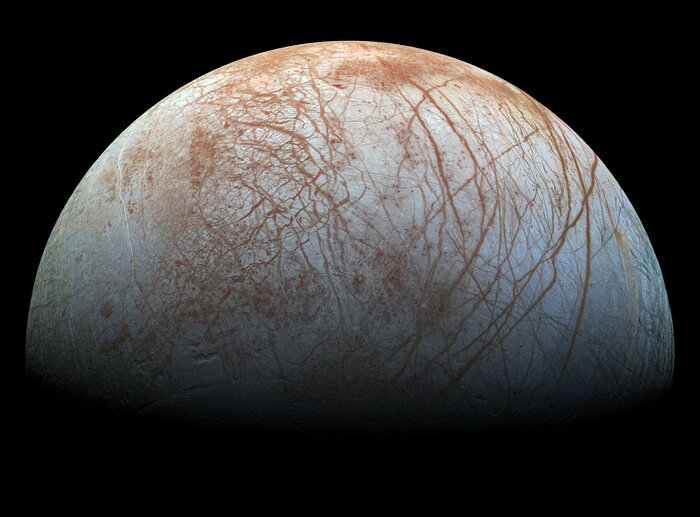
This reprocessed color view of Jupiter’s moon Europa was created from images captured by NASA’s Galileo spacecraft in the late 1990. (Photo Credit: NASA)
Another two that came close to the gas giant were Cassini, a spacecraft traveling to Saturn in 2000 that captured high-resolution images of the planet’s atmosphere, and New Horizons, a spacecraft bound for Pluto in 2007 that used Jupiter’s gravity to gain speed and, at the same time, observed volcanic plumes on Io, refining our knowledge of the planet’s rings and magnetosphere.
Building on these foundations, NASA’s Juno mission, in orbit since 2016, has provided unique perspectives by tracing a polar trajectory. Juno has revealed the depth of atmospheric jet streams, studied the internal structure of the Great Red Spot, and mapped Jupiter’s magnetic field with great precision, offering insights into processes hidden beneath the cloud tops.
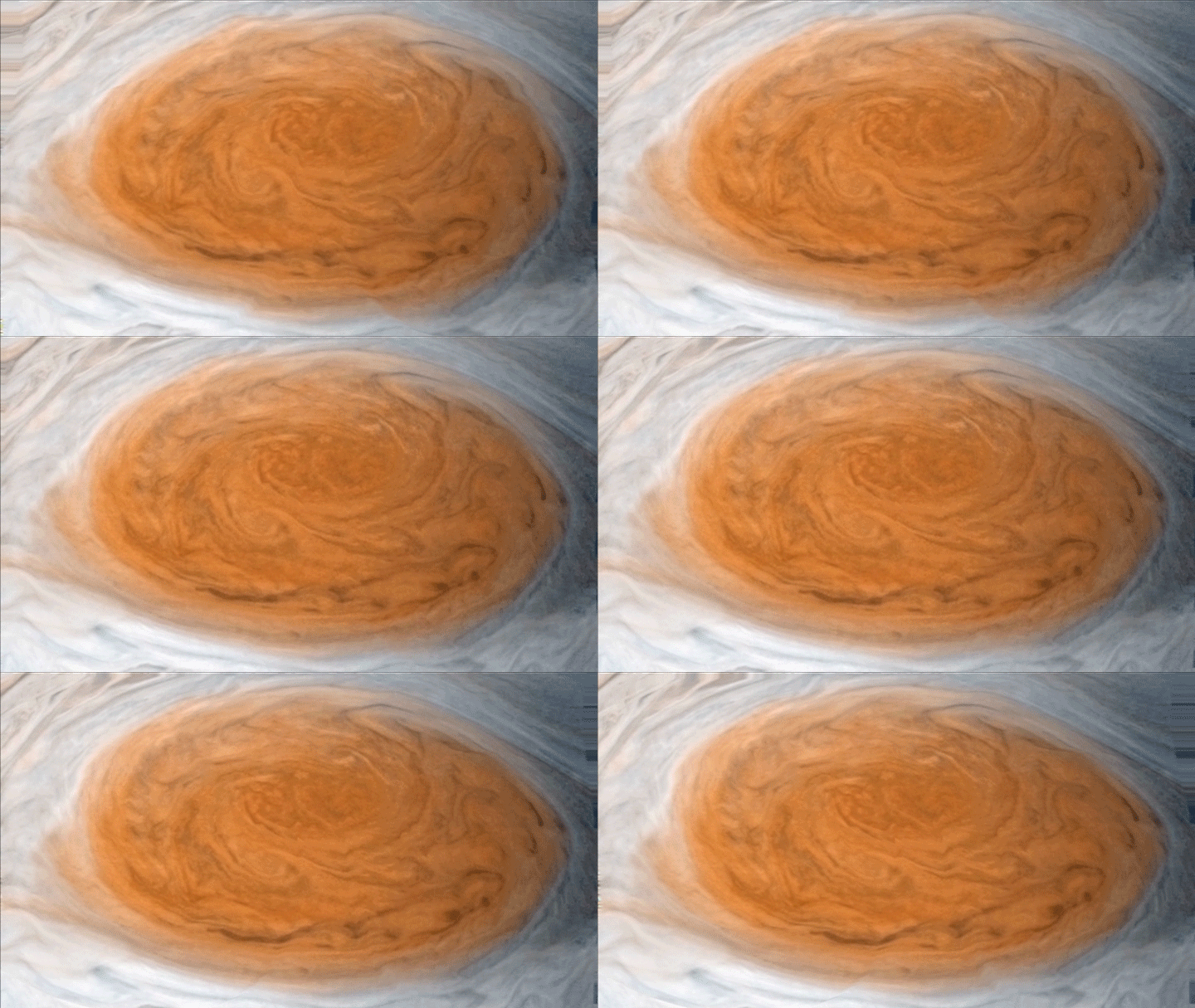
This animation, made using a wind movement model to Juno Images, shows the motion of the clouds in Jupiter’s Great Red Spot. (Photo Credit: NASA)
Looking to the future, the European Space Agency’s JUICE (Jupiter Icy Moons Explorer) mission, launched in 2023, is set to arrive in the early 2030s. It will shift the focus from Jupiter itself to Ganymede, Europa, and Callisto, investigating their icy shells and subsurface oceans. By orbiting Ganymede directly, JUICE will mark the first time a spacecraft has orbited a moon other than Earth’s, representing a new chapter in the exploration of the Jovian system.
Meanwhile, NASA launched the Europa Clipper mission on October 14, 2024, which is set to arrive in the early 2030s. Equipped with a variety of instruments designed to penetrate ice using radar, this spacecraft will conduct multiple flybys of Europa, one of Jupiter’s moons, to determine the thickness of its ice, study the composition of its surface, and assess its potential habitability. The mission’s findings are expected to significantly enhance our understanding of icy worlds and their ability to support life.
Conclusion
Jupiter is both a scientific marvel and a historical symbol. Its immense size makes it a natural laboratory for studying planetary cycles on a scale far beyond that of Earth. This globe is not only the largest in the Solar System; it’s also crucial in our quest to understand how planetary systems form, evolve, and whether life might exist beyond our own.
Its gravitational force has shaped our Solar System, and its moons may hold answers to one of humanity’s most profound questions. As exploration continues, Jupiter will remain a beacon of discovery, reminding us that the mysteries of the cosmos are vast, interconnected, and endlessly exciting.