
A Look Into Artemis II and Humanity's Return to the Moon
This article explores NASA's Artemis II mission, the first crewed flight beyond low Earth orbit in over 50 years, covering the SLS rocket, Orion spacecraft, crew milestones, and what it means for future lunar landings and Mars exploration.
History
Astronomy
NASA
History
A Look Into Artemis II and Humanity's Return to the Moon
13 Min Read
Introduction
The success of the Artemis II mission represented a turning point in human history as we know it, marking the first time in over half a century of travel beyond low Earth orbit. Although the mission itself consisted of an extraordinary voyage around the Moon, its significance stems from years of development, testing, and complex engineering required to safely transport a crew through deep space.
Artemis II confirmed the Space Launch System (SLS) and the Orion Multi-Purpose Crew Vehicle (MPCV) spacecraft as the primary vehicles for humanity’s return to the lunar surface and, eventually, to Mars.
During the mission, the Orion spacecraft and its crew, composed of Commander Reid Wiseman, Pilot Victor Glover, and Mission Specialists Christina Koch and Jeremy Hansen, flew by the far side of the Moon, returning to Earth after a nearly ten-day journey. An undertaking that confirmed the enormous responsibility of the crew and bore fruit with extraordinary results, presented to the eyes of the entire world.
From Artemis I to System Validation
The path to the resounding success of Artemis II was paved by the previous mission, Artemis I, launched in late 2022. This expedition, though uncrewed, served as a test for the entire integrated flight system, pushing the Orion capsule to its thermal limits during a twenty-five-day voyage.
During the first mission, engineers monitored how well the spacecraft could handle the intense radiation of the Van Allen radiation belts and the scorching heat of a high-velocity reentry from lunar distance. Data collected by hundreds of sensors aboard Orion provided the necessary assurance that the life support systems, though not fully activated during the first flight, were capable of maintaining a habitable environment for a human crew.
Preparation for Artemis II involved an exhaustive series of ground validations, including the Green Run test series at Stennis Space Center, where the SLS core stage was docked to a massive test stand and fired for a full eight minutes. This approach allowed engineers to observe the behavior of the propellant tanks, fuel lines, and avionics under launch stresses.
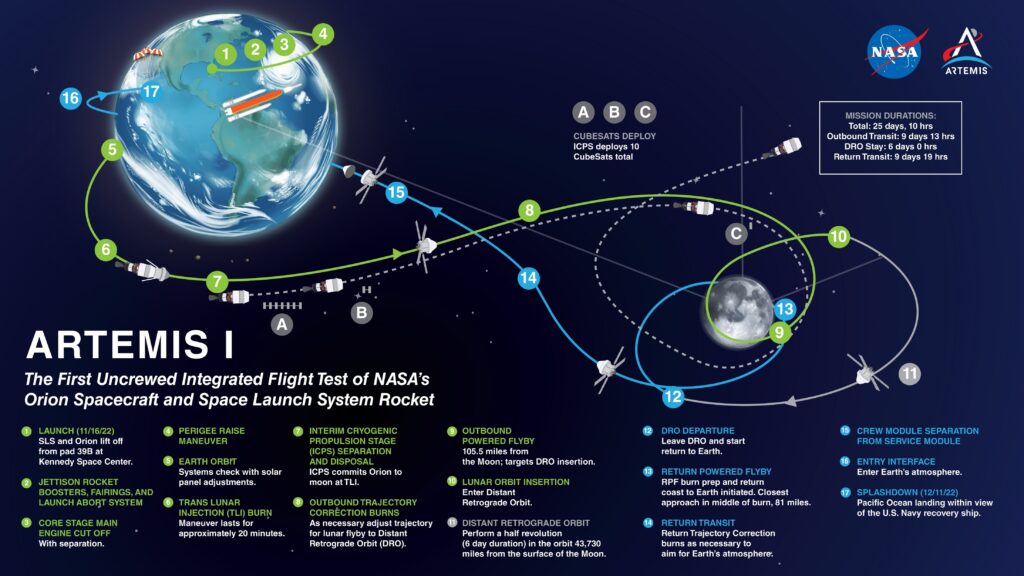
This infographic illustrating the complete flight path of Artemis I, the first uncrewed integrated test flight of NASA’s Orion spacecraft and Space Launch System (SLS) rocket. (Image Credit: NASA)
RS-25 as a Breakthrough in Technology
To meet the requirements of a lunar mission, NASA engineers had to redesign and adapt several key technologies originally optimized for low-Earth orbit.
The pioneers of this evolution are undoubtedly the RS-25 main engines and solid-fuel booster rockets. While these components share an apparent similarity with the Shuttle, their internal architecture and performance have been significantly improved to support the highest loads ever required in the history of the National Aeronautics and Space Administration.
The RS-25 engines that powered the Shuttle were designed to be reusable and were maintained between flights. To operate at a higher thrust level in the SLS, they were modified from 104.5% of the original design thrust to 109% for both Artemis missions. This increase was necessary to lift the massive core stage and the Orion spacecraft, counteracting Earth’s gravitational pull.
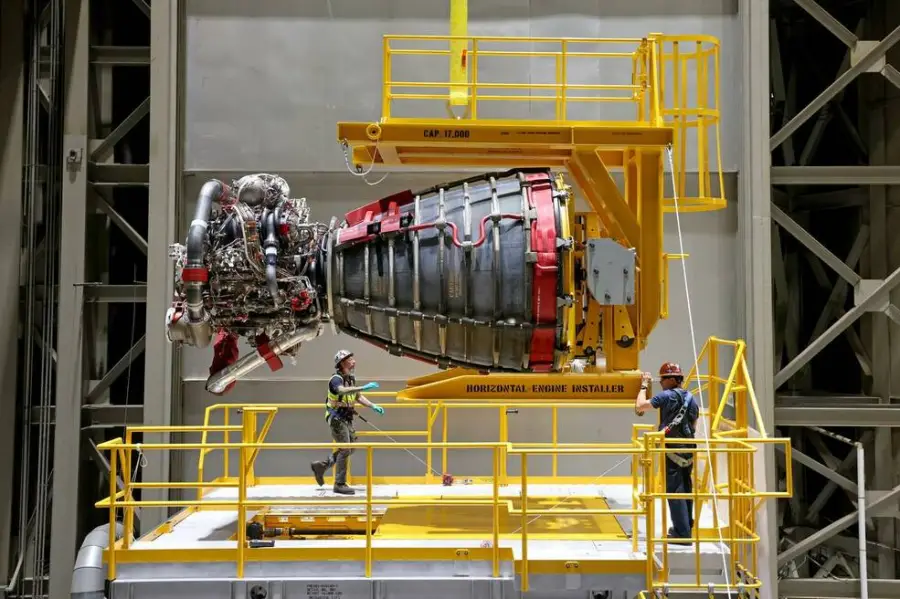
Technicians at NASA’s Michoud Assembly Facility in New Orleans who worked to attach the first of four RS-25 engines to the core stage of the SLS (Space Launch System) rocket for the Artemis I mission to the Moon. (Photo Credit: Wikimedia Commons)
This increase was necessary to lift the massive core stage and the Orion spacecraft, counteracting Earth’s gravitational pull. Furthermore, the engines had to be adapted for single, high-performance use, requiring new insulation and cooling configurations to handle the more intense thermal environment created by the proximity of the solid-propellant boosters.
The “brains” of the propulsion system are represented by the engine control systems, which were also completely modernized with advanced digital avionics, offering greater processing speed and reliability than the analog frameworks used in the 1980s.
Engineers and researchers are constantly striving for improvement, and this has led to a transformation in solid-propellant boosters as well. The Space Shuttle was accustomed to using four-segment boosters, but for the SLS, a fifth propellant segment was added to each engine. This additional element provided the thrust needed to propel the larger vehicle through the denser layers of the atmosphere.
The propellant shape was redesigned to create a more uniform thrust curve, reducing vibrations during the first two minutes of flight. These upgrades balanced proven hardware with modern modifications for future exploration.
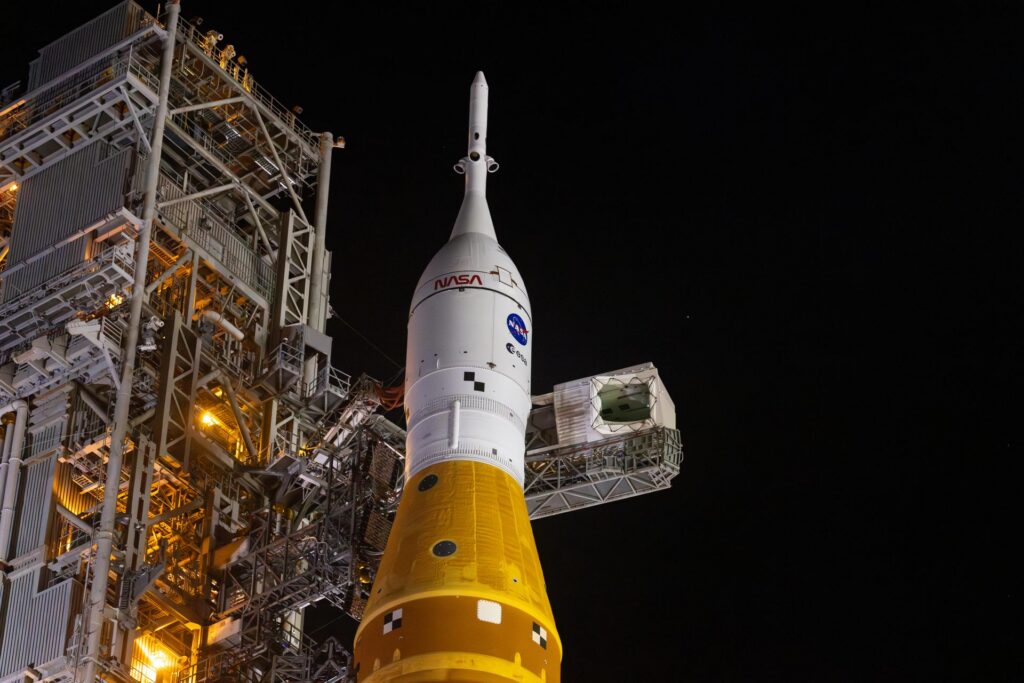
A closeup view of the Orion spacecraft with the launch abort system atop secured to NASA’s crawler-transporter 2. (Image Credit: NASA)
The rocket’s main component is the “Core Stage,” over sixty meters tall, which stores liquid hydrogen and oxygen to power four RS-25 engines. Two five-segment solid rocket boosters provide most of the thrust at liftoff and are jettisoned after their fuel is exhausted, followed later by the Core Stage once the upper stage reaches a temporary parking orbit.
The upper stage of the rocket consists of the Interim Cryogenic Propulsion Stage and the Orion spacecraft. The upper stage is responsible for the Trans-Lunar Injection maneuver, which pushes Orion out of Earth orbit and toward the moon.
The spacecraft in question is divided into the Crew Module, where the astronauts live and work, and the Service Module, provided by the European Space Agency (ESA), which contains the propulsion, power, and life-support systems.
Completing the entire structure is the Launch Abort System, a powerful rocket tower designed to safely remove the crew capsule from the launch vehicle in the event of an emergency during the early stages of flight.
The Artemis Crew
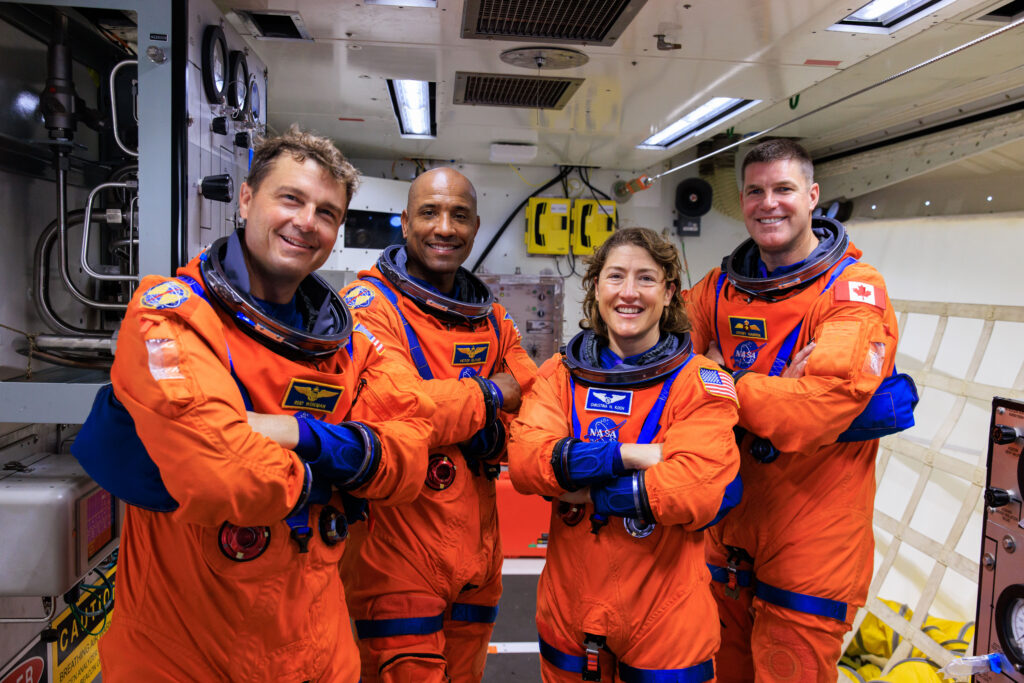
Artemis II NASA astronauts Reid Wiseman, Victor Glover, and Christina Koch, together with Canadian Space Agency astronaut Jeremy Hansen, stand inside the white room on the crew access arm of the mobile launcher at Launch Pad 39B. (Photo Credit: NASA)
However, we cannot discuss the technical aspects of the mission without mentioning the people who experienced it firsthand. The crew selected for Artemis II represents a highly qualified group of industry professionals who, with their strong passion and curiosity for discovery, carry on the legacy of 20th-century lunar exploration.
Commander Reid Wiseman, a veteran of the International Space Station, managed to calibrate every aspect of the journey with great responsibility, never backing down. He led the expedition with particular attention to technical precision and operational safety.
At his side, Pilot Victor Glover made history as the first Black person to travel beyond low Earth orbit, transforming every moment of the flight into a symbol of progress and courage. A seasoned NASA astronaut and Navy test pilot who previously flew aboard the SpaceX Crew Dragon on the Crew-1 mission, he guided his ship with the calm of one who never gives up on anything, not even the unknown.
The next highlight was Mission Specialist Christina Koch, holder of the record for the longest single spaceflight by a woman, another unparalleled achievement. She played a key role as a researcher during the transit, applying her scientific expertise to the various experiments conducted aboard the spacecraft.

Artemis II Mission Specialist Christina Koch gazes at Earth through the Orion spacecraft window en-route to the Moon, farther from our planet than any woman in history. (Photo Credit: NASA)
Finally, a significant milestone for international cooperation was the inclusion of Mission Specialist Jeremy Hansen of the Canadian Space Agency, as the first Canadian citizen to travel near the Moon. His participation embraced the global essence of the Artemis program and served as a vital link between international partners.
Each crew member brought a unique set of skills and large-scale experience to the mission, representing the human heart of a technological undertaking. Their presence aboard Orion transformed the mission from a structured test to a human journey, inspiring young scientists and explorers who followed its progress from Earth.
Mission Milestones
Artemis II lifted off from Launch Complex 39B at NASA’s Kennedy Space Center at 6:35 p.m. EDT on April 1, 2026, beginning a nearly ten-day voyage that would carry the crew farther than any humans had ever traveled. The astronauts named their Orion spacecraft “Integrity,” a fitting tribute to a mission built on decades of careful engineering and trust.
After reaching orbit, the crew performed a proximity operations demonstration, using the spent upper stage as a visual target to test Orion’s manual handling. This rehearsal of rendezvous and docking techniques will prove essential for future Artemis missions involving commercial lunar landers.
The mission then escalated to its defining maneuver, the translunar injection (TLI) burn, which propelled Orion out of Earth’s orbit and onto a free-return trajectory toward the Moon. This propulsive tactic transitions a spacecraft into a lunar transfer trajectory by firing engines to maximize the Oberth effect, in which the craft gains enough velocity to escape Earth’s gravity and travel to the Moon. The trajectory was chosen for its inherent safety, because if the spacecraft’s main engine had failed, lunar gravity alone would naturally pull Orion back toward Earth for a safe reentry.

"Earthset" captured through the Orion spacecraft window on April 6, 2026, as the Artemis II crew swept behind the far side of the Moon, echoing the iconic "Earthrise" photo taken by the Apollo 8 astronauts in 1968. (Image Credit: NASA)
On April 6, the crew swept around the far side of the Moon during a seven-hour flyby, briefly losing all radio contact with Earth in a silence not experienced by a human crew since the Apollo program. At their farthest point, the astronauts traveled 252,756 miles from Earth, setting a new record for the greatest distance humans have ever ventured into space.
The crew also became among the first humans to lay eyes on previously unseen lunar terrain near the Orientale basin, and during the flyby they proposed names for two small craters they spotted there. The first, Integrity, honors the Orion spacecraft that carried them. The second, Carroll, is a deeply personal tribute to Carroll Taylor Wiseman, Commander Reid Wiseman’s late wife who passed away from cancer in 2020. Mission Specialist Jeremy Hansen radioed the proposal to Houston with audible emotion, surrounded by the crew, in one of the most moving moments of the mission.
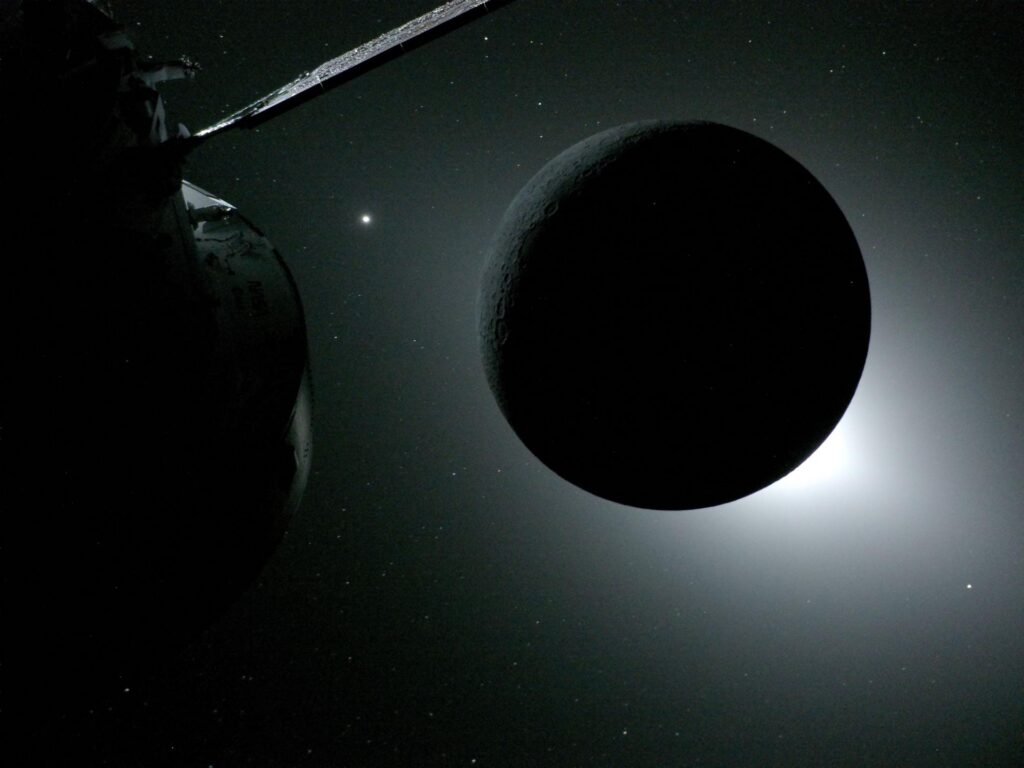
The Moon eclipses the Sun in this view captured by the Artemis II crew during their lunar flyby on April 6, 2026, with Orion in the foreground and Venus glimmering nearby. (Image Credit: NASA)
Beyond the visual spectacle, the crew carried out a rigorous program of testing and science. They evaluated Orion’s life-support systems in the high-radiation environment of deep space, monitored carbon dioxide buildup, and verified that thermoregulation kept the cabin habitable. They supported scientific investigations such as the AVATAR study, which examines how human tissue responds to microgravity and deep-space radiation, and even held a historic space-to-space call with the Expedition 74 crew aboard the International Space Station.
Not everything went perfectly. The Universal Waste Management System, more plainly known as the space toilet, required workarounds in microgravity, and a valve on the service module flagged itself for a redesign before Artemis III flies.
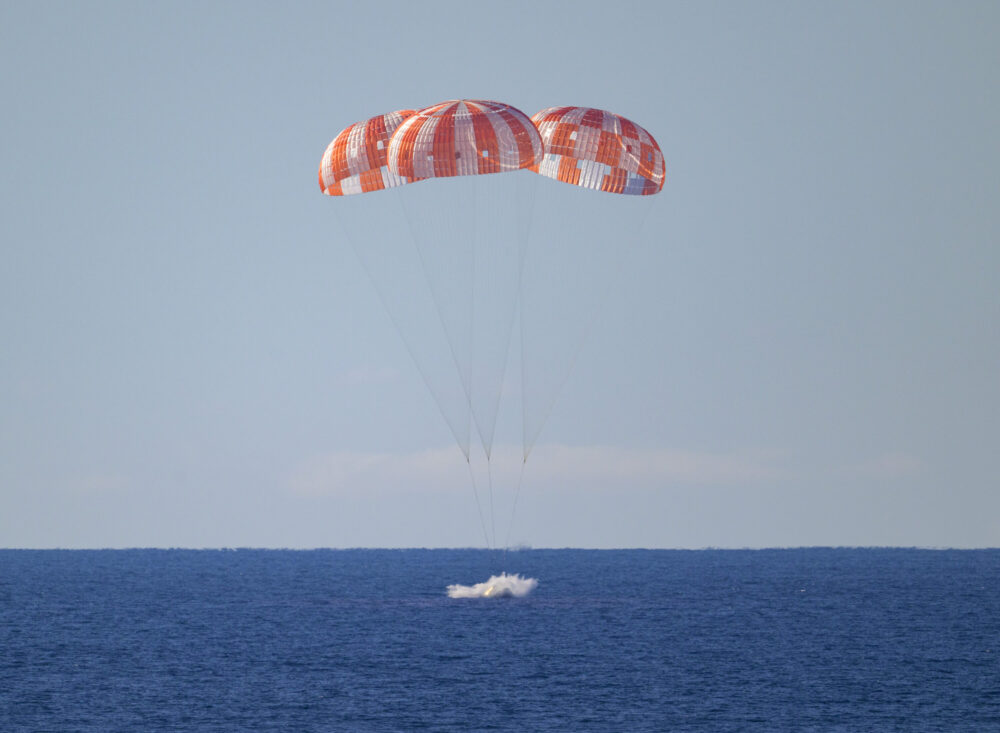
he Orion spacecraft, named Integrity, splashes down in the Pacific Ocean off the coast of San Diego at 8:07 p.m. EDT on April 10, 2026, safely returning the Artemis II crew home after their historic lunar voyage. (Image Credit: NASA)
The mission concluded with a high-speed skip reentry into Earth’s atmosphere at nearly 24,000 miles per hour, where the heat shield endured temperatures approaching 5,000 degrees Fahrenheit. Orion splashed down in the Pacific Ocean off the coast of San Diego at 8:07 p.m. EDT on April 10, 2026, where recovery teams aboard the USS John P. Murtha retrieved the crew. The successful return demonstrated that the Orion capsule could protect its human cargo through the most violent phase of the journey, clearing the path for the next steps of the Artemis program.
A Vision for the Future of Exploration
The achievement of the Artemis II lunar mission was seen by all as a lifeline and a beacon of hope for a future human presence in Earth’s space.
This achievement was vitally important because it paved the way for the Artemis III mission, which aims to test integrated operations between the Orion spacecraft and commercially built Moon landers, bringing humanity one step closer to returning astronauts to the lunar surface. By learning to utilize lunar resources and developing long-term life-support technologies, humanity is preparing for the future journey to Mars and beyond. The Moon has thus become a testing ground and a gateway to the stars.
Looking to the future, the Artemis program marked a shift in how we perceive our place in the universe, fostering an era of international and commercial collaboration that will drive innovation in propulsion, robotics, and medicine.
The pursuit of space exploration is a fundamental quest for understanding ourselves and our origins. As we push beyond the Moon, we carry with us the lessons learned from Artemis II, building a future where space travel and the boundaries of human knowledge will be pushed ever further. The journey that began with a nearly ten-day flight around the Moon is the first step in a permanent expansion toward the final frontier