Space. Rockets. Science. These three words often ring through our minds as children, and for many, remain at the center of our imagination even as adults. They evoke a sense of wonder, curiosity, and endless possibility—and they all lead to one name: NASA. The National Aeronautics and Space Administration, better known as NASA, is the independent U.S. federal agency that has been at the forefront of space exploration and aeronautics research for decades. From launching rockets to exploring the farthest reaches of our universe, NASA is the go-to destination for those who dream of venturing beyond Earth’s atmosphere. For anyone with a passion for space, like myself, NASA represents the pinnacle of innovation, discovery, and the boundless potential that lies in the cosmos.
Inventions
You would think that NASA's groundbreaking work would stay confined to the realms of space, where stars, black holes, and distant planets reign supreme. But here's the twist: NASA's innovations have a funny way of sneaking back down to Earth, popping up in places you’d never expect. Like, say, in a hospital room. Imagine this: you’re lying there, getting prepped for an MRI scan. As the technician slides you into the tunnel, you might not realize it, but you’re about to experience a piece of space-age technology firsthand. That’s right—NASA’s legacy isn’t just in the stars; it’s also in the science that preserves your health on the ground.
How does a space agency known for sending astronauts into orbit end up contributing to your medical check-up? It all begins with superconducting magnets, essential for MRI machines to generate highly detailed images of the human body. The connection to space exploration dates back to the 1960s and 1970s, during the height of NASA's Apollo missions. As NASA pushed the boundaries of space exploration, they made significant advancements in cryogenics—a technology crucial for maintaining extremely low temperatures in the harsh environment of space. NASA's extensive work in perfecting cryogenic systems, initially designed to keep spacecraft components cool during these missions, directly influenced the development of cooling systems used in MRI machines. By the 1980s, these refined cryogenic technologies were being applied in medical imaging, enhancing the performance and reliability of the superconducting magnets that make MRI scans possible.
As NASA worked to keep spacecraft instruments running in the frigid, unforgiving expanse of space, they developed technologies that, with a little adjustment, found a second life in medicine. That’s the beauty of innovation: it rarely remains on a linear path. What starts as a solution for one problem often spirals into applications that transform entirely different fields. So, the next time you’re marveling at an MRI image of your brain, remember that the technology behind it owes a lot to those brilliant minds who’ve been shooting for the stars.
Budget
NASA faces a planet-sized problem, and it's not about tackling cosmic challenges—it's a funding issue originating right here on Earth. Congress's penny-wise but pound-foolish approach to NASA’s budget, releasing only a trickle of funds annually, severely hampers the agency’s ambitious mission goals. This short-term thinking, constrained by the typical two-year House or six-year Senate terms, has repercussions that extend far beyond our planet.
Currently, the Perseverance rover is diligently working on Mars, collecting samples from inside the Jezero Crater, an ancient lakebed that holds great promise for discovering evidence of past life or conditions suitable for life. These samples are securely stored in hermetically sealed cylinders and either kept onboard the rover or deposited on the Martian surface, awaiting retrieval by a future mission. However, that future mission is still in the conceptual phase, and its timeline remains uncertain.
An independent review board in September 2022 found a “near-zero probability”—essentially, no chance—that the Mars Sample Return (MSR) mission will be ready for launch by 2028. Meeting a 2030 deadline might be possible, but it would come with a staggering price tag of $10 billion, making it one of NASA’s most expensive science projects ever. Despite this, the MSR is a crucial component of NASA’s plans due to the collection of samples through the rover lowering the cost of a future MSR mission, identifying it as a “highest-priority flagship mission” by the National Research Council’s Planetary Science Decadal Survey for 2013–2022.
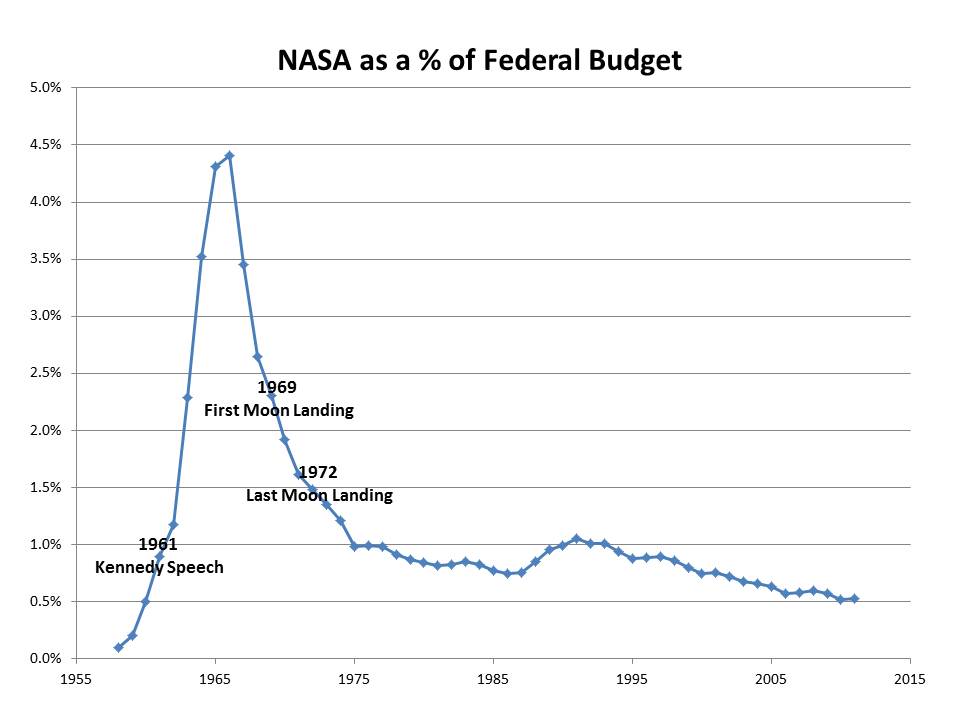
A graph illustrating NASA's annual budget from 1959 to 2022, highlighting the significant initial increase during the Space Race, key funding trends, and their impact on space exploration milestones over the decades. (Photo Credit: Our World In Data)
Following this guidance, NASA designed Perseverance with this exact goal in mind. Now, the challenge is to bring those samples back to Earth, a complex task involving the development of a Mars Ascent Vehicle (MAV) and a lander equipped with sample-carrying helicopters. The 2023 independent review found that the current MSR mission plan cannot be accomplished within the available budget and timeframe, necessitating a complete overhaul. Yet, in the grand scheme of the U.S. federal budget, NASA's allocation of 0.35%—a mere $25 billion out of a total $7.3 trillion—seems almost modest. It’s a far cry from the days when NASA’s budget peaked during the space race between the United States and the Soviet Union, reflecting the era’s prioritization of space exploration as a critical national endeavor. Today, despite its relatively small slice of the budget, reports indicate that one in four Americans believe NASA's funding should be reduced, even though the agency receives significantly less funding compared to military and social programs.
This perspective is reminiscent of our ancestors questioning the value of investing time in agriculture when hunting and gathering already provided sustenance. The crux of the argument is that we often overlook the long-term benefits of certain investments. Consider NASA’s contributions to modern conveniences—did you know that NASA’s research and technological advancements are key reasons why we have GPS systems and advanced airport technology? This isn't common knowledge, yet it underscores the hidden value of such investments.
NASA’s budget was at its highest in 1964-65, consuming roughly 4% of all federal spending at the time. The Apollo program, spurred by President John F. Kennedy’s iconic speech at the Houston Center, was a national priority. This ambitious endeavor consumed half of NASA’s budget, driving a workforce of over 34,000 employees and 375,000 contractors from industry and academia. By 1973, congressional testimony revealed that the total cost of the Apollo Project was approximately $25.4 billion, which, adjusted for inflation, amounts to around $182 billion today.
"We chose to go to the moon. We choose to go to the moon in this decade and do the other things not because they are easy, but because they are hard. " were the words uttered by the late president, John F. Kennedy at the Rice Center in 1962. (Credit: NASA)
Large-scale investments in space exploration may seem costly at first, but their long-term benefits often outweigh the expense. The Apollo program, beyond its Cold War symbolism, sparked breakthroughs in technology, science, and industry. From miniaturized electronics and microchips to satellite TV and telecommunications, its legacy shaped many modern conveniences and launched industries that continue to drive global economic growth today.
Investments during the Apollo era greatly influenced education and workforce development, inspiring a generation of STEM professionals who fueled innovation across industries. Though NASA’s budget today is much smaller, its impact remains strong. Programs like the Mars rovers, Hubble, Artemis, and the James Webb Space Telescope continue to advance science and exploration, proving that even with limited funding, NASA delivers remarkable returns and inspires future discoveries.
What People Think
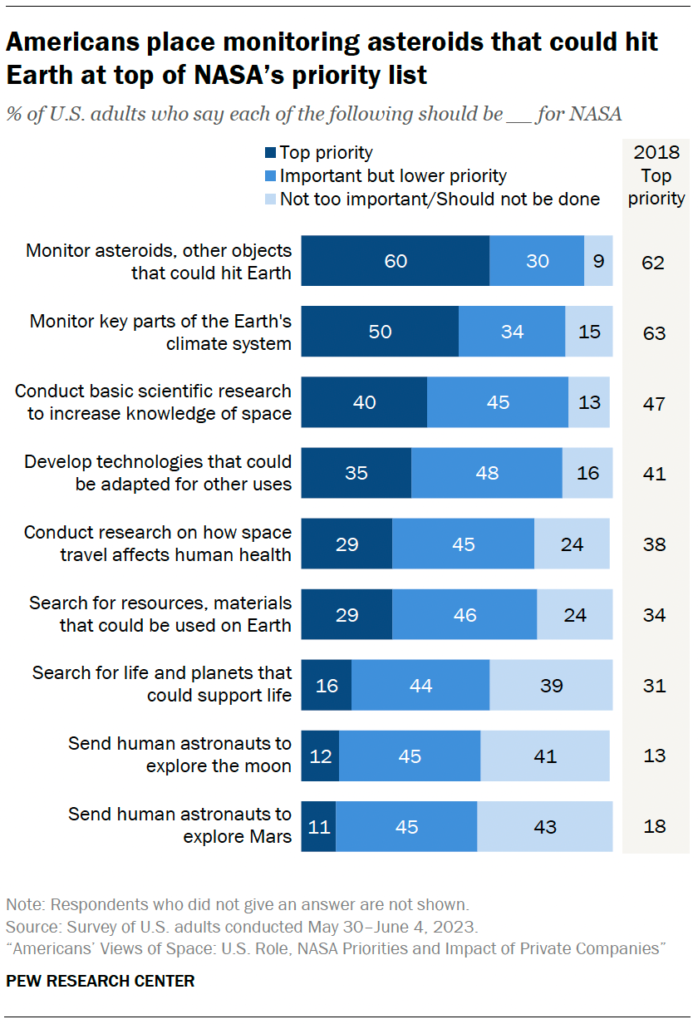
Since NASA's inception, there has been widespread discussion worldwide about what people think of it. If your Uncle Zubair has an interest in space, he will definitely bring up the economic side of the bigger picture—because that's what we, as humans, do. We love to deny things, add mystery to topics, and make them seem more exciting than they already are. This tendency is further illustrated by a 2023 Pew Research Center survey that offers a compelling glimpse into public opinion regarding NASA’s priorities. Conducted with over 10,000 U.S. adults, the survey reveals a clear preference for practical and Earth-centric missions. A significant 60% of respondents believe that monitoring potentially hazardous asteroids should be NASA’s top priority, followed by 50% who emphasize the importance of climate monitoring.
Graph displaying American views on the importance of NASA's different roles in space exploration, examining public priorities and whether these responsibilities should hold such significance in national policy. (Photo Credit: PEW Research Center)
Research on the effects of space travel on human health is a priority for 29% of those surveyed, while only 16% consider the search for extraterrestrial life and habitable planets a top focus. Notably, traditional goals such as Moon and Mars exploration rank much lower, with only 12% and 11% of respondents, respectively, seeing them as top priorities. This shift in public opinion suggests a growing interest in addressing immediate and tangible challenges rather than ambitious exploration. But don’t worry, Uncle Zubair—if they ever find aliens, I’m sure they’ll still ask us to foot the bill! (the joke is that even if NASA were to discover aliens, the public (including Uncle Zubair) would still be expected to pay for it, reflecting the common sentiment that taxpayers often bear the costs of expensive government projects, sometimes for things they might not see as immediately necessary)
Critics of space exploration funding often argue that such money could be better spent addressing pressing issues on Earth, such as poverty, healthcare, and infrastructure. However, this perspective fails to recognize the interconnectedness of space exploration with these very issues. The technologies developed for space exploration often have direct applications on Earth, improving lives in ways that are not always immediately visible. For example, NASA's advancements in satellite technology have revolutionized weather forecasting, disaster response, and environmental monitoring, leading to better preparedness and resilience in the face of natural disasters.
Moreover, the challenges posed by space exploration—such as the need for sustainable life support systems on long-duration missions—drive innovations that can help address global challenges like resource scarcity and environmental sustainability. For instance, NASA’s research into closed-loop life support systems for space habitats has applications in developing more efficient water purification and recycling systems here on Earth, which could prove vital in regions facing water shortages.
The economic impact of NASA’s budget is another often-overlooked aspect. Every dollar spent on NASA generates multiple dollars in economic output, thanks to the agency’s extensive network of contractors, suppliers, and partners. This multiplier effect is particularly pronounced in regions with a strong aerospace presence, where NASA’s investments support local economies and drive job creation. Additionally, NASA’s collaborations with private companies have helped to create a thriving commercial space industry, which is poised to play a key role in the global economy of the future.
Conclusion
As we gaze up at the stars, it’s easy to forget that the remarkable triumphs of space exploration come with a hefty price tag. NASA’s budget is often scrutinized, with critics questioning why billions are spent on exploring the cosmos when there are pressing needs here on Earth. But the truth is, investing in space exploration is investing in our future—and it pays dividends in ways that far outweigh the price. We are a curious species, always wanting to know what is over the next hill, around the next corner, on the next island. And we have been that way for thousands of years.
This is why Space exploration has always inspired us. It pushes the boundaries of what we believe is possible, uniting humanity in the pursuit of knowledge and the shared dream of reaching beyond our earthly confines. This inspiration fuels education, ignites the imaginations of the next generation, and fosters global collaboration. In an era where division seems to be the norm, space exploration reminds us of our common goals and shared destiny. Cutting NASA’s budget might seem like a quick fix in tough economic times, but it’s a short-sighted solution that undermines long-term benefits. More money for NASA isn’t just spending—it’s an investment in our future, our economy, our safety, and our collective human spirit. Author William Burroughs echoes this thought in a few succinct words:
"Man is an artifact designed for space travel. He is not designed to remain in his present biological state any more than a tadpole is designed to remain a tadpole."