Early Life
James Arthur Lovell Jr, born on March 25, 1928, in Cleveland, Ohio, is best known for his remarkable career as a NASA astronaut, but his fascination for aeronautics began long before his time in space. Growing up, Lovell developed an interest in rocketry, often building homemade rockets as a teen. Famously, one of his early creations flew up to eighty feet before exploding, setting the stage for his ultimate recruitment into NASA.
James was inducted into the Navy after graduating from the US Naval Academy in Maryland in 1952, where he was part of the famous F4H ‘Phantom’ program, a precursor to the more famous F-4 Phantom II. Over the course of his military career, Lovell logged over six thousand hours of flying time, a testament to his skill, determination, and experience in high-performance flight. He quickly rose through the Navy ranks and ultimately became a flight instructor, passing on his expertise and experience to other, young, naval aviators. It was during this period that NASA recognized his unique combination of technical skill, leadership, and operational experience. Thus, in 1962, Lovell was selected to be part of NASA’s second group of astronauts, a batch that would ultimately have the honour of hosting accomplished astronauts like Lovell, Armstrong, Aldrin, and Collins.
Lovell wasn't accepted into the U.S. Naval Academy on his first attempt; he initially studied engineering under Navy programs at the University of Wisconsin before succeeding later. During this period, he focused on rocket technology, even building and testing small rockets, which reflected his early passion for spaceflight.
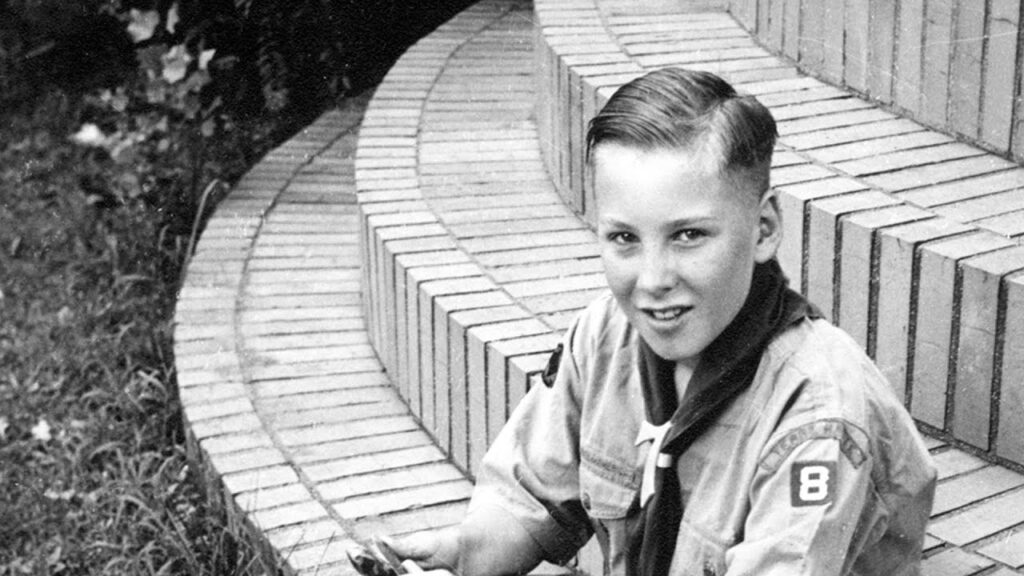
A photo of Jim Lovell as a child shows him sitting on steps outdoors
in a Boy Scouts uniform with the number "8" patch on his sleeve. (Photo Credit: Adler Planetarium)
NASA Career
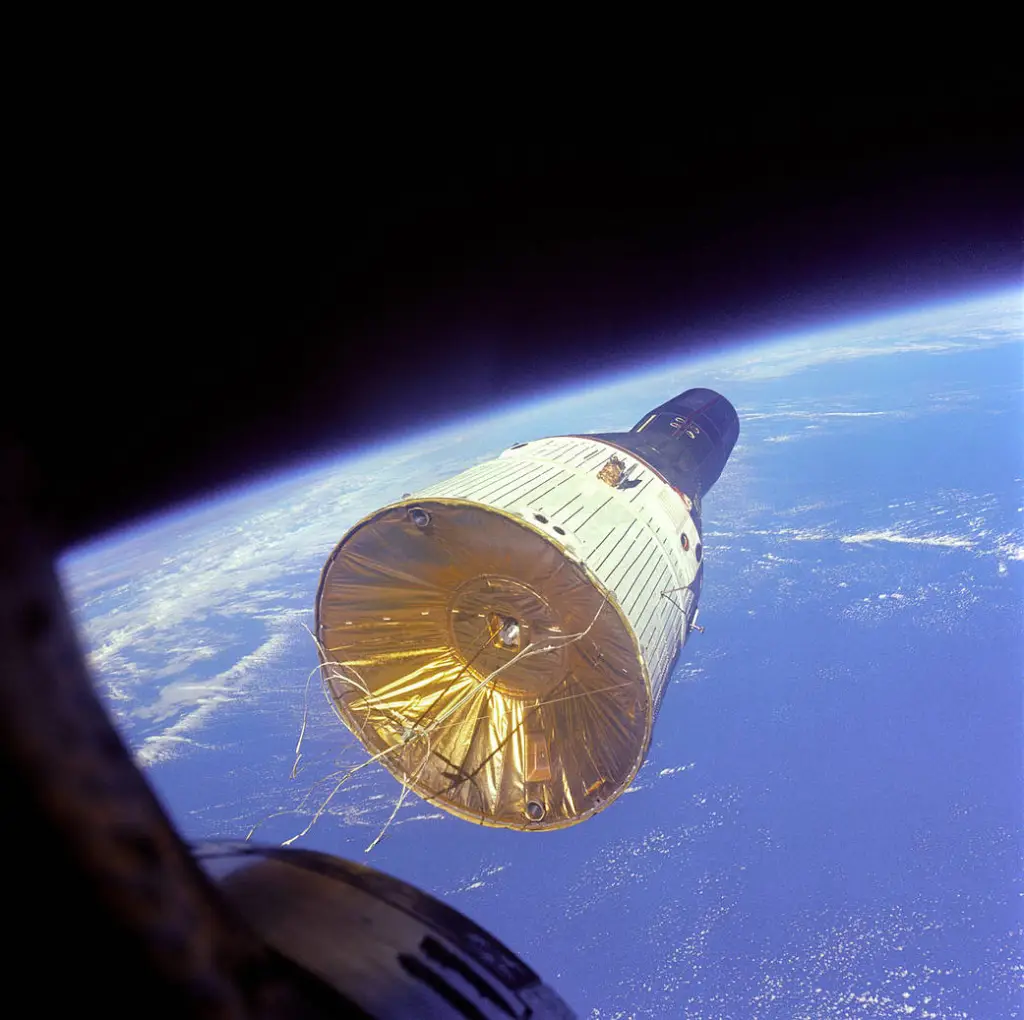
Before embarking on his first journey to space aboard Gemini 7, Lovell had to undergo intense training as the mission was designed as a 14-day endurance flight, the longest human spaceflight attempted up to that point. Pilot James Lovell and Command Pilot Frank Borman lifted off aboard a Titan II rocket from LC-19 at the Kennedy Space Center on December 4, 1965. The flight had two main objectives: to test and validate life support systems capable of sustaining astronauts for two weeks in space, and to perform the first crewed close-rendezvous with Gemini 6A, launched 11 days later. The rendezvous successfully demonstrated precise orbital maneuvering, a technique that would later prove essential for Apollo’s lunar landings.
Over the course of the mission, Lovell and Borman endured cramped conditions in the small capsule, with limited mobility and no ability to change out of their spacesuits, making it a true test of human endurance in space. At its closest approach, Gemini 7 and Gemini 6A came within just one foot of each other and flew in formation for over five hours, matching speed and orbit with remarkable precision. After 13 days and 18 hours in orbit, completing 206 revolutions around Earth, Gemini 7 splashed down safely in the Atlantic Ocean on December 18, 1965.
A picture taken aboard Gemini 7 shows Gemini 6A in orbit 257 km above Earth, capturing the historic moment of the first crewed rendezvous in space. (Photo Credit: NASA)
The following year, Lovell flew his second mission aboard Gemini 12, the final flight of the Gemini program, alongside astronaut Buzz Aldrin, who would later become the second man to walk on the Moon. Launching from LC-19 on November 11, 1966, the four-day mission focused on extravehicular activity, with Aldrin performing three successful spacewalks to test techniques for working outside a spacecraft, photographing star fields, retrieving a micrometeorite collector, and completing other tasks. The crew also executed a docking with an Agena Target Vehicle, solidifying rendezvous and docking as reliable procedures. By the end of the Gemini program, Lovell had logged more than 18 days in space—at the time, more than any other American astronaut.
The Apollo Program
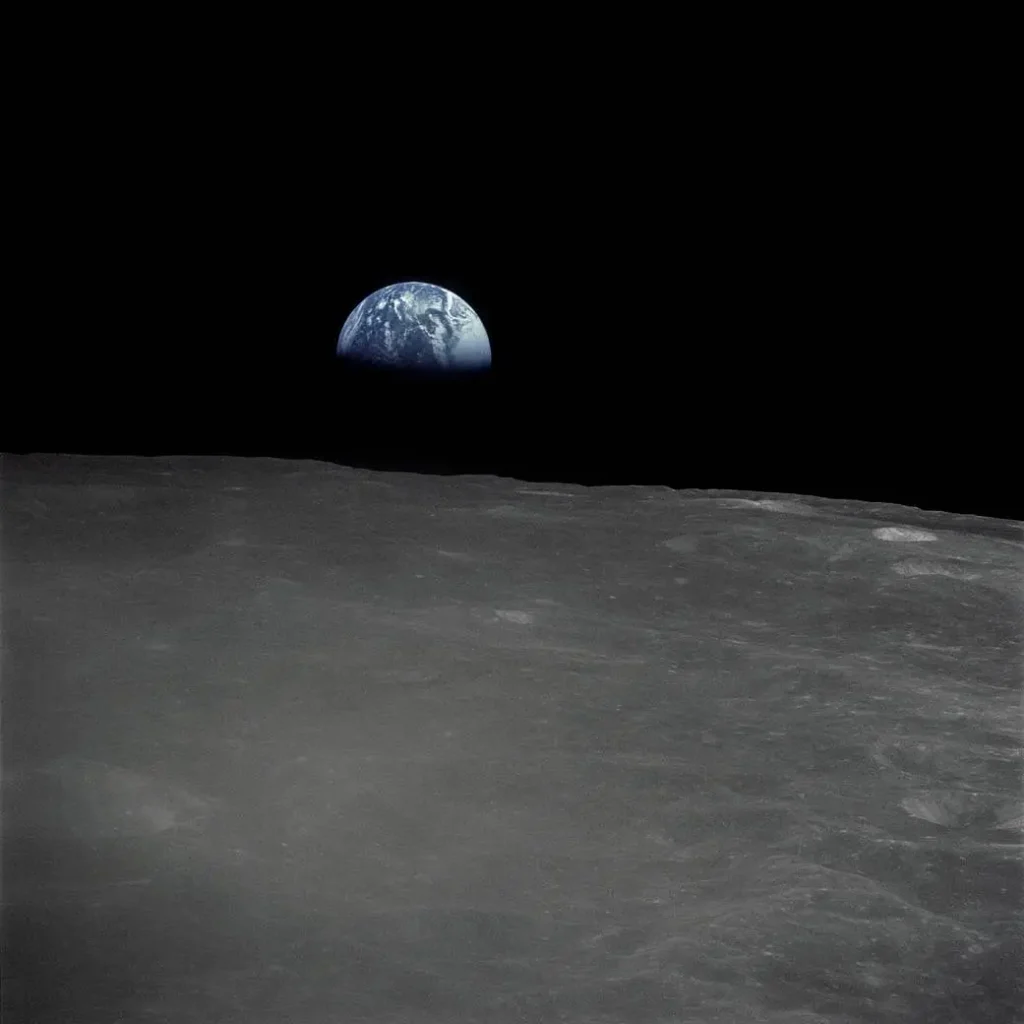
At the dawn of the Apollo program, James Lovell was originally slated to command Apollo 14, but crew reshuffles after the tragic Apollo 1 fire led to him serving as part of the backup crew for Apollo 9. When Michael Collins stepped down for surgery, Lovell was reassigned as Command Module Pilot aboard Apollo 8. Alongside Commander Frank Borman and Lunar Module Pilot Bill Anders, he launched on December 21, 1968, aboard the Saturn V. Apollo 8 became the first crewed spacecraft to leave Earth’s orbit and enter the Moon’s sphere of influence, completing ten lunar orbits. The mission is remembered for its historic Christmas Eve broadcast, where the crew read the first verses of Genesis, as well as the iconic "Earthrise" photograph taken while orbiting the Moon. After more than six days in space, Apollo 8 splashed down safely in the Pacific Ocean on December 27, 1968.
The famous “Earthrise” photograph, taken by astronaut William Anders during Apollo 8, shows Earth rising above the Moon’s horizon. It was captured while orbiting the far side of the Moon, the hemisphere not visible from Earth. (Image Credit: NASA)
Apollo 8’s success paved the way for Apollo 10 and, ultimately, Apollo 11’s Moon landing in July 1969. Lovell’s next mission, Apollo 13, would become his most famous. Launched on April 11, 1970, it was meant to be the third crewed Moon landing, with Lovell as Commander, Jack Swigert as Command Module Pilot, and Fred Haise as Lunar Module Pilot. Two days into the mission, an oxygen tank exploded in the Service Module during a routine procedure, crippling the spacecraft’s power, propulsion, and life support systems. With oxygen, electricity, and water severely limited, the crew was forced to use the Lunar Module, designed to support two astronauts for two days , to keep three men alive for four days. It was during this crisis that Swigert delivered the now-famous words: “Houston, we’ve had a problem.”
A 34-kilometer-wide crater on the Moon’s far side was named in his honor, along with nearby craters recognizing his Apollo 8 crewmates Borman and Anders. These craters, located near the Mare Moscoviense region, serve as lasting tributes to the first crewed mission to orbit the Moon, immortalizing their historic journey in the very landscape they helped humanity see for the first time.
As Commander, Lovell’s steady leadership proved crucial. He worked closely with Mission Control to assess the damage and implement emergency solutions, including navigating manually when guidance systems failed, and overseeing critical power down procedures to conserve energy. Conditions worsened as carbon dioxide levels rose and freezing temperatures set in, but Lovell kept his crew focused and calm. After four perilous days, Apollo 13 re-entered Earth’s atmosphere and splashed down safely in the Pacific Ocean on April 17, 1970. Though the mission did not achieve its goal of a lunar landing, it became known as NASA’s “successful failure,” remembered as a triumph of teamwork, ingenuity, and Lovell’s exceptional command under pressure.
Life After NASA
After retiring from NASA in 1973, Jim Lovell transitioned into the business world, holding executive positions at Bay-Houston Towing and Fisk Telephone Systems, where he later served as president. He also joined Centel Corporation, working in telecommunications, and later became involved with the executive aviation industry. His leadership skills, honed in space, translated effectively into business, where he was respected for his strategic thinking and ability to guide organizations through periods of growth and change.
Beyond his corporate career, Lovell became a prominent public speaker, delivering lectures worldwide on leadership, teamwork, and crisis management. He often drew parallels between his Apollo 13 experience and real-world challenges, offering lessons on resilience and problem-solving under pressure. His advocacy extended to science and education, where he worked to promote STEM initiatives and encouraged young people to pursue careers in aerospace, engineering, and technology.
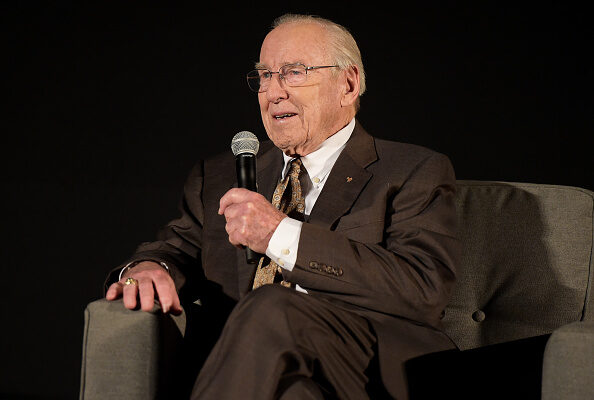
Astronaut Jim Lovell speaks at the 2015 TCM Classic Film Festival in Los Angeles during a special screening of Apollo 13 on March 27, 2015. (Photo Credit: WireImage)
Lovell also left his mark culturally. In 1994, he co-authored Lost Moon with Jeffrey Kluger, recounting the dramatic Apollo 13 mission. The book later inspired the 1995 Oscar-winning film Apollo 13, in which Tom Hanks portrayed Lovell, making his story known to millions worldwide and further cementing his place in popular history. Lovell made a cameo appearance in the film and remained an active participant in preserving space history, attending anniversaries, and supporting museum and educational programs.
Lovell appears in the Apollo 13 movie as the captain aboard the recovery ship USS Iwo Jima. He insisted on portraying his actual rank as Captain, not Admiral, and even wore his own dress uniform to ensure authenticity.
In recognition of his contributions, Lovell received numerous honors, including the Presidential Medal of Freedom, the Congressional Space Medal of Honor, and induction into the U.S. Astronaut Hall of Fame in 1993. He and his wife Marilyn also gave back to the community, supporting educational and civic causes, while raising their four children.
Conclusion
Jim Lovell’s legacy is defined by his exceptional leadership during crisis and his ability to remain calm and decisive under extreme pressure. The Apollo 13 mission best demonstrated these qualities, where Lovell’s steady command helped guide him and his crew safely back to Earth. His role in this “successful failure” cemented his place in the history of space exploration and earned him induction into the U.S. Astronaut Hall of Fame in 1993.
James Arthur Lovell Jr. passed away on August 11, 2024, at the age of 96. His remarkable life, from Navy pilot to Apollo commander, left behind a legacy of courage, resilience, and inspiration that will continue to guide future generations of explorers.
"I could put my thumb up to a window and completely hide the Earth. I thought, 'Everything I've ever known is behind my thumb,'"