
Understanding How Time Changes In Relativity
This article explains how time is not constant, exploring the basics of relativity and how speed and gravity can affect the way time passes.
Phenomenon
Astronomy
Albert Einstein
Phenomenon
Understanding How Time Changes In Relativity
15 Min Read
Introduction
Have you ever wished for a single moment to stretch into eternity or for one to end before it even starts? It feels like a trick of perception, but in reality, disguised in plain sight, it holds true. Physics shows us that what seems impossible in everyday life is entirely possible in the universe with a few conditions. Time stretches and contracts, and like most truths, it too is not absolute, just as the cosmos bends in a way Newtonian physics never imagined.
For centuries, Newton’s universe was seen as mechanical and predictable, with time ticking uniformly and space remaining fixed. However, as the nineteenth century ended, small inconsistencies began to emerge, revealing that the universe wasn’t entirely faithful to Newton’s theories. This called for a radical rethink of time itself, leading to the birth of the Special Theory of Relativity.
The Newtonian Universe and Maxwell
When I first studied Newton’s Laws of Motion, I shared the common initial thought that these laws seemed to embody common sense: an object in motion stays in motion, while an object at rest remains at rest. Similarly, relative speed felt intuitive.
However, a crucial lesson in physics is that even the simplest ideas can be challenged. In discussions of relativity, names like Einstein and Newton often come up, but we tend to overlook a pivotal figure: James Clerk Maxwell. This brilliant Scottish physicist was instrumental in developing the classical theory of electromagnetic radiation, unifying electricity, magnetism, and light as manifestations of the same underlying phenomenon.
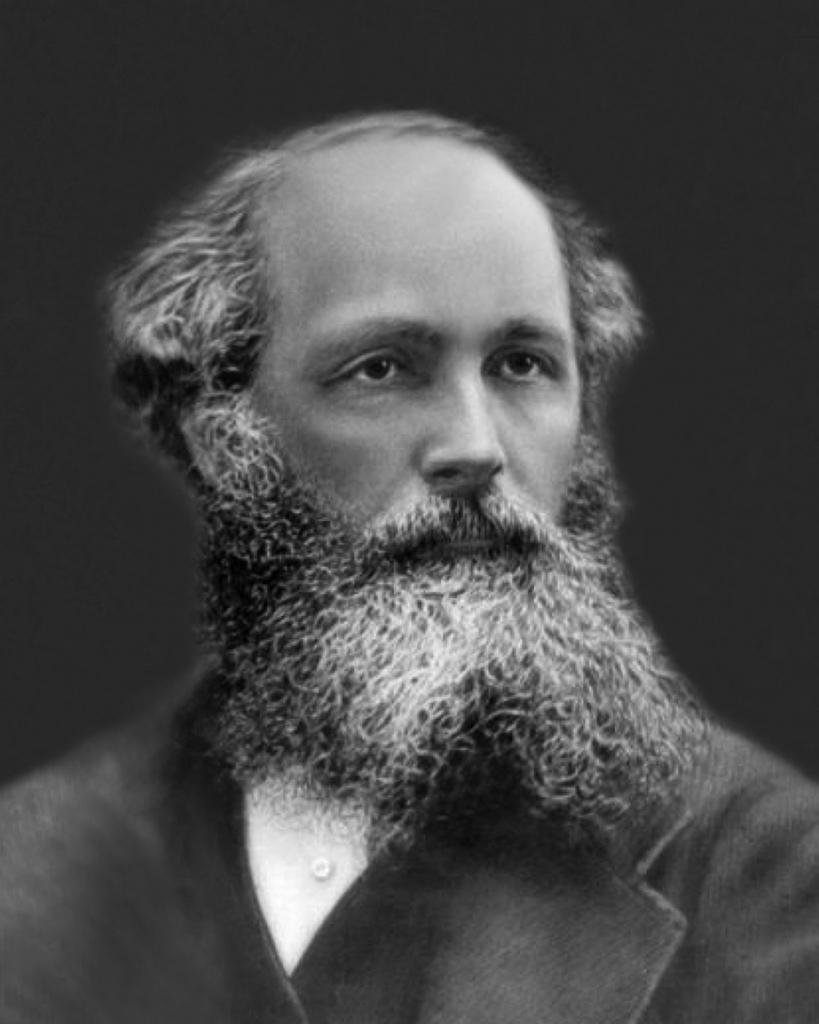
Portrait of James Clerk Maxwell, 19th-century physicist and mathematician (Image Credit: Smithsonian Institution Libraries / Dibner Library of the History of Science and Technology.)
Maxwell’s assertion that the speed of light is constant marked a significant departure from Newton’s framework, transforming our understanding of the universe. Interestingly, he wasn’t initially aiming to define the speed of light; he was unraveling the complexities of magnetism and encountered a ‘glitch’ in the mathematics of electricity. In the end, he realized he had uncovered the very nature of light itself.
This revelation shattered Newton’s concept of relative speed, which suggested that the velocities of two objects simply add or subtract. Instead, it became clear that the speed of light is a constant 299,792,458 meters per second, no matter the circumstances. In a lighthearted way, I like to call Maxwell the father and Einstein the mother of the theory of relativity, recognizing their essential contributions to reshaping our understanding of the cosmos.
Einstein's Theory of Relativity
Physics becomes more relatable when we consider the human stories behind it. Take Albert Einstein, for example. In 1905, he was just a 26-year-old patent clerk, largely disconnected from academia and struggling to find his place in the scientific world. To most, he was an outsider. Yet, in the same year he would challenge ideas that stood unchanged for nearly 200 years. Imagine the audacity; a young man, with no formal academic position, telling the scientific community their understanding of time was flawed
That year – now known as Einstein’s Annus Mirabilis or “Miracle Year” – he published four groundbreaking papers. One of which, titled “On the Electrodynamics of Moving Bodies,” intended to tidy up Maxwell’s equations for moving objects. But as he worked through the mathematics, Einstein realized he couldn’t fix the math without altering our concept of time. Thus, rather than forcing the math to fit the traditional understanding of time, Einstein birthed the Special Theory of Relativity, a framework that fundamentally changed the way we perceive time and space.
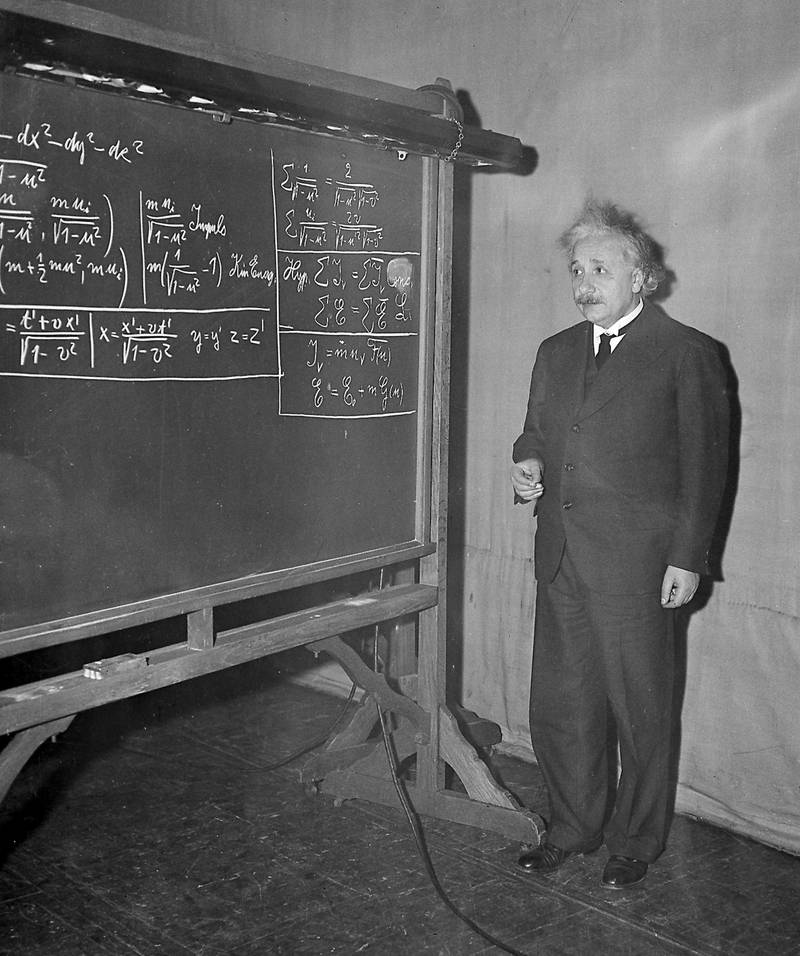
Albert Einstein stands beside a chalkboard filled with complex equations, appearing to explain or contemplate his work in a lecture setting. (Photo Credit: Wikimedia Commons)
At its core, there are two very simple ideas:
First, the laws of physics are identical for all observers in inertial frames of reference. In other words, no experiment conducted in a uniformly moving system can reveal whether that system is at rest or moving at a constant velocity.
Second, the speed of light in a vacuum is constant for all observers, regardless of the motion of the observer or source. Whether you are moving towards the source or away from it, light will always travel at approximately 3×10⁸ m/s.
These two principles, while simple on the surface, have profound implications on how we view the universe. They imply that time is not constant, lengths can contract, and events that appear simultaneous to one observer may not be so for another. To fully appreciate this, we must understand frames of reference. An inertial frame of reference is one that is either at rest or moving at a constant velocity. Essentially, it has zero acceleration. In such frames, Newton’s laws hold true without modification. A non-inertial frame, on the other hand, is accelerating or rotating, and requires the introduction of fictitious forces (like centrifugal force) to explain motion.
Einstein’s journey from the limitations of Special Relativity to the groundbreaking insights of General Relativity is a testament to human perseverance and creativity. After realizing that his initial theories couldn’t account for gravity or acceleration, he embarked on a challenging decade of intellectual struggle.
In a moment of brilliance, the “Happiest Thought” struck him while envisioning a man falling; he understood that in free fall, gravity feels absent, revealing the fundamental connection between gravity and acceleration. This epiphany led him to see light bending in an accelerating rocket, not as a pull on light itself, but as a curving of the very fabric of spacetime.
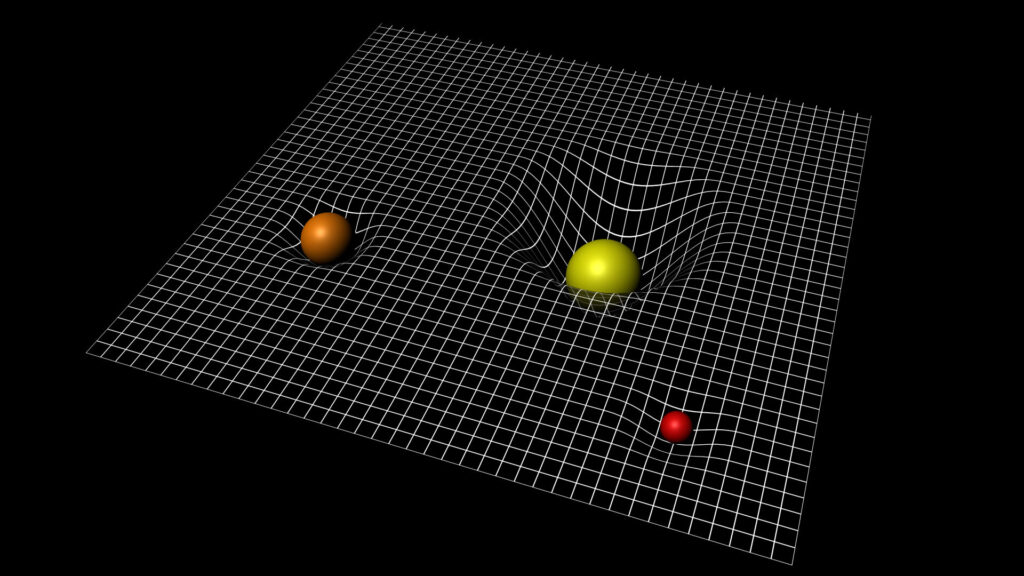
This illustration depicts spacetime as a simplified two-dimensional surface warped by the gravitational influence of three massive objects, shown as coloured spheres. (Photo Credit: ESA–C.Carreau )
Ultimately, his discovery illustrated that gravity is not just a force but a warping of spacetime, reshaping our understanding of the universe itself. This leads to the famous analogy, that of a trampoline and a heavy ball, which creates a dip, guiding smaller marbles along its curve. This beautifully encapsulates how mass influences the path of objects in space.
Just like in the movie Interstellar, Einstein’s theories come to life when characters land on Miller’s Planet, near a massive black hole. Due to its strong gravity, time runs much slower there; one hour equals seven years on Earth. What Einstein made us understand, Christopher Nolan (Director of Interstellar) made us see and feel it deeply.
Relativity of Space and Time
Some of the most striking concepts in Einstein’s Theory of Relativity arise from a simple idea; space and time are not fixed – they are dependent on the observer. The concept of time dilation suggests that if the speed of light is constant, your clock slows down when you move faster to maintain balance. Imagine a clock bouncing light between two mirrors: when still, it travels straight up and down, measuring proper time. On a fast-moving rocket, it takes a longer zigzag path, known as dilated time. Since the speed of light is constant, the journey takes longer, meaning the clock ticks more slowly.
To an astronaut, time feels completely normal. But to an outside observer, their clock runs slower. In extreme cases, an astronaut travelling close to the speed of light could return to earth to find out that far more time has passed here than for them. They have, in a sense, travelled into the future. This phenomenon shows how time stretches in space, prompting us to consider how our perceptions of time differ depending on our location.

Animation showing the "Cosmic Prank" of Relativity. While light simply bounces up and down for someone standing still, it must travel a longer, zigzag path for someone in motion. Because light’s speed is a fixed law of nature, the moving clock must take longer to complete a single tick. (Photo Credit: Daniela Leitner & Markus Pössel, via Einstein-Online
Closely tied to this is the concept of length contraction, which shows that space adjusts along with time and speed. An object travelling at a very high speed appears shorter in the direction of motion to the stationary observer. For example, a 100 cm ruler appears whole when standing still, but at 90% the speed of light, it seems to shrink to just 39 cm for an observer. To the person in motion, the world feels unchanged, highlighting the paradox of perception versus reality and how our experience of the universe is influenced by our perspective.
Energy, Mass, and Gravity
Einstein’s insights didn’t stop at space and time – they extended into the very nature of matter and energy. The concept of mass-energy equivalence, famously captured by Einstein’s equation E=mc², reveals an essential law about our universe: as objects near the speed of light, they gain mass and resist acceleration, highlighting the deep connection between energy and matter, with even tiny particles holding vast energy potential. It beckons us to reflect on how the fundamental forces of the cosmos intertwine, transforming the very nature of motion and existence. In this way, a tiny bit of matter is not just weight but a vast reservoir of energy, underscoring the intricate dance of the universe’s fabric.
Einstein’s leap to General Relativity emerged from the realization that space and time form a single, flexible fabric called Spacetime, a concept introduced by his professor Hermann Minkowski. Visualize it as a trampoline: in Special Relativity, it’s flat, but adding gravity creates curves, like when a heavy bowling ball (the Sun) sinks in the center. A nearby marble (the Earth) doesn’t orbit due to an invisible force, but follows the curve of the fabric. As John Wheeler said, “Mass tells space how to curve; space tells mass how to move,” making gravity the shape of the cosmos rather than a mysterious pull.”
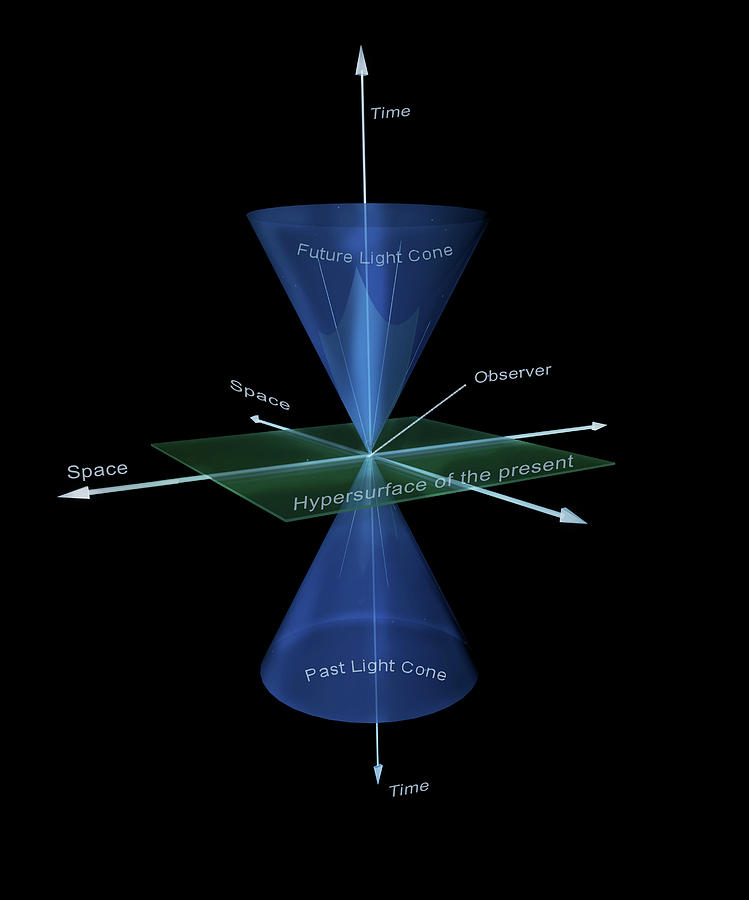
Illustration showing the ‘Light Cone’ of Minkowski Space, where the past and future meet at a single point: the Present. This four-dimensional hourglass represents the ultimate speed limit of the universe, showing that every movement through space is also a movement through time. (Image Credit: Spencer Sutton / Science Source.)
Real World Applications
Although this theory may seem abstract, it has important applications that demonstrate its concrete relevance.
The everyday application of relativity is vividly demonstrated in GPS navigation systems, utilized by smartphones and vehicles. GPS satellites, orbiting approximately 20,000 km above Earth and traveling at speeds of 14,000 km/h, experience the effects of both general and special relativity. While general relativity causes their onboard atomic clocks to tick faster due to the weaker gravitational field, special relativity slows them down because of their high velocity. The net result is a daily gain of about 38 microseconds in satellite clocks. Without daily corrections for this discrepancy, GPS positioning errors would accumulate to around 10 kilometers per day, rendering navigation impractical. In the intricate weave of time and space, we are reminded of our existence in a universe ruled by relentless laws, where even the smallest nuances can dramatically alter the course of our journey.
Another application of relativity is in our understanding of how black holes work. According to the spacetime curvature, if a star is the bowling ball on our spacetime trampoline, a black hole is a lead weight so heavy that it doesn’t just dent the fabric, it creates a bottomless well.
In these cosmic “no-go zones,” gravity is so intense that not even light can escape the Event Horizon, the point of no return. Black holes pull everything in– including my attention, and yes, the pun is intended. Relativity predicts that as you approach a black hole, the warping of spacetime becomes extreme. To an outside observer, your clock would appear to tick slower and slower until, at the very edge, time seemingly stands still.
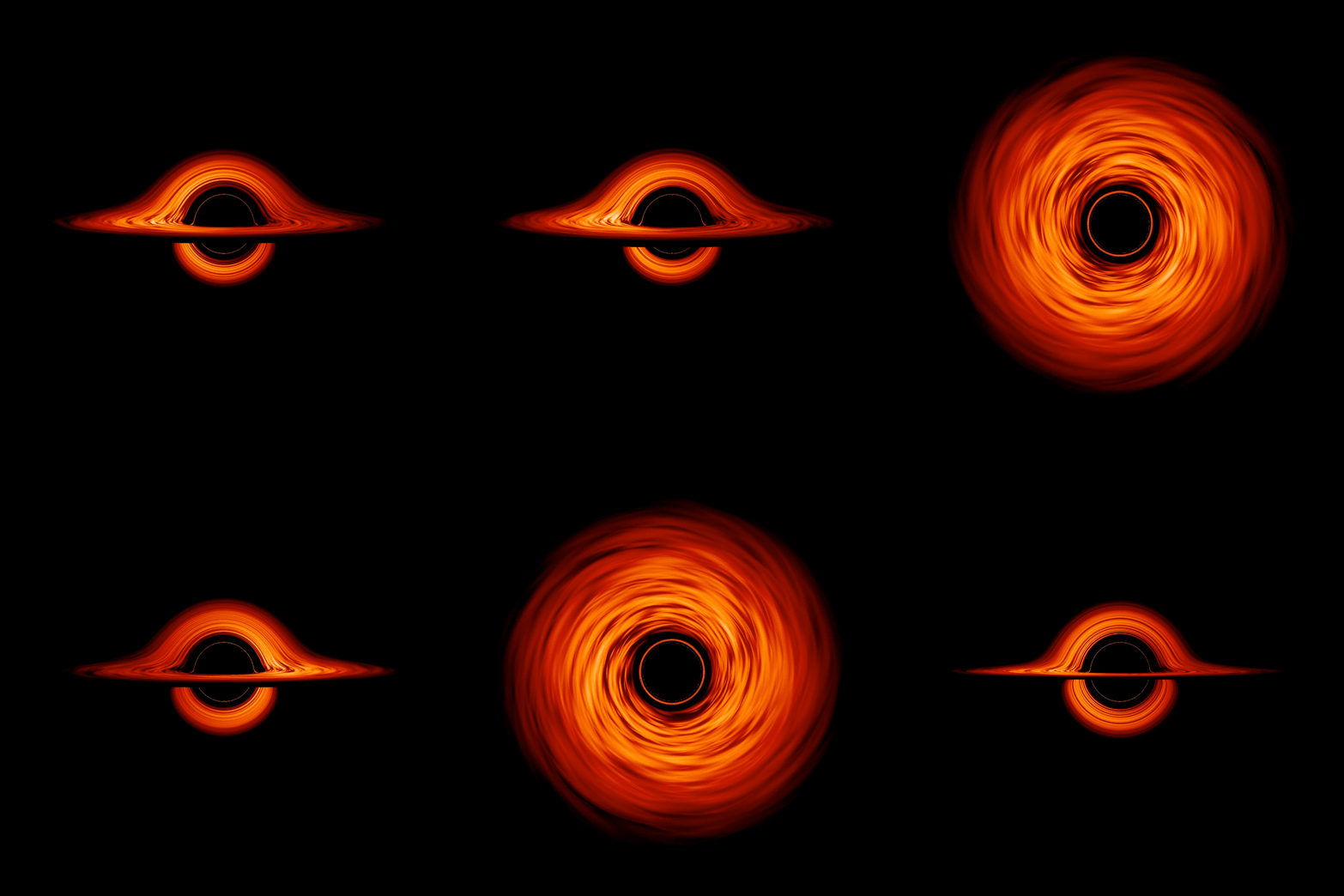
Animation of a "Plunge into the Abyss": This simulation captures a camera diving into a supermassive black hole. As it nears the Event Horizon, gravity distorts light into "photon rings" and "accretion disks", creating a swirling backdrop. (Credit: NASA’s Goddard Space Flight Center)
Frozen in time, forever. This is no longer just a theory. In 2019, the Event Horizon Telescope revealed the first image of a black hole’s “shadow” in the galaxy M87, validating Einstein’s predictions that light bends into a stunning ring around these colossal entities. More recently, we have also detected Gravitational Waves, ripples in the fabric of spacetime created by colliding black holes. These discoveries reveal the universe as a vibrant, ever-changing landscape, where time and space are consistently tested to their limits.
Conclusion
Relativity has fundamentally changed our understanding of the universe, revealing that space and time are not fixed absolutes but rather a dynamic, interwoven continuum. This groundbreaking theory by Einstein is just one example of how even well-accepted laws of nature can be challenged and proven wrong.
It plays with our perception of reality, leading me to wonder how much we truly comprehend about the universe and whether our current beliefs are merely stepping stones toward a deeper truth. Each discovery can shift our perspective, pushing the boundaries of what we consider possible and prompting us to question the very nature of existence. Maybe that is life: stumbling with each step, realizing we are wrong, while learning something revolutionary in the process.