As humanity boldly ventures into the unknown and pushes the limits of our knowledge, the idea of
colonizing other worlds has sparked heated discussions. While the concept of inhabiting a different planet
once seemed like a mere fantasy, it is now a plausible outcome. In fact, numerous space organizations and
corporations are actively pursuing plans to turn this dream into a reality. In this piece, we will dive into the
current state of space exploration, delving into NASA's ambitious Artemis program and the endeavors of
private enterprises to establish a colony on Mars. Together, we will explore the obstacles and potential
breakthroughs that lie ahead on this journey.
NASA’s Artemis Program
NASA's ambitious Artemis program marks a momentous leap towards reclaiming the moon for
humankind and setting our sights on Mars. With its namesake being the revered Greek goddess of the
moon, this program sets out to achieve the historic feat of landing the first female and male astronauts on
the lunar terrain. Undoubtedly, the Artemis program serves as a pivotal component of NASA's
comprehensive plan to establish a lasting presence on the moon, propelling us towards even farther reaching missions to the red planet. According to NASA Administrator Jim Bridenstine, “Artemis is more
than just a moon landing. It’s a first step on a journey to Mars, and it will help us prepare for the deep space
missions we’ll need to send astronauts to the Red Planet.”
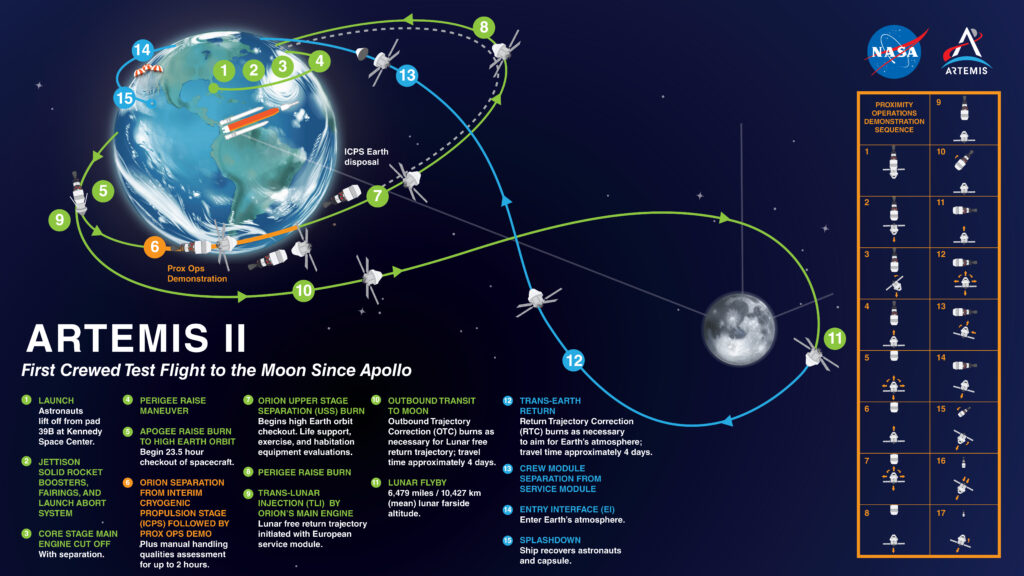
Summary of the upcoming Artemis II mission plna (Credit: NASA)
The program includes the development of new
spacecraft, such as the Orion spacecraft and the Space Launch System (SLS), which is the most powerful
rocket ever built. The Orion spacecraft is a marvel of engineering, designed for the sole purpose of
transporting astronauts beyond the confines of low Earth orbit. Its ultimate destination: the moon and
even Mars. Packed with state-of-the-art technology, including advanced life support systems, radiation
shielding, and a reusable launch abort system, this spacecraft is well-equipped to ensure the safety of those
embarking on the daring journey. But the journey would not be possible without the mighty SLS, a heavylift rocket that will launch the Orion spacecraft and other payloads into the depths of space. With a
capacity to carry up to 130 metric tons, the SLS surpasses even the current largest rocket, the Delta IV
Heavy, by double. And with its reusable capabilities, the SLS is poised to pave the way for cost-effective
future missions.
Private Companies’ Efforts to Colonize Mars
NASA is focused on returning humans to the moon, but the possibility of colonizing Mars has not
escaped the attention of several private companies. Among them are SpaceX, Blue Origin, and Mars One,
each with their own unique innovations and tactics, all with the ultimate goal of establishing a thriving
human community on the red planet. Elon Musk's SpaceX stands out as the most renowned among these
enterprises, with its founder boldly proclaiming a grandiose mission of ensuring the survival of humanity
as a multi-planetary species. Through various initiatives, SpaceX is making significant strides towards this
goal, one of which being the Starship spacecraft project. This innovative spacecraft is being developed to
transport up to 100 people to and from Mars, equipped to accommodate both passengers and cargo.
Designed for multiple launches, it promises to notably diminish the costs of future missions.
An intriguing discovery captured by HiRISE pictures of Newton Crater unfolds over a year, revealing dark streaks believed to be remnants of flowing saltwater. Witness the phenomenon through the lens of NASA/JPL-Caltech/U of Arizona imagery.
Moreover, its
in-orbit refueling capabilities will facilitate longer and quicker journeys beyond what current spacecrafts
can achieve. Jeff Bezos, the visionary mastermind behind Blue Origin, is determined to pave the way for
human colonization of Mars. In pursuit of this ambitious goal, his company is engineering a
revolutionary reusable rocket, the New Glenn, equipped to transport both crew and cargo into space.
Remarkably, the New Glenn will also have the ability to refuel while in orbit, propelling it to even greater
distances and speeds than what is achievable with current spacecraft. Did you hear about Mars One? It's a
Dutch non-profit making big moves to colonize Mars. They're aiming to create a thriving colony on the
red planet with the first pioneers landing in 2027. Can you imagine? They'll have everything they need to
survive - habitats, greenhouses, and all the essential infrastructure. It's truly groundbreaking.
"I would like to die on Mars. Just not on imapct." - Elon Musk, CEO SpaceX
Challenges and Opportunities
The concept of establishing human settlements on other planets is exhilarating, but not without obstacles.
Among the greatest hurdles is the vast distance between Earth and Mars. This distance fluctuates greatly,
ranging from a mere 34 million miles during the closest approach, to a staggering 249 million miles at its
farthest. As a result, travel time between the two planets can take several months, posing immense
logistical and psychological challenges. One of the most pressing obstacles that must be overcome in
sending humans to Mars is the unforgiving terrain of the red planet. Mars resembles a desert,
characterized by a sparse atmosphere that offers minimal defense against the sun's intense radiation.
Moreover, the weather on Mars is extremely unpredictable, with scorching temperatures exceeding 70
degrees Fahrenheit during the daytime and plummeting to a bone-chilling -197 degrees Fahrenheit at
night.
As a result, any potential human habitation on Mars would require ingenious solutions to
withstand these extreme and constantly changing conditions. Although there are certainly obstacles to
overcome, the act of colonizing other planets presents a great deal of potential. Particularly noteworthy is
the possibility for groundbreaking discoveries and advancements. Inhabiting another planet will require
the cultivation of new technologies and ideas, many of which could prove beneficial here on Earth. Take,
for instance, the creation of advanced life support systems and radiation shielding - advancements with
the potential to greatly benefit both space and our home planet. A thrilling possibility awaits us in the
emergence of novel economic and political systems. Inhabiting a new planet will demand the creation of
fresh models for governing and managing resources, potentially revealing groundbreaking understandings
of societal functioning. The implications extend beyond outer space to our persistent challenges here on
Earth, including climate change and resource scarcity.
Conclusion
In conclusion, the future of space exploration is exciting, with several space agencies and private
companies working on plans to return humans to the moon and colonize Mars. While the challenges of
colonizing other planets are significant, the opportunities are also significant. As we continue to push the
boundaries of what we know and explore, it is clear that the future of space exploration is bright, and the
possibilities are endless. As Jim Bridenstine, NASA Administrator, has stated, “We are on the cusp of a
new era of space exploration, one in which humans will return to the moon and push out into the solar
system.” The future of space exploration is indeed bright, and it is an exciting time to be alive