What does it mean to look up at the night sky and feel small or insignificant in comparison to the seemingly infinite universe? For Carl Sagan, that feeling wasn’t a weakness. It was the beginning of wisdom. To him, wonder was not the enemy of reason; it was its spark. He believed that if we could understand the cosmos, we would start to understand ourselves, as children of the universe.
Carl Sagan was more than an astronomer. To scientists, he was a pioneer in planetary research and the father of astrobiology. To the public, he was the calm voice in Cosmos: A Personal Voyage, a series explaining astronomy, physics, biology and history, all in one, to millions around the world. Such programs were Sagan’s way of bringing the story of the universe to the general public: bridging the gap between them and experts. In this article, we will journey through his story from his early days to his work and what impact the left has on our world today.
As a boy, Sagan’s parents bought him a book called The Stars by H.A. Rey, the same author who created Curious George. That simple gift sparked his lifelong fascination with astronomy, leading him to spend countless hours at the library exploring the universe through books long before he could study it through telescopes.
Path To Wisdom
Carl Edward Sagan was born on November 9, 1934, in Brooklyn, New York, to Samuel Sagan, a garment cutter who had immigrated from Kamianets-Podilskyi in present-day Ukraine, and Rachel Molly Gruber, a homemaker from New York City. Raised in a modest, working-class Jewish household, Sagan grew up during an era when space exploration was still confined to the imagination of science fiction writers. His early fascination with the universe was nurtured by frequent visits to the Brooklyn Public Library and the American Museum of Natural History’s Hayden Planetarium. A formative moment in his childhood occurred when he attended the 1939 New York World’s Fair with his parents, where he was captivated by futuristic exhibits such as the “World of Tomorrow.”
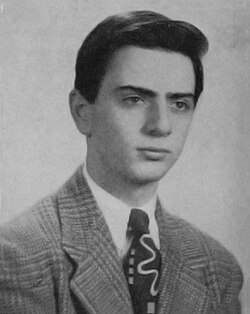
An image of Carl Sagan at age 16, featured in the 1951 Rahway High School yearbook. (Photo Credit: Rahway High School)
Sagan enrolled at the University of Chicago, where he studied both biology and physics. In 1960, he earned a Ph.D. in astrophysics under the mentorship of three Nobel laureates: Harold Urey, Gerard Kuiper, and Hermann Muller. From that point on, he had famously believed that science was more about asking the right questions than just a ‘body of knowledge’. This philosophy was reflected by Sagan tackling some of astronomy’s most pressing puzzles, including the mystery of Venus’s intense microwave radiation. At the time, Venus was often imagined as an Earth-like paradise, but Sagan’s research revealed a starkly different reality: a planet covered in carbon dioxide with surface temperatures reaching as high as 473°C (883°F), a death sentence to any previous ideas about life existing there. His findings not only transformed our understanding of planetary atmospheres but also served as an early warning about the dangers of the greenhouse effect, a warning that resonates strongly in the context of today’s climate crisis.
Contributions To Society
After getting his Ph.D., Sagan briefly started teaching genetics at Stanford before moving into astronomy full time. He soon joined the faculty at Harvard as well where he delivered a series of lectures titled “Planets as Places” where he focused on the idea of life on other planets by drawing comparisons between other planets and Earths as well as how atmosphere changes, form and what conditions can allow life to exist somewhere else other than ours.
However, his influence extended far beyond academic papers and research. Through his work with NASA’s Jet Propulsion Laboratory in Pasadena, he played a key role in some of the agency’s greatest achievements, including the Voyager missions. Launched in 1977, the pair of spacecraft, Voyager 1 and Voyager 2, were initially meant to study the gas giant, Jupiter and the ringed planet, Saturn. However, as they travelled farther away from the sun, they studied Uranus and Neptune, providing humanity with the closest look of the two gas giants. Both probes have long since left the Solar System and are now studying conditions beyond the heliosphere (albeit with limited functionality).
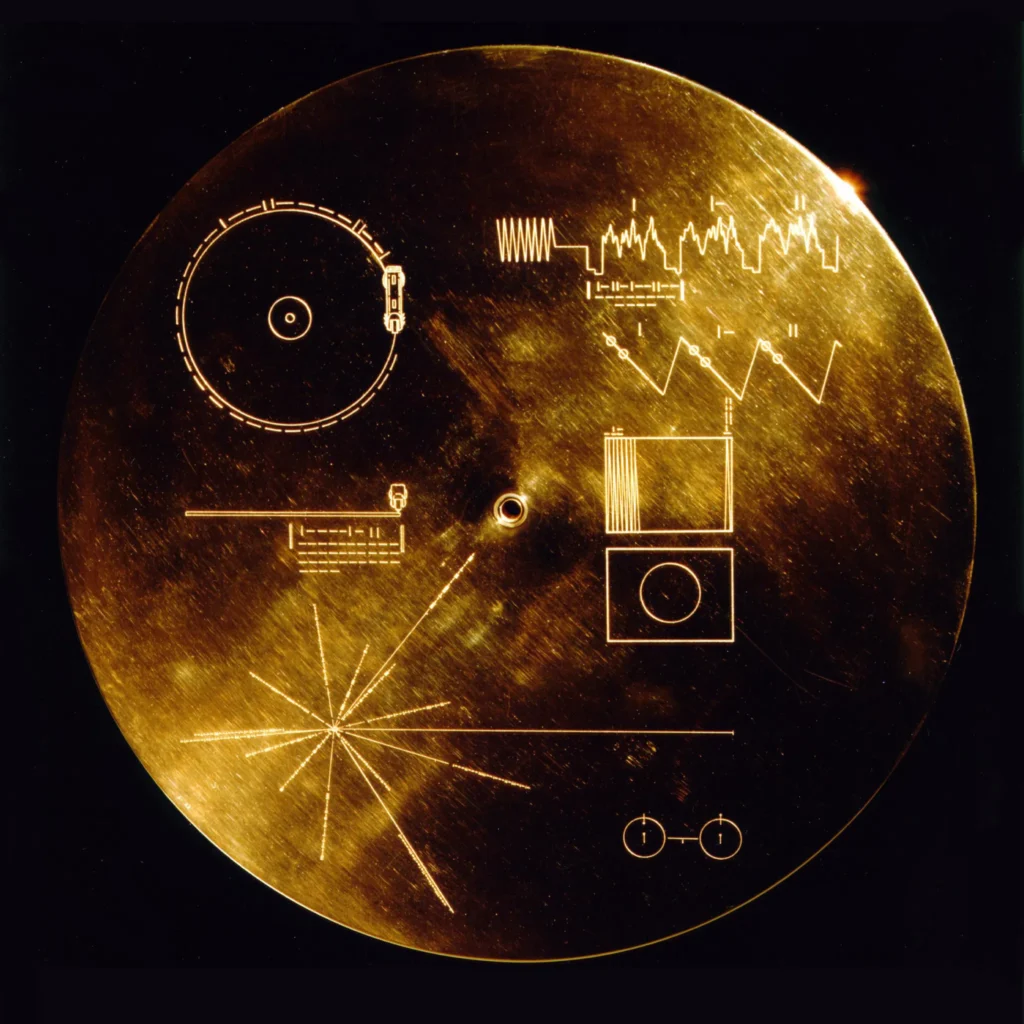
The spacecraft also carried the famous “Golden Record,” a message to any intelligent life beyond our solar system, filled with Earth’s sounds, images, and music. Conceived by Sagan, it reflected his belief that exploration is not only about science but also about meaning. More than a scientific gesture, the Golden Record was a cultural time capsule: Sagan and his team carefully selected greetings in 55 languages, music ranging from Bach to Chuck Berry, the sound of wind, rain, and a mother’s heartbeat—it even included a kiss and a message of hope.
A diagram of the Golden Record cover and playback instructions, designed to communicate with potential extraterrestrial civilizations by depicting how to play the record, the location of Earth in the galaxy, and the nature of its creators. (Photo Credit: NASA)
Sagan And The Red Planet
In 1967, Sagan, together with his first graduate student James Pollack, solved a major puzzle of planetary science: the seasonal “wave of darkening” observed on Mars. While many believed the phenomenon was caused by changes in vegetation, they proposed instead that Martian winds were alternately depositing and removing light-colored dust from darker rock surfaces. This explanation was later confirmed by the Viking missions.
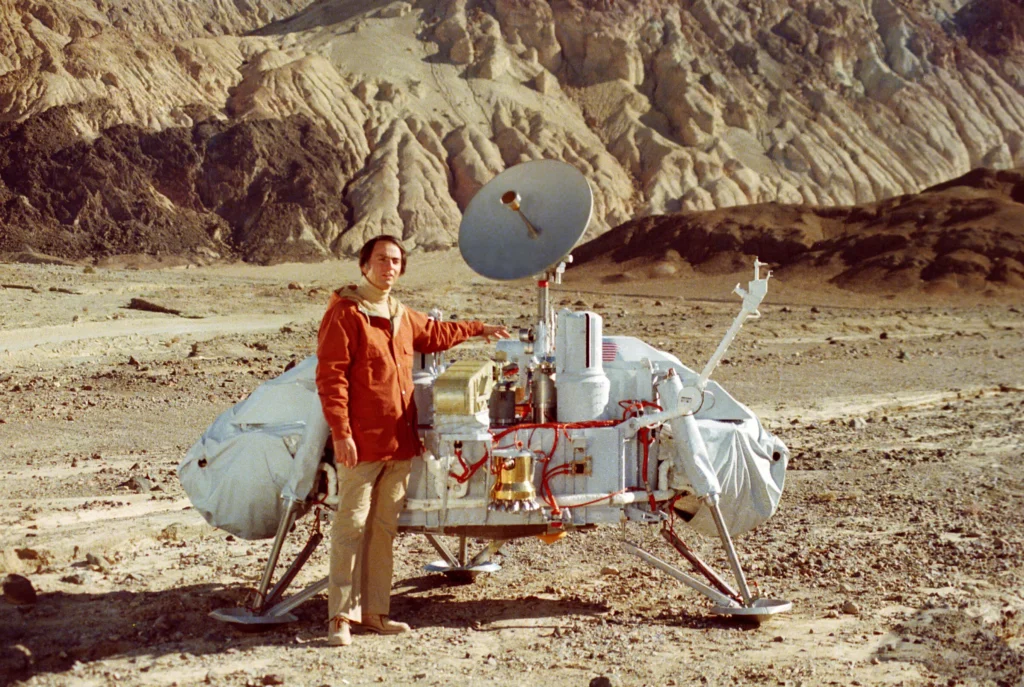
Beyond this, Sagan devoted much of his career to the study of Mars, examining its climate, atmosphere, and geology. He directed studies on the planet’s ancient climate, linking long-term changes to variations in orbital cycles, and investigated erosion as well as the dynamics of Martian sandstorms. He also served as a key advisor on the Viking mission, shaping the design and interpretation of its biological experiments, though the results were ultimately inconclusive regarding the possibility of life. Through these studies, Sagan helped establish the scientific foundations of modern astrobiology and advanced the search for extraterrestrial intelligence (SETI).
Carl Sagan with a Viking lander model in Death Valley, California, where the terrain was used to simulate Martian conditions in preparation for the Viking missions to Mars. (Image Credit: NASA/JPL)
Sagan was friends with filmmaker Stanley Kubrick. He was asked to advise on the science behind 2001: A Space Odyssey but declined when Kubrick wanted to depict aliens directly. Sagan insisted that aliens should remain ambiguous to keep the film scientifically credible.
Preventing Nuclear Winter
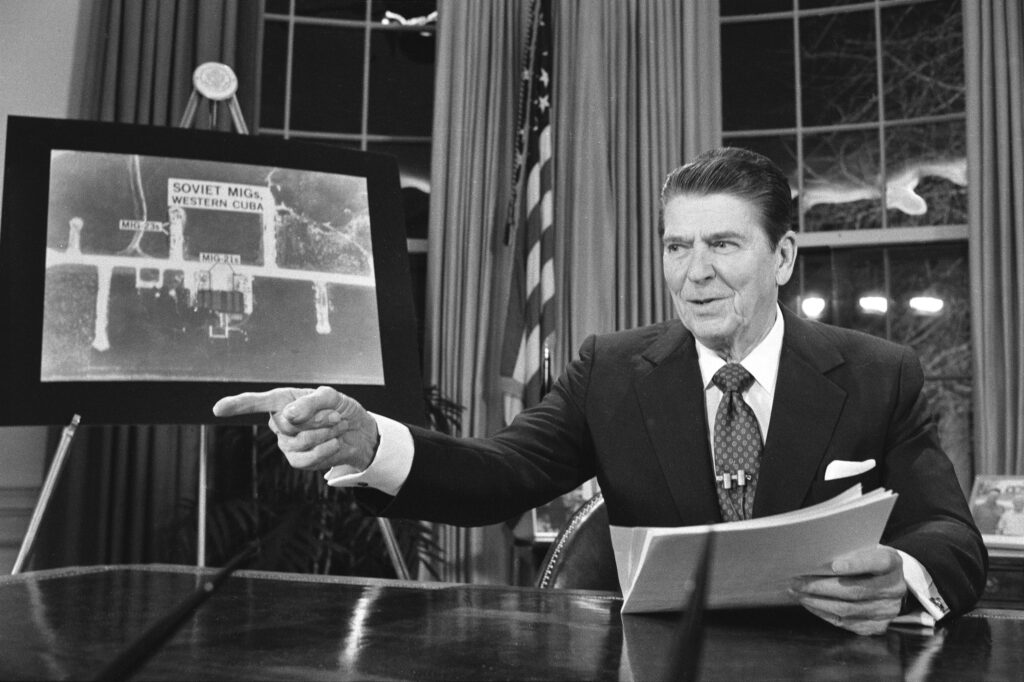
As the nuclear arms race escalated in the late 1970s and early 1980s, Sagan grew increasingly worried about the survival of human civilization. In March 1983, he nearly lost his own life during a ten-hour operation to replace his esophagus. While still recovering in intensive care, he learned of late President Ronald Reagan’s announcement of the Strategic Defense Initiative, a proposed space-based anti-missile “shield.” To Sagan, the plan was not only scientifically unworkable but dangerously destabilizing, as it risked undermining nuclear deterrence and triggering the very war it claimed to prevent. Consequently, from his hospital bed, he immediately drafted a petition to Congress opposing the project, rallying many of America’s leading scientists to sign it.
President Reagan addresses the nation on March 23, 1983, supporting his defense budget and unveiling the Strategic Defense Initiative. (Photo Credit: AP Photo)
That same year, Sagan helped in research into the climatic consequences of nuclear war. Working with a team of atmospheric scientists, he applied models originally developed to study volcanic eruptions and asteroid impacts to calculate the potential effects of smoke from firestorms ignited by nuclear explosions. Their findings suggested that enough soot could reach the stratosphere to block sunlight, plunging the planet into a catastrophic “nuclear winter.” Though controversial, and later revised to reflect less extreme but still devastating effects, the research was groundbreaking in reframing nuclear war as not just a geopolitical crisis but a planetary one. The idea quickly spread beyond academia: in 1986, Sagan briefed the Soviet Central Committee, and Mikhail Gorbachev later acknowledged that the nuclear winter studies strengthened his resolve to pursue arms reduction. Some Russian scientists even credit Sagan’s influence as a key factor in ending the Cold War.
Cosmos And His Books
If Sagan had only been a scientist, his name might have remained in journals and academic circles. But he had a gift, a voice that made the incomprehensible beautiful. When Cosmos: A Personal Voyage aired in 1980, it wasn’t just a TV series, it was an awakening. Thirteen episodes, broadcast in over 60 countries and watched by an estimated 500 million people worldwide, brought the universe into living rooms like never before. Families sat together and listened, not to equations or jargon, but to poetry about galaxies and atoms, delivered with warmth and conviction. Sagan didn’t just say, “We are made of star stuff.” He made us feel it. In those four words, he collapsed the distance between the human heart and the heart of a star, pulling the cosmos down from unreachable skies to the intimacy of a TV screen.
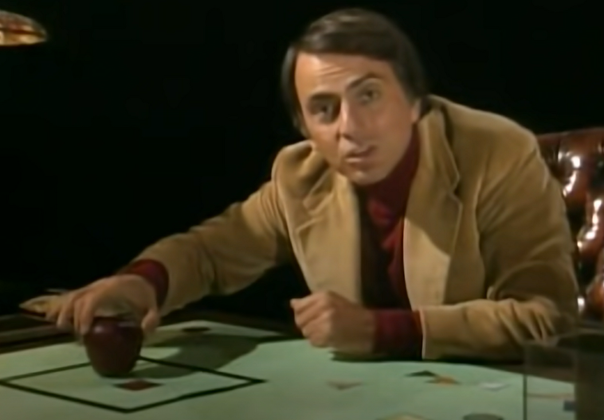
An shot from the series
Cosmos: A Personal Voyage where Carl Sagan explains the fourth dimension simply using an apple. (Photo Credit: AP Photo)
And then there were his books. Cosmos sold more than 5 million copies, becoming one of the best-selling science books of all time. Contact, his science-fiction novel, was later adapted into a 1997 film starring Jodie Foster, carrying his ideas into popular culture and that Sagan advocated that aliens would be friendly and good-natured. The Demon-Haunted World became a rallying cry for critical thinking, warning against pseudoscience, superstition, and intellectual laziness, not with arrogance but with hope. His writing never talked down to the reader; it invited them in, like a friend pulling up a chair and saying, “Let me tell you a story about the universe.” In the case of Cosmos, decades later, Neil deGrasse Tyson, a renowned astrophysicist, revived it with “Cosmos: A Spacetime Odyssey”, explicitly citing Sagan as his guiding light and a mentor. Nevertheless, even today, clips from the original series circulate online, proving that Sagan’s way of teaching was timeless.
Before becoming famous, Sagan was a behind-the-scenes consultant for NASA. He briefed astronauts of the Apollo program on what they might see on the Moon and later helped with surface operations for the Viking Mars missions.
The Pale Blue Dot
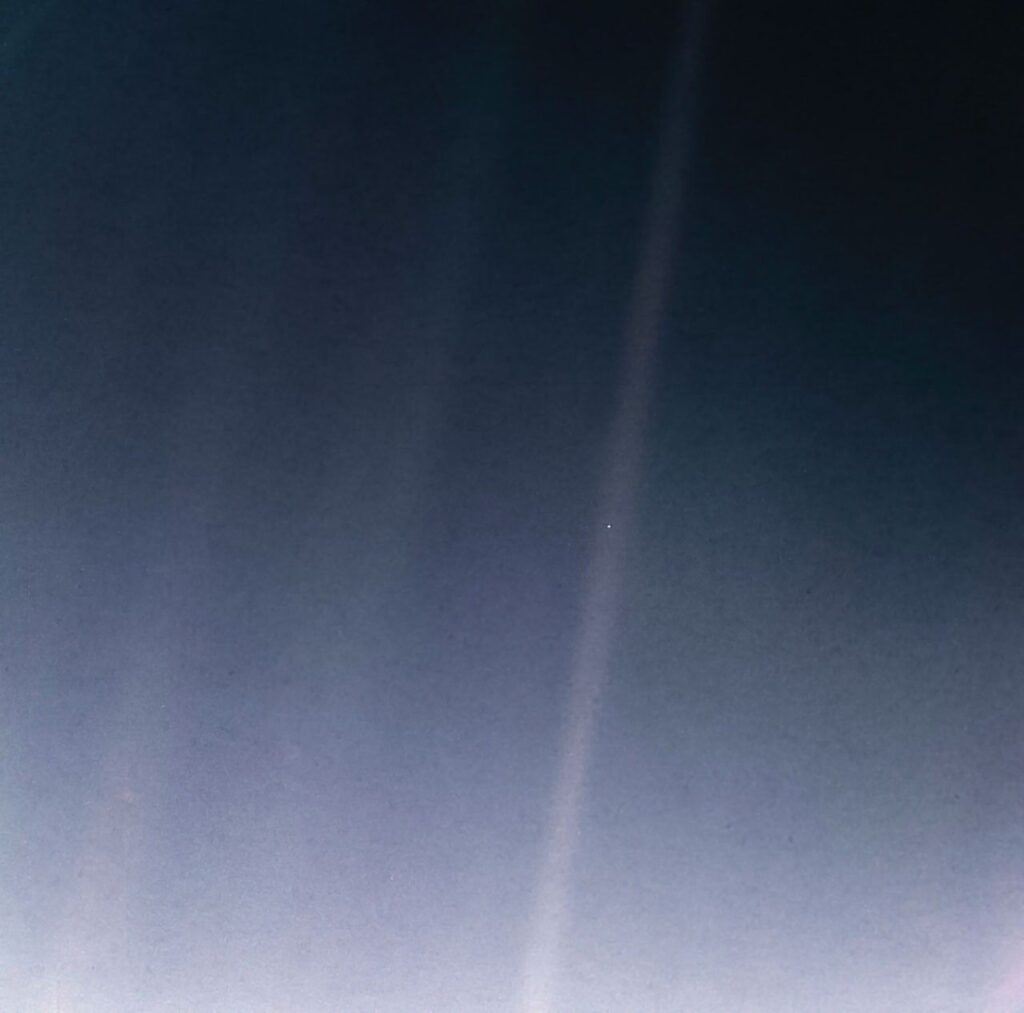
If there is one image that defines Sagan, it is the Pale Blue Dot. In 1990, at his urging, Voyager 1, then nearly 13 years into its mission and leaving the solar system, turned its camera back toward Earth from 3.7 billion miles away. What it captured was astonishing, not a majestic planet filling the frame, but a faint bluish pixel, less than a single point of light on the sensor, suspended in a shaft of sunlight caused by lens scattering, barely visible against the vast darkness. The image was taken as part of the “Family Portrait” series of the solar system, showing six of our neighboring planets. Yet it was that single dot, easy to overlook, that became iconic. Just as Cosmos opened with the imagery of Earth as a small world floating in the immensity of space, this photograph became the ultimate opening sequence for humanity itself, a reminder of our place in the cosmos.
The legendary Pale Blue Dot, showing Earth from 3.7 billion miles away, captured by NASA’s Voyager 1 spacecraft in 1990 at Carl Sagan’s suggestion. (Photo Credit: NASA/JPL)
Sagan looked at that pixel and wrote words that will echo for centuries. He reminded us that every war, every empire, every colonization, every mother, every father, every hopeful child, every saint and sinner, every invention, every discovery, and every civilization that ever was, lived out their story on that pale speck of dust. “Our planet,” he said, “is a lonely speck in the great enveloping cosmic dark.” It was more than a scientific observation, it was a moral one. How absurd our conflicts seem when seen from that perspective, how fragile our world is, and how precious.
His Legacy
Carl Sagan passed away in 1996, but his presence has never left us. Every time we marvel at a Hubble image, every time a rover sends back pictures from Mars, every time a child points to the night sky and asks, “What’s out there?”, Sagan is there. His voice lingers, not in sound, but in spirit.
Astronauts quote him. Innovators cite him. Elon Musk once said Sagan shaped his vision for Mars. And countless students (maybe even you reading this) still find themselves watching Cosmos on a late night and feeling that first spark: the realization that science is not cold or distant, but alive and full of meaning.
Conclusion
So, who was Carl Sagan? A scientist? Yes. A communicator? Absolutely. But perhaps the best word is philosopher, not one confined to ivory towers, but one who stood on a cliff at night, pointed to the sky, and asked us to look. He taught us that to gaze outward is to reflect inward, that the search for other worlds is ultimately a search for ourselves. In an age where cynicism often overshadows wonder, his words remain a lighthouse, steady, patient, urging us to lift our gaze. His greatest gift was not the discoveries, missions, or even the Golden Record, but his ability to awaken in us something rare: awe. Pure, unfiltered awe, the kind that makes us pause and whisper, “We are star stuff.” And perhaps this is the ultimate truth he left us with: not that the universe is vast and we are small, but that within our smallness lies our greatness, for the very atoms of our bodies were forged in the cores of long-dead stars, making us a way for the cosmos to know itself.
“A proclivity for science is embedded deeply within us, in all times, places, and cultures. It has been the means for our survival. It is our birthright.”