
Alien Probe or Comet? The Mystery of Interstellar Object 3I/ATLAS
This article explores the discovery and fascinating properties of Comet 3I/ATLAS, examining its unusual composition, reddish hue, and high-speed trajectory while addressing theories suggesting it could be an alien probe.
Phenomenon
Astronomy
NASA
Phenomenon
Alien Probe or Comet? The Mystery of Interstellar Object 3I/ATLAS
14 Min Read
Introduction
Ever since I was a kid, I’ve always been fascinated by space. One of the biggest questions that’s stuck with me is whether there’s any intelligent life out there besides us on Earth. Being me, I couldn’t just leave it at that, I started digging for answers, whether it was through random Google searches or reading books that explored the idea both scientifically and imaginatively, like Contact by Carl Sagan and Space Chronicles by Neil deGrasse Tyson.
Since my childhood, there have been countless attempts by NASA to find evidence of life, with one of the most promising being the recent discovery in 2025 of potential microbial life on Mars. Another thing that has fascinated both astronomers and casual space enthusiasts alike is the discovery of 3I/ATLAS, a comet from interstellar space that recently entered our solar system, opening up even questions about life and materials in outer space.
Detection
Comet 3I/ATLAS is known to be the third interstellar object to visit our Solar System, following 1I/‘Oumuamua in October 2017 and 2I/Borisov in August 2019, both of which sparked huge discussions (we’ll cover them in detail another day). It was reported by the ATLAS (Asteroid Terrestrial-impact Last Alert System) telescope in Río Hurtado, Chile, on July 1st, 2025. After its discovery, astronomers began gathering data from three different ATLAS telescopes around the world, along with Caltech’s Zwicky Transient Facility at the Palomar Observatory in San Diego, California, where observations extended back to June 14th, 2025. Pre-discovery images from several observatories, including the Zwicky Transient Facility and ATLAS, retrospectively traced the comet back to mid June 2025 and even late May 2025, noting it was initially faint and difficult to distinguish because it was passing in front of dense star fields near the Galactic Center.
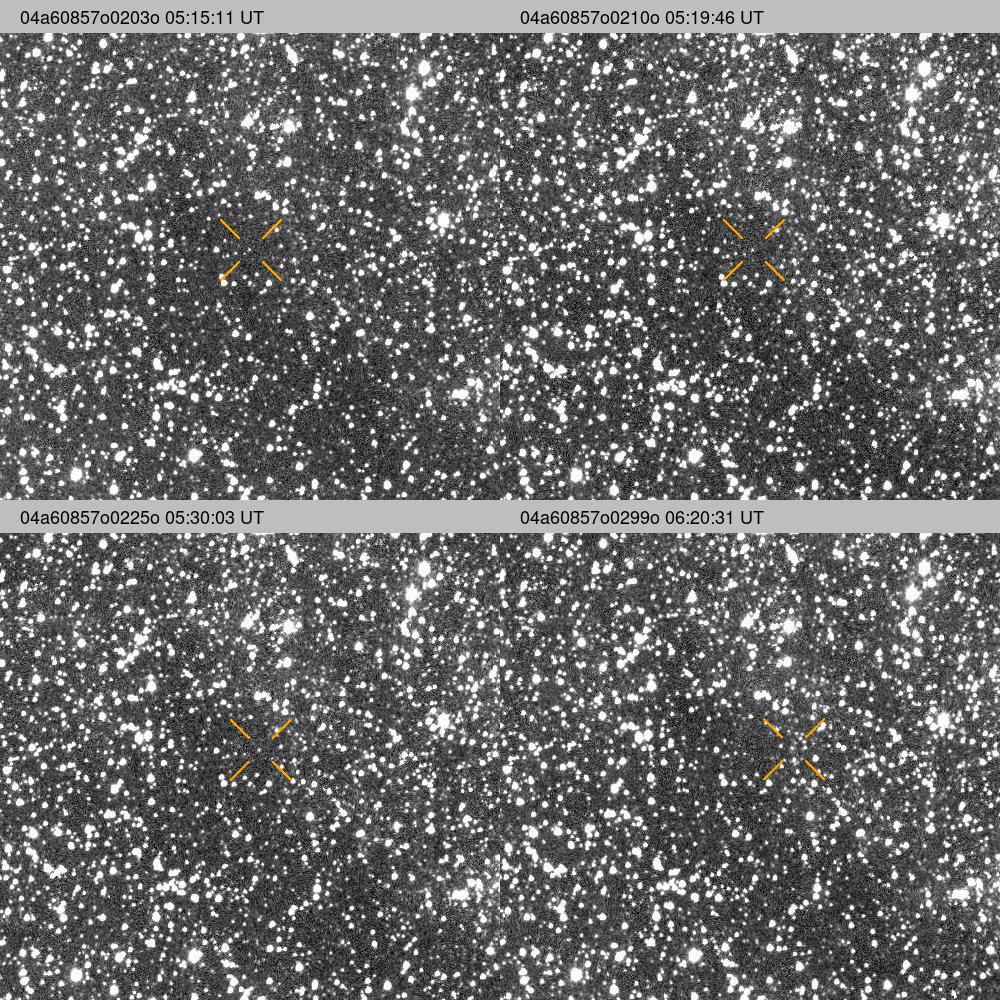
This compiled series of the images taken from the ATLAS survey telescope in Chile shows the initial observations made for the 3I/ATLAS arriving from interstellar space. (Photo Credit: University Of Hawaii, NASA)
Once it was confirmed that the comet had entered our Solar System, the name 3I/ATLAS was officially assigned with “I” standing for interstellar, indicating that it originated outside our Solar System, “3” marking it as the third known interstellar object, and ATLAS recognizing the survey team that discovered it. Thank god, this name change happened because I would’ve had to memorize the previous name given to it, A11pI3z, which would be a nightmare!
Initially, it was detected at an apparent magnitude of 18, moving at a speed of approximately 61 kilometers per second relative to our Sun. Early observations placed it along the border of the constellations Serpens Cauda and Sagittarius, near the galactic plane. The comet was quickly identified as having a highly eccentric, hyperbolic trajectory with an eccentricity of about 6.1 and an excess velocity of approximately 57 km/s, confirming its interstellar origin.
Appearance And Properties
When Comet 3I/ATLAS was first observed, its nature was unclear to the point that astronomers were unsure whether it was an asteroid or a comet. However, follow-up imaging from multiple observatories soon revealed a faint coma and a possible tail, confirming cometary activity. The nucleus of 3I/ATLAS is estimated (due to coma obscuration) to be less than 1 km in diameter, with overall size estimates ranging from 320 meters to 5.6 kilometers. To reduce uncertainty as it will make its closest approach to Earth on December 19, 2025, at a distance of approximately 270 million kilometers, we will be able to get the precise data reading. At present, there are no plans to send a spacecraft to rendezvous with the comet, as it poses no threat to Earth since it never comes closer than 1.8 astronomical units (AU).
Based on data from the Hubble Space Telescope, astronomers estimated the comet’s size and activity level, while the James Webb Space Telescope revealed that its coma is unusually rich in carbon dioxide, along with traces of water ice, water vapor, carbon monoxide, carbonyl sulfide, cyanide gas, and atomic nickel vapor. These materials are common among comets formed within our Solar System, but the proportions observed in 3I/ATLAS are noticeably different, suggesting that it may have formed under unique chemical conditions in another stellar environment.
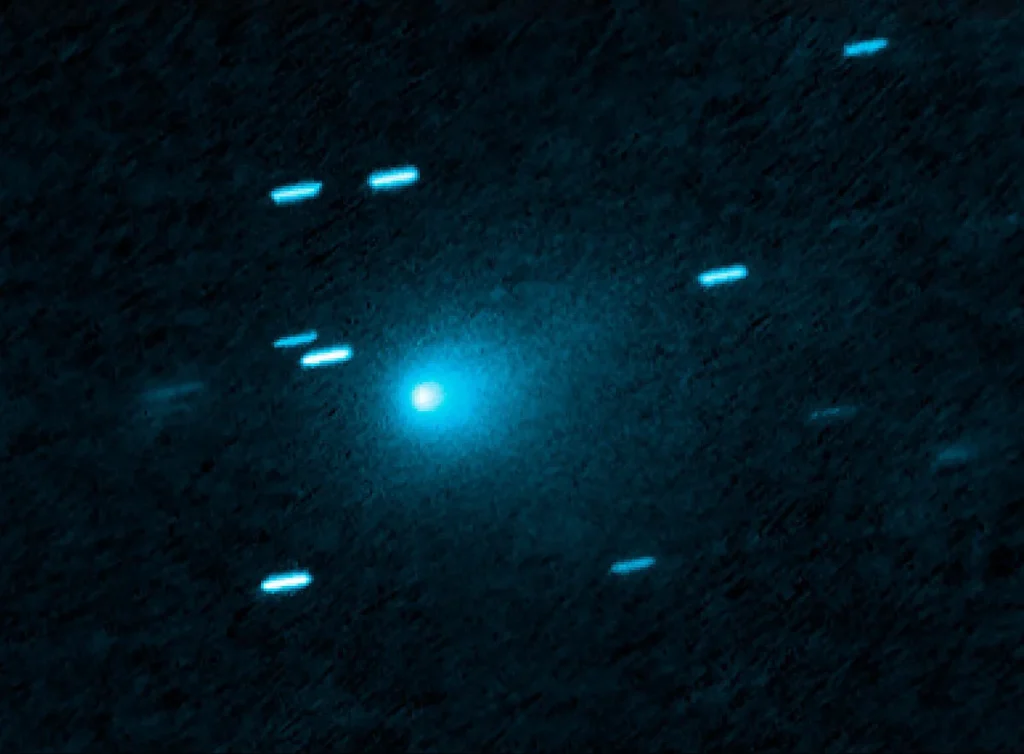
A picture of Comet 3I/ATLAS as seen by NASA’s Hubble Space Telescope which clearly displays its rather coma and faint trail. (Photo Credit: NASA)
Photometry across multiple bands showed that 3I/ATLAS has a relatively red color compared to the other two known interstellar comets and most Solar System comets. This reddish hue likely results from organic compounds or tholins on its surface, which form when simple carbon-based molecules are exposed to cosmic radiation over billions of years. In terms of activity, the comet has a dust mass loss rate comparable to that of 2I/Borisov, but higher than 1I/ʻOumuamua, indicating that it is shedding more material as it travels through the Solar System. Its dust tail appears faint but extended, composed of small, reflective particles that contribute to its reddish brightness.
Considering its high velocity of around 61 km/s and its hyperbolic orbit, scientists believe that 3I/ATLAS likely originated from the Milky Way’s thick disk, a region populated by some of the oldest stars in the galaxy. This supports the idea that the comet could be among the oldest known, possibly dating back 11 billion years, offering valuable clues about the early chemical makeup of our galaxy.
Conspiracy
What began as the detection of a brand-new interstellar object soon shifted into speculation that 3I/ATLAS might actually be alien technology. Questions arose about its proximity to the four rocky planets, including Earth, and whether this position was chosen deliberately for extraterrestrials to observe or spy on us. The discussion gained attention after a paper published on July 17, 2025, by a team from Harvard University’s Department of Astronomy titled “Is the Interstellar Object 3I/ATLAS Alien Technology?” The authors described the hypothesis as an “interesting” and imaginative exercise worth exploring, even if it is unlikely to be true.
As per the authors, 3I/ATLAS exhibits several unusual characteristics, including a nearly ecliptic retrograde orbit, exceptionally close approaches to Venus, Mars, and Jupiter with a probability of less than 0.005%, and a complete lack of cometary outgassing despite its large size of around 20 kilometers. The team also observed that the tail of material ejected from ATLAS was directed toward the Sun rather than away from it, and that very little dust was being shed. Loeb pointed out that if ATLAS were a typical comet, solar radiation pressure would have pushed particles outward, forming a conventional dust tail in the opposite direction of the Sun. Furthermore, observations from the James Webb Space Telescope (JWST) revealed that the object appeared to be emitting a cloud of carbon dioxide (CO₂) extending for hundreds of kilometers. In contrast, most comets typically display water vapor trails, which in this case were either absent or present only in trace amounts. This unusual composition and behavior further fueled speculation.
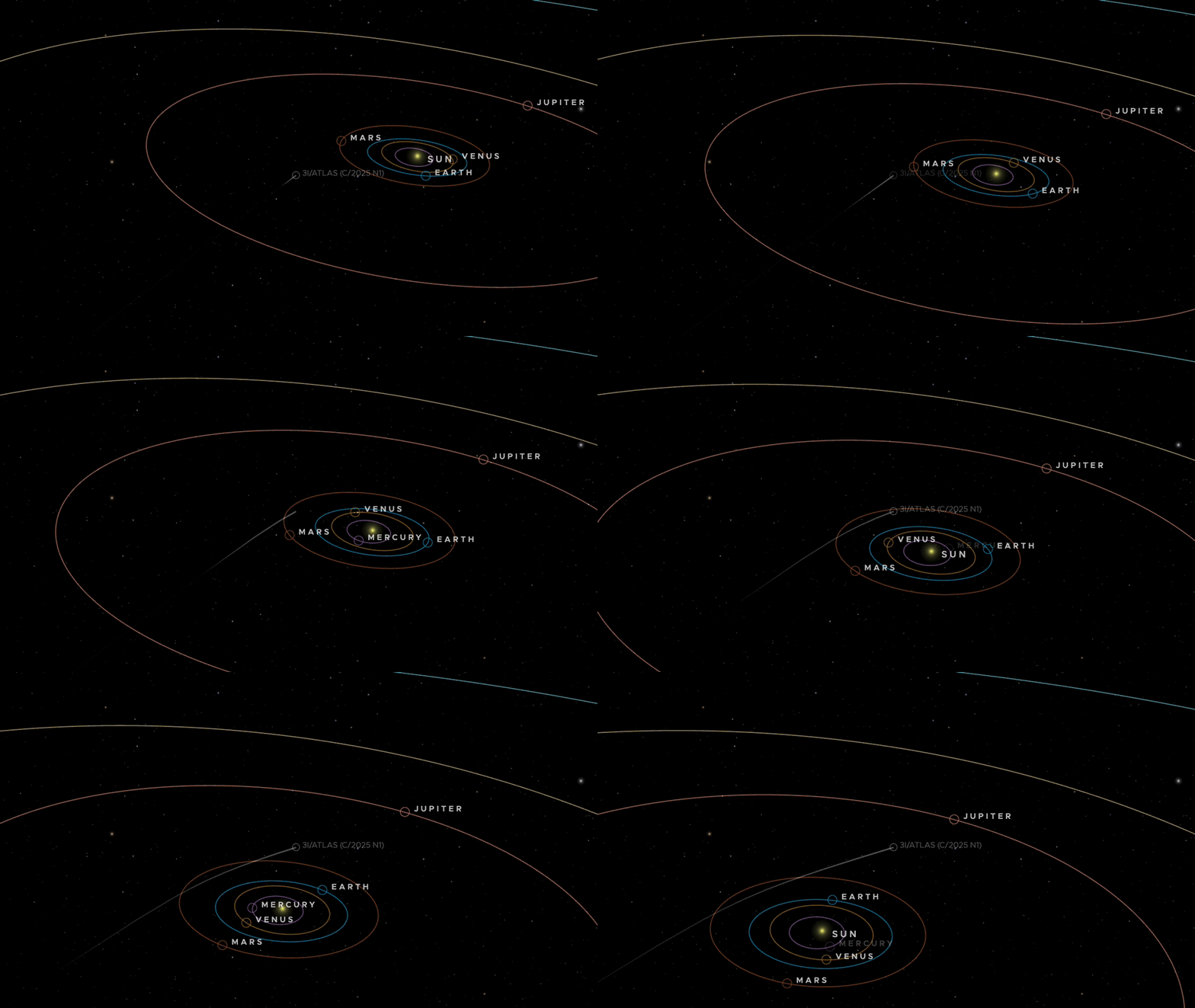
An animation of Comet 3I/ATLAS’s eccentric trajectory as it enters our solar system, displaying how close it goes by the inner rocky planets as well as passing by the gas giant, Jupiter. (Photo Credit: NASA, JPL)
Their main hypothesis suggests that 3I/ATLAS could be a “technological artifact” hidden in plain sight, possibly possessing active intelligence and even potential hostility according to the Dark Forest resolution of the Fermi Paradox. The Dark Forest theory, taken from Liu Cixin’s novel The Dark Forest, compares the universe to a vast, silent forest where every civilization is a cautious hunter. Each hides its presence for fear that revealing itself could attract a more advanced and possibly dangerous civilization. Under this view, the idea of 3I/ATLAS quietly observing us becomes far more unsettling, although it remains pure speculation. In addition to this, the authors propose that the trajectory of 3I/ATLAS would allow it to perform a reverse Solar Oberth maneuver (a spacecraft uses its close pass near the Sun to slow down) at perihelion for braking and intercept Earth. This suggests that it could potentially deploy probes or enter bound orbits around bodies within the Solar System.
This paper was spearheaded by Avi Loeb, the head of Harvard’s Galileo Project (a project that focuses on finding evidence of alien life), who, along with his colleagues, was not able to convince NASA experts. This is because, as mentioned earlier in this article, multiple ground- and space-based telescopes have been closely observing the object and have determined that it poses no threat. Dr. Thomas Statler, NASA’s lead scientist for small bodies in the Solar System, stated that it is, in fact, a comet: “It has some interesting properties that are a little bit different from our Solar System comets, but it behaves like a comet. And so the evidence is overwhelmingly pointing to this object being a natural body. It’s a comet.” He also noted that due to the positions of the planets and the gravitational forces acting on the object over the next few months, it will not come any closer to Earth than about 170 million miles.
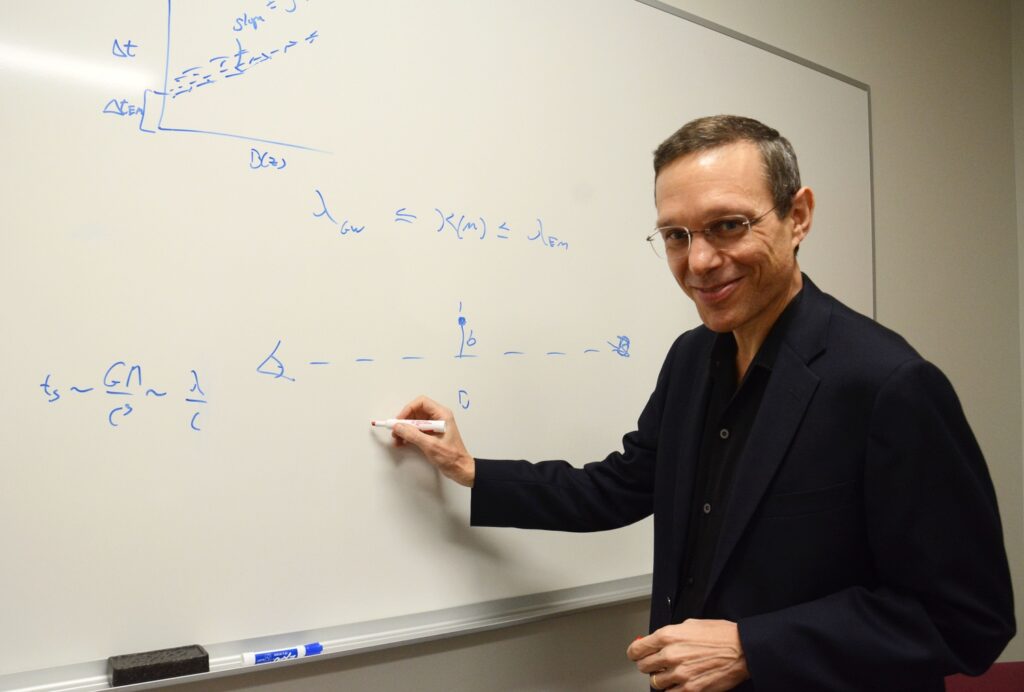
Avi Loeb, pictured in 2017, at a session at Harvard University for the Galileo Project as an astrophysicist. (Photo Credit: Ruiyi Li)
Thoughts
In my opinion, the findings presented by Avi Loeb and his team at Harvard certainly fuel our curiosity and imagination about the possibility of extraterrestrial intelligence. However, it’s important to recognize that even Loeb himself does not firmly claim that 3I/ATLAS is alien technology, rather, he believes that it should be explored as a possibility worth investigating. He had previously made similar suggestions about ‘Oumuamua back in 2017, though the current debate surrounding 3I/ATLAS has drawn far greater attention, especially following recent discussions about potential microbial life on Mars.
Personally, I remain neutral on this matter. While I agree that objects like 3I/ATLAS should continue to be observed using our most advanced instruments, such as the James Webb Space Telescope (JWST), Hubble, and other ground-based observatories capable of high-precision spectroscopy, I also believe that NASA should be cautious with how much funding and resources are directed toward such speculative pursuits. The agency is already facing financial strain due to repeated budget cuts and government constraints, making it unwise to divert large sums toward what currently appears to be a low-probability hypothesis.
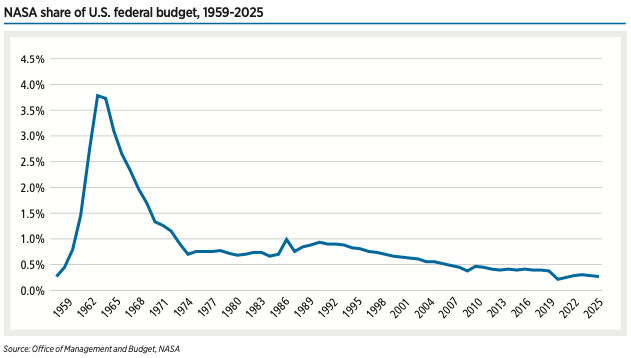
A line chart showing NASA’s budget from 1959 to 2025, peaking during the Apollo era and steadily declining to much lower levels in recent years. (Photo Credit: The Space Report)
That said, with the tools and instruments available to us today, we possess the capability to detect biosignatures, chemical compositions, and even atmospheric conditions of exoplanets tens of light-years away. If 3I/ATLAS truly exhibited any signs of intelligent design, we would likely have detected anomalies in its spectral data, motion, or emitted radiation by now. Instead, consistent readings from NASA, ESA, and other observatories continue to show that it behaves like a natural comet, composed of ice, dust, and volatile gases, with no indicators of artificial structure or control.
Conclusion
Comet 3I/ATLAS stands as yet another example of how unique, diverse, and expansive our universe is. Each new interstellar visitor brings more data and valuable insight into how the cosmos functions, deepening our understanding of interstellar space, and more importantly, reminding us of how much we do not know. Its unusual chemical composition and trajectory offered astronomers a rare glimpse into how other star systems may have formed. And perhaps most importantly, it once again highlights humans’ obsession with the age old question, are we alone?